
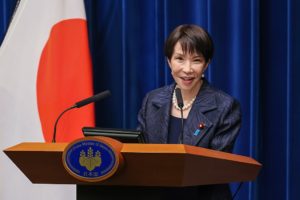
In the Japanese snap election on 8th February 2026, Prime Minister Sanae Takaichi’s Liberal Democratic Party (LDP) achieved a landslide victory, securing 316 out of 465 seats in the lower house of parliament. What does this supermajority mean for Takaichi and Japan?
Landslide victory
On 23rd January, the first Japanese female Prime Minister, Sanae Takaichi, dissolved the House of Representatives (the lower chamber of the Japanese parliament – the National Diet) and called a snap election for 8th February. With this risky move – only three months into her tenure – Takaichi aimed at capitalising on her high popularity to restore an LDP-led majority and take back control of the House. It is worth underlining that the previous two years were politically disastrous for the LDP. Its coalition with Komeito lost majority in the House of Representatives in the October 2024 snap election and majority in the House of Councillors (the upper chamber) in July 2025, marking the first time in the LDP’s 71-year existence that it did not control either of the houses.
Takaichi took a gamble that proved to be a resounding success. After the shortest election campaign in Japan’s post-war history, Takaichi’s LDP won 316 out of 465 seats in the House of Representatives – an increase from 198. Besides being the biggest electoral win in the LDP’s history, this marked the first time in Japanese post-war politics that a single party had won a two-thirds majority. The Prime Minister can also count on the 36 seats that the LDP’s coalition partner, the Japan Innovation Party (JIP), got, further strengthening her position. The LDP and JIP formed a coalition in October 2025 after Komeito broke its 26-year partnership with the LDP. The election, however, was a political catastrophe for the main opposition party. The Centrist Reform Alliance (CRA) – formed in January through the merger of the Constitutional Democratic Party of Japan (CDPJ) and Komeito – saw its representation dramatically reduced from 167 to 49 seats.
Success enablers
The LDP owes its success to a number of factors. First and foremost, it is its leader Prime Minister Sanae Takaichi. Despite her right-wing and, for some, controversial political views, since the very beginning of her tenure, she has enjoyed high public support, long unseen among the LDP leaders, with her cabinet’s approval ratings consistently staying at 60-70%. Takaichi has managed to build a very likeable “cool” image of herself, contrasting with the traditional LDP leader persona of elderly male politicians, as exemplified by her joint drum performance with the South Korean President Lee Jae-myung during their January summit. It has allowed her to refresh the party’s image and to appeal also to young voters. Takaichi’s positive effect on the LDP’s public standing was so big that even 41 out of 43 candidates she endorsed who were involved in the slush funds scandals, which had toppled the party’s power in the two previous elections, won in their constituencies. As Japanese society faces rising prices, it was also Takaichi’s counter-inflation package, including the pledge to suspend the consumption tax, that probably won people over. Although the election results demonstrate clearly the victory of the right-wing camp on the Japanese political spectrum, Takaichi’s conservative views on immigration and social issues – while largely reflecting the Japanese public’s sentiments – should not be overestimated as the decisive variable in this case. The ideological debate played a limited role in the campaign compared to the 2025 election.
Moreover, voters chose the LDP because in times of geopolitical instability and economic hardship they seek strong leadership. Takaichi gets along very well with the US President Donald Trump and can promise relatively stable US-Japan relations. The Prime Minister benefitted equally from the tensions with China stemming from her statement about Japan’s military involvement in a Taiwan contingency. Beijing’s economic and political coercion, coupled with Takaichi’s adamant stance towards China, could have created a “rally-around-the-flag” effect. The opposition’s weakness can also explain the LDP’s tremendous success. The creation of CRA by the Buddhist Komeito and the centre-left CDPJ was meant to offer a viable political alternative to the “right-wing” LDP. However, the sudden pivot towards the centre proved an ill-fated strategy, not only failing to attract new voters but also leaving the traditional base confused over the party’s political platform shift.
Whither with the supermajority?
Sanae Takaichi has been provided with an unprecedented public mandate for governance and legislative power. Her supermajority gives the LDP control of all lower house committees and the option to override the upper chamber’s decisions. This, in turn, means Takaichi can smoothly pursue her political agenda in the Diet, including her “responsible and proactive” fiscal and ambitious security policies, without having to rely on support from other parties.
Already in October 2025 the Japanese Prime Minister signalled the goal of revising the three national security documents (National Security Strategy, National Defence Strategy and Defence Buildup Programme) by December 2026 and elevating the state’s defence expenditure to 2% of GDP by the end of 2025 fiscal year (2 years ahead of the goal set in 2022 by prime minister Fumio Kishida). With the supermajority in the House of Councillors, Takaichi is now well positioned to translate her plans to further strengthen the military capabilities of the Japanese Self-Defence Forces (JSDF) and to implement security reforms into concrete action. Her government is also planning on adopting a first National Intelligence Strategy and establishing a separate intelligence bureau, with a bill to be submitted during the current Diet session. Takaichi’s security policy will also encompass further relaxation of Japan’s three rules on transfer of defence equipment and technology in order to reinforce the domestic defence industry and strengthen Tokyo’s international influence. Continued easing of post-war pacifist regulations and JSDF build-up are meant to elevate Japan’s regional deterrence and assertiveness as the country faces the most severe security environment since World War Two. While improving Japan’s autonomy in its military capabilities, the Prime Minister also wants to demonstrate to the US that Tokyo is investing in the alliance’s burden-sharing.
Most importantly, however, Sanae Takaichi has set her eyes on Article 9 of the Japanese constitution adopted in 1946. LDP has long sought to amend the pacifist clause prohibiting the use of force and the maintenance of armed forces; former prime ministers Shinzo Abe and Fumio Kishida aimed at achieving constitutional revision by 2020 and 2024, respectively. Notwithstanding their political ambitions, the objective remained unrealised under both administrations, constrained by the requirement for a two-thirds majority in parliament. Now Takaichi – wielding the two-thirds power in the lower house – desires to push for the commencement of the revision process to enshrine the legality of the JSDF directly in the constitution. Though she still lacks the two-thirds majority in the House of Councillors and any parliamentary amendment would need to be approved in a national referendum, she can now start the wider debate and preparations from a good footing.
No easy path forward
Despite Takaichi’s strong electoral mandate and supermajority, the path forward with her agenda is not without hurdles. Her bid for constitutional revision could meet opposition even within the LDP, where lawmakers hold differing views on the nature and extent of potential amendments. Furthermore, on the one hand, the Prime Minister wants to bolster public spending and strategic investments. On the other hand, she has proposed to freeze the consumption tax on food and beverages for two years. The International Monetary Fund (IMF) has warned Tokyo that this step could reduce the government’s budget by $32 billion annually. Given Japan’s public debt in 2025 at 230% of GDP and Takaichi’s proactive fiscal policy, questions arise about the feasibility of all her economic policies. Japan’s defence expenditure is also about money – a tighter government budget could force trade-offs and delay the achievement of the 2% of GDP target for defence spending.
Challenges await equally in the foreign policy area. Tokyo and Washington are in the middle of negotiating the details of Japan’s $550 billion investment in the US economy as part of the July 2025 trade deal, while doubts persist among US allies about the reliability of US security guarantees under the Trump administration. On top of that, the worst crisis in Sino-Japanese relations since 2012 following Takaichi’s remarks on Japanese intervention in a Taiwan contingency continues, and in the light of China’s role as an economic partner and as a revisionist power, Takaichi faces the task of cautiously managing tensions with Beijing.
Sanae Takaichi’s popularity and hopes to retake control of the House of Councillors in the 2028 election will hinge on how she addresses these challenges. Following the 2024 and 2025 losses, voices about the end of the LDP grew louder. However, after the 2026 snap election the party could say, quoting the famous words of Mark Twain, “The reports of my death have been greatly exaggerated”. Similarly, one should now refrain from declaring the LDP is back to its full strength. The landslide election win constituted, to a great extent, a “Takaichi success” and the society’s vote of confidence in her leadership style and vision. The upcoming months will show whether she can translate this momentum into long-term political stability and the LDP’s domination.

Jakub Witczak Koordynator Projektów w Instytucie Boyma. Student stosunków międzynarodowych na Uniwersytecie Warszawskim. Członek Forum Młodych Dyplomatów oraz założyciel koła naukowego Koło Państw Obszaru Pacyficznego. Zainteresowania badawcze obejmują bezpieczeństwo transatlantyckie, bezpieczeństwo międzynarodowe na Indo-Pacyfiku, międzynarodowe stosunki wojskowe, politykę bezpieczeństwa Japonii, Tajwan, relacje chińsko-amerykańskie oraz historię stosunków międzynarodowych w Azji i Pacyfiku.


Więcej informacji na temat: newslettera, polityki prywatności serwisu
czytaj więcej
Kwartalnik Boyma – nr 2 (16)/2023
Zachęcamy do lektury najnowszego wydania naszego kwartalnika dotyczącego spraw Azji w coraz bardziej azjatyckim świecie i refleksji nad tym, czemu współpraca Polski z tą dynamiczną gospodarczo i ważną politycznie częścią świata jest zaniedbywana.
Azjatech #174: Węgiel może być czysty. Japonia już to testuje
Azjatech to cotygodniowy przegląd najważniejszych informacji o innowacjach i technologii w krajach Azji, tworzony przez zespół analityków Instytutu Boyma we współpracy z Polskim Towarzystwem Wspierania Przedsiębiorczości.
Forbes: Holding Tata, czyli pięć stereotypów o indyjskim biznesie
Marka Tata towarzyszy Indusom przez całe życie. Rodzą się w szpitalach ufundowanych przez holding, chodzą do szkół przez niego wspieranych, mogą studiować na uczelniach, które zostały założone z inicjatywy członków rodziny Tata. (...) Ale Tata to dziś gracz globalny
Krzysztof ZalewskiTydzień w Azji #280: Putin dostał sygnał, którego nie można przeoczyć. Od potężnego przyjaciela
Przegląd Tygodnia w Azji to zbiór najważniejszych informacji ze świata polityki i gospodarki państw azjatyckich mijającego tygodnia, tworzony przez analityków Instytutu Boyma we współpracy z Polskim Towarzystwem Wspierania Przedsiębiorczości.
Czemu w relacjach z Chinami potrzebna jest silniejsza ochrona inwestora zagranicznego?
Jednym z kluczowych elementów ochrony inwestycji zagranicznych (a przy tym i inwestora zagranicznego) jest mechanizm rozwiązywania sporów pomiędzy państwem, a inwestorem zagranicznym. Sam mechanizm może przybrać różne formuły...
Adrian ZwolińskiTydzień w Azji #52: Szczyt 17+1 w Pekinie, czyli dlaczego polskie władze powinny tam pojechać
Przegląd Tygodnia w Azji to zbiór najważniejszych informacji ze świata polityki i gospodarki państw azjatyckich mijającego tygodnia, tworzony przez analityków Instytutu Boyma we współpracy z Polskim Towarzystwem Wspierania Przedsiębiorczości.
Nasi analitycy opowiedzą o współpracy gospodarczej z ChRL z perspektywy samorządowej, Polski oraz UE.
Kwartalnik Boyma – nr 1 (15)/2023
W nowym numerze Kwartalnika Boyma prezentujemy teksty poświęcone najwyższym kręgom władzy w Kazachstanie, relacjom albańsko-koreańskim, nauce dla Tajwanu z inwazji na Ukrainę, czy kryzysom nawozowym i gazowym.
Azjatech #49: Izraelskie innowacje w walce z koronawirusem
Azjatech to cotygodniowy przegląd najważniejszych informacji o innowacjach i technologii w krajach Azji, tworzony przez zespół analityków Instytutu Boyma we współpracy z Polskim Towarzystwem Wspierania Przedsiębiorczości.
Tydzień w Azji #310: BRICS rośnie w siłę, a Rosja zaciera ręce. Tak Putin chce omijać sankcje
Przegląd Tygodnia w Azji to zbiór najważniejszych informacji ze świata polityki i gospodarki państw azjatyckich mijającego tygodnia, tworzony przez analityków Instytutu Boyma we współpracy z Polskim Towarzystwem Wspierania Przedsiębiorczości.
Tydzień w Azji #89: Węgry otwierają się na Wschód
Przegląd Tygodnia w Azji to zbiór najważniejszych informacji ze świata polityki i gospodarki państw azjatyckich mijającego tygodnia, tworzony przez analityków Instytutu Boyma we współpracy z Polskim Towarzystwem Wspierania Przedsiębiorczości.
RP: Indie wspierają inwestycje produkcyjne. Mogą na tym skorzystać i polskie firmy
Rządowi Indii zależy na ściągnięciu do kraju inwestycji produkcyjnych. Tworzy więc bodźce dla rozwoju fabryk na Subkontynencie Indyjskim. Polskie przedsiębiorstwa eksportujące do Indii coraz częściej decydują się na wytwarzanie w tym kraju.
Krzysztof ZalewskiAzjatech #202: Chińskie firmy zbrojeniowe ruszają po nowych klientów. Ucierpieć może głównie Rosja
Azjatech to cotygodniowy przegląd najważniejszych informacji o innowacjach i technologii w krajach Azji, tworzony przez zespół analityków Instytutu Boyma we współpracy z Polskim Towarzystwem Wspierania Przedsiębiorczości.
Przegląd Tygodnia w Azji to zbiór najważniejszych informacji ze świata polityki i gospodarki państw azjatyckich mijającego tygodnia, tworzony przez analityków Instytutu Boyma we współpracy z Polskim Towarzystwem Wspierania Przedsiębiorczości.
Dlaczego nie rozumiemy polityki zagranicznej Indii?
Wystąpienie dr Krzysztof M. Zalewskiego, prezesa Instytutu Boyma, dla Forum Młodych Dyplomatów.
Krzysztof ZalewskiAzjatech #74: Wodór z księżycowego lodu napędzi pojazdy kosmiczne?
Azjatech to cotygodniowy przegląd najważniejszych informacji o innowacjach i technologii w krajach Azji, tworzony przez zespół analityków Instytutu Boyma we współpracy z Polskim Towarzystwem Wspierania Przedsiębiorczości.
Azjatech #143: Azja chce zarabiać na pędzie ku gwiazdom
Azjatech to cotygodniowy przegląd najważniejszych informacji o innowacjach i technologii w krajach Azji, tworzony przez zespół analityków Instytutu Boyma we współpracy z Polskim Towarzystwem Wspierania Przedsiębiorczości.
Tydzień w Azji #216: Wyczekiwany przełom na linii Korea Południowa – Japonia
Przegląd Tygodnia w Azji to zbiór najważniejszych informacji ze świata polityki i gospodarki państw azjatyckich mijającego tygodnia, tworzony przez analityków Instytutu Boyma we współpracy z Polskim Towarzystwem Wspierania Przedsiębiorczości.
Tydzień w Azji #127: Ofensywa OZE na Wschodzie. Kazachstan liderem
Przegląd Tygodnia w Azji to zbiór najważniejszych informacji ze świata polityki i gospodarki państw azjatyckich mijającego tygodnia, tworzony przez analityków Instytutu Boyma we współpracy z Polskim Towarzystwem Wspierania Przedsiębiorczości.
Tydzień w Azji#17: Czy ktoś może zyskać na tej wojnie? USA i Chiny dalekie od porozumienia
Przegląd Tygodnia w Azji to zbiór najważniejszych informacji ze świata polityki i gospodarki państw azjatyckich mijającego tygodnia, tworzony przez analityków Instytutu Boyma we współpracy z Polskim Towarzystwem Wspierania Przedsiębiorczości. W tym numerze piszemy nie tylko o napięciu w stosunkach chińsko-amerykańskich, ale i Japonii, która przystosowuje się do napływu obcokrajowców, Uzbekistanie rozwijającym przemysł budowlany i o tym, do kogo tak naprawdę należy Huawei.
Przedstawiciel Instytutu Boyma weźmie udział w konferencji organizowanej przez Polsko-Chińską Główną Izbę Gospodarczą SinoCham.
Język rosyjski w Azji Centralnej – ryzykowne inicjatywy
Rozpad Związku Radzieckiego i powstanie na jego gruzach pięciu republik w Azji Centralnej zapoczątkowało odbudowywanie tożsamości etnicznej i narodowej przez Kazachów, Uzbeków, Turkmenów, Tadżyków i Kirgizów oraz inne ludy pozbawione państw.
Jerzy OlędzkiTydzień w Azji #293: Polskie firmy szturmują Chiny. Oto nasze hity eksportowe
Przegląd Tygodnia w Azji to zbiór najważniejszych informacji ze świata polityki i gospodarki państw azjatyckich mijającego tygodnia, tworzony przez analityków Instytutu Boyma we współpracy z Polskim Towarzystwem Wspierania Przedsiębiorczości.
Azjatech #123: MarCoPay, czyli filipiński fintech dla marynarzy
Azjatech to cotygodniowy przegląd najważniejszych informacji o innowacjach i technologii w krajach Azji, tworzony przez zespół analityków Instytutu Boyma we współpracy z Polskim Towarzystwem Wspierania Przedsiębiorczości.