
On 4th December 2025 the Donald Trump administration released the new National Security Strategy (NSS) of the United States of America. The document, which constitutes the primary roadmap of security and foreign policy, outlining national interests, addressing threats and defining strategic priorities, may provide some reference points for understanding Trump’s vision of international affairs. What are the key takeaways on Asia?
- Asia: a top priority after homeland
The new NSS hails Asia as the top US foreign policy priority. It is only preceded by the Western Hemisphere, which exerts direct impact on the US homeland security as the principal source of direct threats related to drugs and migration. NSS recognises Asia, also interchangeably referred to as the Indo-Pacific, as the central place in today’s global economic and geopolitical dynamics, stating that America’s domination there underpins prosperity “at home”. The document reiterates the US commitment to maintaining a free and open Indo-Pacific, but it is clear this pledge must, in the first place, serve the US national interests, and cannot eclipse the goal of rebalancing trade relations in the US’ favour. America’s approach towards Asia is defined largely through the prism of economic interests, which can be identified as a central thread throughout the entire NSS.
- China: between economic competition and engagement
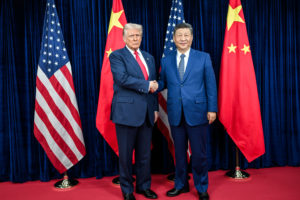
The NSS voices criticism of the previous administrations’ approach to China. It states that promoting its integration into the global economy has led to the current trade imbalance. The new strategy and its language signal a departure from former policy. While the previous Trump and Biden administrations positioned China as a political and military contender, eroding international order and American security, this NSS lacks the “great power competition” tone and frames Beijing mainly as an economic competitor. The 2025 NSS is the first since 1988 not addressing democracy or human rights issues. One of the main objectives of Trump’s Asia policy will certainly be to reconfigure the “unbalanced” economic relations with China, with decoupling in areas critical to national security, such as rare earth elements, as a key tenet. The NSS, however, leaves room for engagement with Beijing to “maintain genuinely mutually advantageous economic relationship”.
- Taiwan and the First Island Chain: deterrence
Besides reducing the current trade deficit with China, the US strategy in Asia will concentrate on deterring a conflict over Taiwan and other parts of the First Island Chain. In contrast to the previous documents, the new NSS does not explicitly mention the “one China” policy, just stating the US commitment to the “longstanding declaratory policy” of not supporting any unilateral changes to the status quo in the Taiwan Strait. The importance of preventing a conflict over the island, mentioned for the first time as a priority, stems from its semiconductor industry and strategic location, including its proximity to key sea lines of communication. There is a clear strategic focus on securing the First Island Chain, evidenced by four references to it – the first occurrence of such mentions in an NSS. The US aims to achieve this by maintaining a favourable balance of military power – here the document heralds close defence and military cooperation with allies, noting “the American military cannot, and should not have to, do this alone”. The new national strategy remains silent on North Korea, potentially implying a deprioritisation of the issue.
- Allies: defence build-ups and trade balance
The NSS mentions America’s network of alliances as one of the strategic assets, echoing the longstanding view that partnerships enhance US security. Trump’s administration stresses its willingness to develop them, but concurrently emphasises restraining free-riding and trade imbalances. The new NSS treats Asian allies in a softer way than the European partners, sparing them criticism about economic decline, censorship or “prospect of civilizational erasure”. Trump will, however, keep putting pressure on Asian allies and partners, including Japan, Australia, Taiwan and South Korea, to ramp up military expenditure and develop capabilities reinforcing regional deterrence. The NSS assigns partners in the Indo-Pacific a crucial role in curbing China’s economic influence, and even suggests that Trump may seek to integrate Asian allies into a unified economic bloc. The document mentions Australia, Japan, South Korea, Taiwan, the Quad format (the US, Japan, India, Australia) and India, outlining the need for its greater contribution to Indo-Pacific security, but leaves out the Philippines and the AUKUS partnership (Australia, the UK, the US).

Jakub Witczak East Asian affairs analyst at the Boym Institute. He holds a BA and an MA in International Relations with a specialisation in Asian studies, and is also pursuing a master’s degree in Global Business, Finance and Governance at the SGH Warsaw School of Economics. His research interests include Japan, its foreign and security policy, international security, military alliances, transatlantic relations, Europe-Asia relations, Indo-Pacific and cross-Strait relations. He is an alumnus of the Japanese Ministry of Foreign Affairs' MIRAI programme, during which he completed the Diplomacy and Security Policy track. For four years he served as the Chairman of the Student Association of Pacific Area States at the University of Warsaw. He is also an alumnus of the Polish Forum of Young Diplomats, where he coordinated the Asia-Pacific Regional Group. In 2026 he was awarded the scholarship of the Minister of Science and Higher Education of Poland for significant scientific achievements.


Więcej informacji na temat: newslettera, polityki prywatności serwisu
czytaj więcej
Book review: “Unveiling the North Korean economy”
Book review of "Unveiling the North Korean economy", written by Kim Byung-yeon and published by Cambridge University Press in 2016.B. Tauris in 2017.
Nicolas LeviWomen’s liberation in China: interview with prof. Wu Lijuan
Interview of Ewelina Horoszkiewicz with prof. Wu Lijuan - Associate Professor at the Department of Sociology at Peking University. Her research concentrates on the gender issues and social changes brought about by globalization. She wrote a book “Job Placements and Job Shifts in China: The Effects of Education, Family Background and Gender”.
Ewelina HoroszkiewiczPolish-Asian Cooperation in the Field of New Technologies – Report
Polish and Polish-founded companies are already on the largest continent in sectors such as: IT, educational technology, finance, marketing, e-commerce and space. Despite this, the potential lying dormant in the domestic innovation sector seems to be underutilized.
Coronavirus and climate policies: long-term consequences of short-term initiatives
As large parts of the world are gradually becoming habituated to living in the shadow of the coronavirus pandemic, global attention has turned to restarting the economy. One of the most consequential impacts of these efforts will be that on our climate policies and environmental conditions.
Dawid JuraszekA Story of Victory? The 30th Anniversary of Kazakh Statehood and Challenges for the Future.
On 25 May 2021, the Boym Institute, in cooperation with the Embassy of the Republic of Kazakhstan, organised an international debate with former Polish President Aleksander Kwaśniewski (1995-2005).
Chinese work on the military use of artificial intelligence
Intensive modernization and the desire to catch up with the armed forces of the United States made chinese interest in the military application of futuristic technologies grow bigger.
Paweł BehrendtEnvironmental problems transcend not only national borders but also historical periods. And yet debates on the necessary measures and timelines are often constrained by considerations of election cycles (or dynastic successions) in any given country.
Dawid JuraszekCharitable activities of the Vietnamese in Poland: their scope and sources
The scale of assistance provided to medics by the Vietnamese community during the 2020 pandemic inspires admiration and gratitude. It stems from the sense of belonging to Poland and deeply rooted in the culture order to help those in need and repay the debt incurred at the time when they themselves needed such help.
Ewa GrabowskaWe would like to inform, that Financial Intelligence has published interview for Balkan Development Support with Patrycja Pendrakowska.
To free oneself from the Chinese embrace. On Indo-Russian relations with Nandan Unnikrishnan
Interview with Nandan Unnikrishnan, who has served for many years as a correspondent for Indian media in Russia. Currently he is a research fellow at the Observer Research Foundation in Delhi. The interview was conducted during the Raisina Dialogue 2019 in Delhi.
Krzysztof ZalewskiThe Boym Institute message to Indian policymakers and analysts
India’s current position towards the Russian invasion on Ukraine may damage its reputation as a major force of peace in the world
Paths to Asia: Conversations that Inspire
Wojciech Jaworski is the founder of Huqiao Games, a company specializing in bringing PC games to the Chinese market. A graduate of Jagiellonian University and participant in the “Chinese Bridge” program, he is currently working on a new, as yet unannounced project in the gamedev/tech industry.
Patrycja ZdybelOnline Course: “Conflict Resolution and Democracy”
The course will be taught via interactive workshops, employing the Adam Institute’s signature “Betzavta – the Adam Institute’s Facilitation Method“, taught by its creator, Dr. Uki Maroshek-Klarman. The award-winning “Betzavta” method is rooted in an empirical approach to civic education, interpersonal communication and conflict resolution.
The unification of the two Koreas: an ASEAN perspective
The aim of the paper is to discuss the role of the ASEAN as a critical component of the solution to the Korean unification. The Korean Unification refers to the potential reunification of both Koreas into a single sovereign Korean state led by the leadership of the two Koreas.
Nicolas LeviFrom quantity to quality. Demographic transition in China – interview with Prof. Lauren Johnston
What we observe in China is a population reduction strategy paired with the socio-economic transition. In my view it’s not a crisis, but it is a very challenging transition.
Lauren JohnstonThe New Trilateral Axis in Asia: What the Pakistan-Saudi-Türkiye Pact Means for India
On 7 August 2026, Pakistan, Saudi Arabia, and Türkiye jointly entered into a defence alliance, known as the ‘Mecca Joint Defence Agreement'. Under this pact, an attack on any one of the three countries would be considered an attack on all three, and accordingly, the three countries would provide each other with the necessary defence support.
Nihar KulkarniWorkshop – Liberalism vs authoritarianism: political ideas in Singapore and China
We cordially invite you to a workshop session “Liberalism vs authoritarianism: political ideas in Singapore and China”. The workshop is organized by Patrycja Pendrakowska and Maria Kądzielska at the Department of Philosophy, University of Warsaw on ZOOM.
Dr. Zeno Leoni is an assistant professor in International Security at the Defence Studies Department of King’s College London. His research focuses on US and Chinese grand strategies, US-China, UK-China relations and Five Eye Alliance. He is the author of articles such as “The End of the “Golden Era”?
Paweł MazurekPolish women do not often become the heroines of media reports in Central Asia. In February 2020, however, it was different. The story of Agnieszka Pikulicka-Wilczewska, a journalist, "heated up" the headlines of local news portals. More importantly, "between the lines" she talked a lot about contemporary Uzbekistan and the role of women in politics.
Magdalena Sobańska-CwalinaSearching for Japan’s Role in the World Amid the Russia-Ukraine War
The G7 Hiroshima Summit concluded on May 21 with a communiqué reiterating continued support for Ukraine in face of Russia’s illegal war of aggression. Although Japan was perceived at the onset of the war as reluctant to go beyond condemning Russia at the expense of its own interests, it has since become one of the leading countries taking action during the war.
Rintaro NishimuraWomen in Public Debate – A Guide to Organising Inclusive and Meaningful Discussions
On the occasion of International Women's Day, we warmly invite you to read our guide to good practices: "Women in Public Debate – A Guide to Organising Inclusive and Meaningful Discussions."
Ada DyndoBorder conflicts as political tools: the Thailand–Cambodia crisis
The border conflict between Thailand and Cambodia is much more than just a territorial dispute. Rooted in historical ambiguities, it has become a tool for domestic political maneuvering in both countries and a stage for international strategic competition.
Andżelika SerwatkaIndonesia – between religion and democracy
Indonesia is the largest Muslim democracy in the world. Approximately 88% of the population in Indonesia declares Islamic religion, but in spite of this significant dominance, Indonesia is not a religious state.
Anna GrzywaczDr Krzysztof Zalewski participates in the Kigali Global Dialogue in Rwanda
A short note and photo gallery from the chairman of the Board of the Boym Institute, who stays in Rwanda at the "Kigali Global Dialogue" conference.