
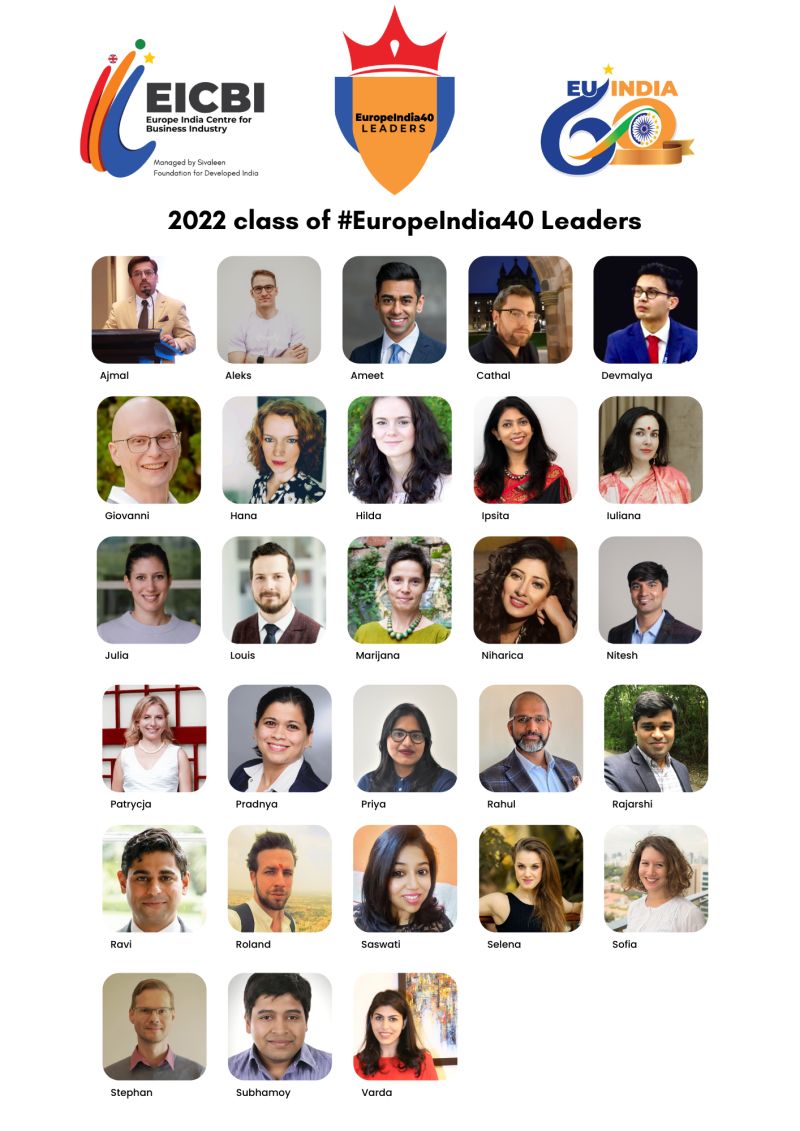
We are happy to announce, that the head of the Boym Institute, Patrycja Pendrakowska made it to the Top 40 under 40 Europe-India leaders list of Europe India Centre for Business and Industry.
#EuropeIndia40, an initiative of EICBI, covers the stories of leaders below the age of 40 and their contributions to promoting EU India / UK India relations.
Congratulations!

Więcej informacji na temat: newslettera, polityki prywatności serwisu
czytaj więcej
Polish-Asian Cooperation in the Field of New Technologies – Report
Polish and Polish-founded companies are already on the largest continent in sectors such as: IT, educational technology, finance, marketing, e-commerce and space. Despite this, the potential lying dormant in the domestic innovation sector seems to be underutilized.
Chinese work on the military use of artificial intelligence
Intensive modernization and the desire to catch up with the armed forces of the United States made chinese interest in the military application of futuristic technologies grow bigger.
Paweł BehrendtTaiwanese Perceptions of Russia’s Ukraine war
Since the invasion of Ukraine, the Taiwanese government remained committed to its position of condemnation for Russia, humanitarian support for Ukraine, and deep appreciation and admiration for the Ukrainian people’s will to defy power, resist aggression, and defend their nation.
Kuan Ting ChenTakaichi’s Historic Election Win: What’s Next for Japan?
In the Japanese snap election on 8th February 2026, Prime Minister Sanae Takaichi’s Liberal Democratic Party (LDP) achieved a landslide victory, securing 316 out of 465 seats in the lower house of parliament. What does this supermajority mean for Takaichi and Japan?
Jakub WitczakThe link between EU Aid and Good Governance in Central Asia
Nowadays all the CA states continue transitioning into the human-centered model of governance where the comprehensive needs of societies must be satisfied, nevertheless, the achievements are to a greater extent ambiguous.
Are Polish Universities Really Victims of a Chinese Influence Campaign?
The Chinese Influence Campaign can allegedly play a dangerous role at certain Central European universities, as stated in the article ‘Countering China’s Influence Campaigns at European Universities’, (...) However, the text does ignore Poland, the country with the largest number of universities and students in the region. And we argue, the situation is much more complex.
Patrycja ZdybelWe would like to inform, that Observer Research Foundation has published article of Krzysztof Zalewski - the Boym Institute Analyst, Chairman of the Board and Editor of the “Tydzień w Azji” weekly.
Krzysztof ZalewskiWorkshop – Liberalism vs authoritarianism: political ideas in Singapore and China
We cordially invite you to a workshop session “Liberalism vs authoritarianism: political ideas in Singapore and China”. The workshop is organized by Patrycja Pendrakowska and Maria Kądzielska at the Department of Philosophy, University of Warsaw on ZOOM.
Central Asia. The winding road to regional integration
The aim of the paper is to present the current stage of integration among the Central Asian republics and to analyze directions and dynamics of this process in the nearest future. This study also attempts to identify factors which can either slow down or strengthen the process of integration as well as its causes and consequences.
Jerzy OlędzkiBook review: “North Korea’s Cities”
Book review of "North Korea’s Cities", written by Rainer Dormels and published byJimoondang Publishing Company in 2014.
Nicolas LeviCharitable activities of the Vietnamese in Poland: their scope and sources
The scale of assistance provided to medics by the Vietnamese community during the 2020 pandemic inspires admiration and gratitude. It stems from the sense of belonging to Poland and deeply rooted in the culture order to help those in need and repay the debt incurred at the time when they themselves needed such help.
Ewa GrabowskaCoronavirus and climate policies: long-term consequences of short-term initiatives
As large parts of the world are gradually becoming habituated to living in the shadow of the coronavirus pandemic, global attention has turned to restarting the economy. One of the most consequential impacts of these efforts will be that on our climate policies and environmental conditions.
Dawid JuraszekHow China uses its narratives on the Russo-Ukrainian war to court the Global South
Three years after Russia’s full-scale invasion of Ukraine, it is entirely clear that this conflict has irrevocably changed the geopolitical landscape both in Europe and beyond and its repercussions will be felt far beyond the battlefield for years to come.
Konrad Szatters80th anniversary of Indonesian Proclamation of Independence and 70th anniversary of Poland-Indonesia diplomatic relations. April 23rd, at 10:00 am, aula im. prof. Waldemara Michowicza, ul. Lindleya 5A, Łódź.
Indonesia – between religion and democracy
Indonesia is the largest Muslim democracy in the world. Approximately 88% of the population in Indonesia declares Islamic religion, but in spite of this significant dominance, Indonesia is not a religious state.
Anna GrzywaczShort summary of events at the Boym Institute
We want the Boym Institute to become a valuable platform of exchanging views, making valuable acquaintances and, above all, deepening knowledge. Therefore, we undertake the organization of many events: debates, lectures, and conferences.
Smiles, Handshakes, and Suspicion: What the US-China Summit Really Tells Us
The US and China held a bilateral summit on the 13th and 14th of May 2026 in Beijing. The visit was attended by the presidents of both countries, accompanied by the top business leaders, particularly from the American side.
Nihar KulkarniFrom quantity to quality. Demographic transition in China – interview with Prof. Lauren Johnston
What we observe in China is a population reduction strategy paired with the socio-economic transition. In my view it’s not a crisis, but it is a very challenging transition.
Lauren JohnstonThe North Korean nuclear dismantlement and the management of its nuclear wastes
Evidence suggests that North Korea stores its high-level nuclear waste (HLW) in liquid form in tanks on the same site where it is made, and has not invested in infrastructure to reduce, dentrify, or vitrify this waste. However, this is just the tip of the iceberg, one of many aspects of the North Korean nuclear waste problem.
Nicolas LeviAssessing the New U.S. National Security Strategy: Key Takeaways on Asia
On 4th December 2025 the Donald Trump administration released the new National Security Strategy (NSS) of the United States of America. What are the key takeaways on Asia?
Jakub WitczakTSRG 2021: The Impacts of the BRI on Europe: The Case of Poland and Germany
It is important to contribute to the understanding of what the New Silk Road can mean in economic, political, leadership and cultural terms for the European countries involved. This analysis should reveal the practical consequences of the Belt and Road Initiative for Europe in the case of Poland and Germany, as well as their respective social effects.
Peace is a precondition for LiFE. How systemic conflicts endanger developmental goals
The G20 can play a pivotal role in dealing with the mounting global challenges by proposing policy coordination and solutions disincentivising armed conflicts.
Krzysztof ZalewskiPeace and development as the call of our day again face severe challenges on a global scale, with more prominent instability, uncertainty and complexity
Yiwei WangCoronavirus (COVID-19) outbreak and emerging contractual claims
With China one of the key players in the global supply chain, supplying major manufacturing companies with commodities, components and final products, the recent emerging outbreak of Coronavirus provides for a number of organizational as well as legal challenges.