
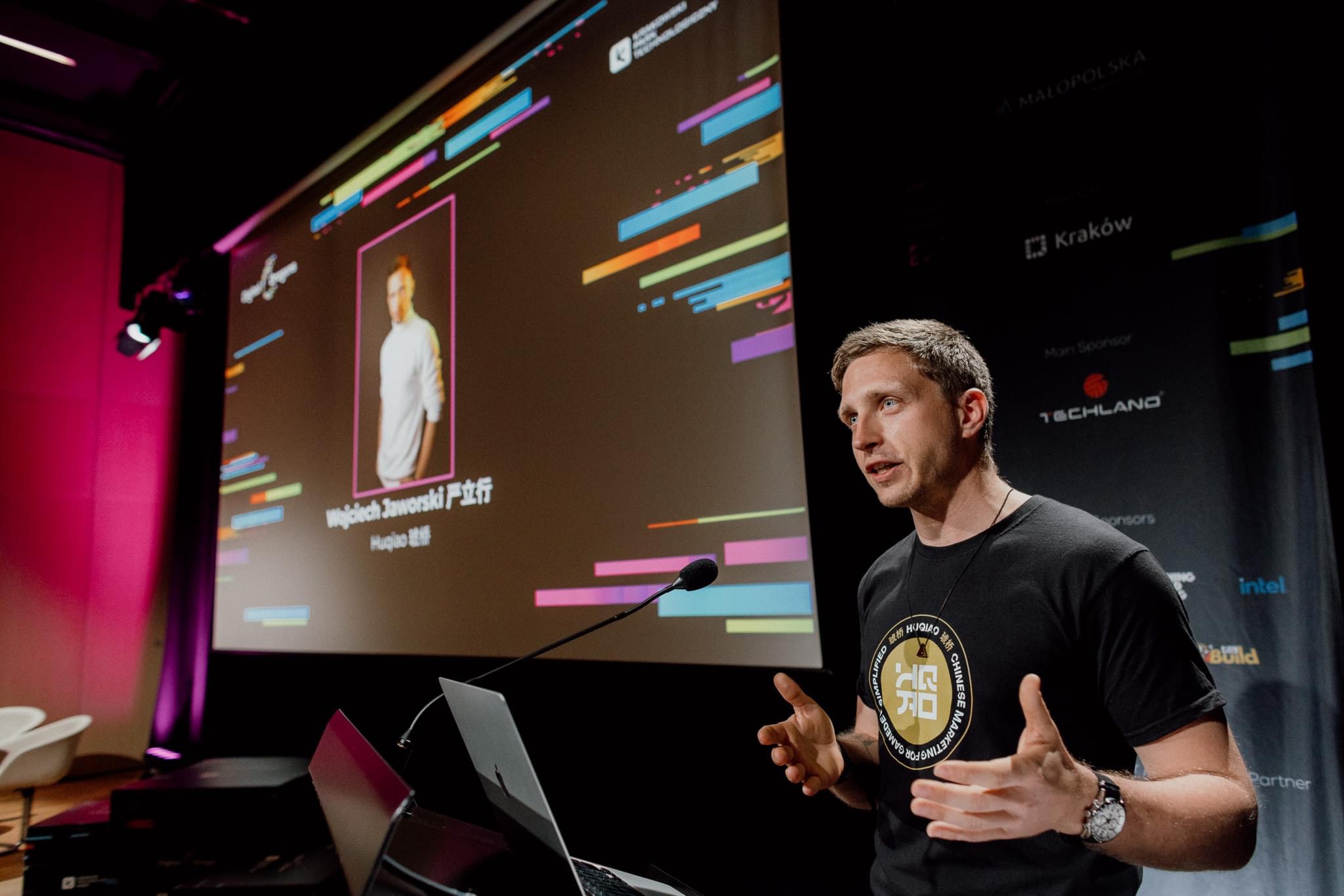
Wojciech Jaworski is the founder of Huqiao Games, a company specializing in bringing PC games to the Chinese market. A graduate of Jagiellonian University and participant in the “Chinese Bridge” program, he is currently working on a new, as yet unannounced project in the gamedev/tech industry. Speaker at Digital Dragons and DevGamm conferences, participant in dozens of industry events. Privately, he is passionate about Chinese culture and sailing.
Patrycja Zdybel (Pendrakowska): How did you come up with the idea of starting a company promoting computer games on the Chinese market?
Wojciech Jaworski: I was interested in languages and Asia, and at first I wanted to study Korean. But I came across Far Eastern Cultural Studies at the Jagiellonian University and started learning Chinese. I have also been very interested in marketing for a long time. I was also interested in the Polish national brand in China in general. And somehow it all came together.
I think it was a natural evolution of my interests. On the one hand, I was fascinated by Asia and the Chinese language, and on the other, by marketing and brand building. I also saw a gap in the market—many companies talked about the potential of the Chinese market, but there was a lack of real action and experts who could combine linguistic, cultural, and marketing skills. Huqiao was created at the intersection of these worlds, as a response to a specific market need.
PZ: Let’s go back to the beginning of your adventure with Asia. How did you end up in China?
WJ: An important factor was the Confucius scholarship, which allowed me to travel to China for the first time. In addition, I was involved in events at the university, research clubs, and sections. I worked with Prof. Adina Zemanek and was involved in the translation section. In general, I was very involved during my studies and helped to create a scientific ecosystem: even then, as a student, I wanted to bridge the gap between academia and business. I was interested in how to implement knowledge.
PZ: And which university did you go to in China?
WJ: Tongji University in Shanghai. Before that, I also took part in the “Chinese Bridge” competition. From there, my path led me to become a representative of international students, and I developed an interest in promotional materials. My passion for promotion and marketing also grew with this opportunity to go to China.
PZ: And what was your attitude towards this trip and what you saw there? Many people who are preparing to study in Asia may have this question.
WJ: I try to act according to the maxim – don’t try to judge, but above all, try to understand. I mean the concept of cause and effect. Developing sensitivity. Also, not being too Western-centric.
This is a key approach that I recommend to anyone who wants to operate effectively in Asia. Instead of imposing my own cultural filters and values, I first tried to deeply understand the context and logic behind various phenomena. In China, many things work differently than in Europe – from social dynamics to business processes. Success depends on the ability to suspend your own judgments and be genuinely curious. This attitude of openness and willingness to understand, rather than judge, proved to be one of the most important factors that later helped me in business.
PZ: Tell us a little more about this “Chinese Bridge” and the project.
WJ: It was somewhere around 2014 or 2015, which later developed into a reality show. It was kind of my first encounter with China in deep water. They threw us into 7-8 places in China to tell stories about the lives of the people there. For example, in Guizhou, we were concerned with the issue of abandoned children. Of course, it was all pre-selected in a sense, but it was a very interesting slice of China. I was also in Yiwu, and I slept in barracks in Beijing. It was like getting to know China from behind the scenes – I could see how the media is produced in China. It lasted three months, and I had a vision of staying longer, but I decided to come back.
PZ: Why?
WJ: I was still studying at the Jagiellonian University at the time and decided to come back to finish my studies.
PZ: And how did you feel after your return?
WJ: The return was quite a contrast. After the intensity and dynamism of China, Poland seemed to function at a completely different pace. It was like switching from a fast train to a horse-drawn carriage – suddenly everything slowed down. I had to adapt, but at the same time I was looking for opportunities to use my unique skills. I wanted to work with the Chinese language and use the experience I had gained in Asia. Paradoxically, this cultural contrast and pace of life helped me better understand how I could create value at the intersection of these two worlds.
PZ: And how did that work out?
WJ: I got a lot of jobs in factories, importing machines. About three or four years of various jobs, including translations. Generally speaking, it was very difficult to find such jobs in Krakow, so I decided to move to Warsaw for that time. At that time, tourism and outsourcing reigned supreme in Krakow.
PZ: Your career took off in Warsaw because you got a job at the Bank of China.
WJ: Yes, I have very fond memories of that stage in my career. Then I quit and went freelance again, various things started to develop, and then COVID came along, which accelerated the digitization process a bit. I had to change industries—there were no tourists, no translations, many jobs disappeared.
The Bank of China was a fantastic experience that gave me a deeper insight into the Chinese approach to business and finance. I learned professionalism and discipline there, but I also saw how Chinese corporations function from the inside. This experience greatly enriched my resume and gave me a solid foundation for further development. However, I felt that I had an entrepreneurial streak and wanted to try something on my own, so I returned to freelancing. COVID was a turning point – it changed the market and forced me to strategically rethink my career path.
PZ: That must have been a difficult period. How did you get through it?
WJ: I thought I needed to narrow down my interests in marketing. As a side note, I was very interested in the process of building Poland’s brand in China for a long time. I oscillated around this topic and finally narrowed down the field – in a sense, that’s how Huqiao was created. It was basically 3-4 years of “eating rubble.” High stress, exhausting process of starting my own business. I set myself the goal of making it a bigger company.
It was a time of intense work and enormous stress. I often worked 12-14 hours a day, including weekends. The beginnings of your own business are real “eating rubble” – constant challenges, uncertainty, and the need to make difficult decisions. But I had a clear vision – I wanted to create something bigger than a one-man business. Narrowing my specialization to game marketing in the Chinese market turned out to be a key decision. Instead of being a jack of all trades, I decided to be an expert in a specific niche where I could use both my knowledge of the Chinese language and culture and my passion for marketing.
PZ: How did you get started?
WJ: We started as a company with Chinese-speaking students, and that’s what brought us together. We felt that there was a lot of talk about China, but not enough action. And so we took action – there were only a few of us Europeans, and we also employed mostly Chinese people. At one point, however, we hit a wall because doing business with China in Poland was quite difficult, partly due to internet barriers. The company took a step further and we set up headquarters in Hong Kong – there were Chinese people from China and Malaysia, the so-called Chinese team. We began to develop the company, working with customers from abroad.
From the very beginning, our greatest competitive advantage was our team – people who not only knew Chinese, but also understood both cultures and were able to operate effectively at their intersection. However, we quickly came up against the realities of running a Chinese business from Poland – technical limitations, internet barriers, time differences. That is why we made the strategic decision to move the business to Hong Kong at the end of 2023. It was a turning point – we closed down the Polish company and moved our operations entirely to Asia. Today, our team consists of about 12-13 people, only three of whom are Europeans, which shows how much we have localized our competencies. We work remotely, but we plan to open a physical office in one of the Asian cities in 2026.
PZ: So your clients weren’t just Chinese?
WJ: We’ve grown rapidly and found many clients in Europe, the US, and East Asia. We currently work remotely. It turns out that being in Asia is crucial.
Our customer base is very diverse geographically. We mainly serve double A studios with production budgets in the tens of millions of dollars, but we also work with smaller indie studios. Our clients come from Europe, the US, and East Asia. Relocating to Hong Kong has significantly increased our credibility and made it easier to scale our business on the global market. It turned out that our physical presence in Asia not only gives us better access to Asian clients, but also optimizes our business for a future exit.
PZ: Why?
WJ: Asia is where the future of gaming lies, and it is from there that trends spread to the rest of the world. For example, you can add issues such as the implementation of AI in games, where they become completely different in terms of the player experience. We also worked to develop cooperation with influencers and ran campaigns. We also advised various companies on how to position themselves and what promotion strategy to adopt – for example, we ran campaigns for Singles’ Day. For effective marketing, you need to be sensitive and know what Chinese players are doing.
Asia, and China in particular, is the epicenter of innovation in the gaming industry. The Chinese market accounts for about half of Steam players, making it a strategic direction for global publishers. Although the mobile gaming industry continues to dominate in China with about an 80% share, the PC and premium gaming segment is growing rapidly.
Interestingly, Chinese gamers show much higher acceptance of AI integration in games—there is no typical Western pushback against these technologies. AI is implemented not only to generate procedural worlds, but also as an integral part of gameplay mechanics, fundamentally changing the player experience.
Our work includes managing campaigns with Chinese influencers, exposure during key events on sales platforms, advising on pricing and promotion strategies during key periods for the Chinese market (such as Singles’ Day or Chinese New Year), as well as localization and cultural adaptation of games. The latter is absolutely critical—we’ve had cases where games received bad reviews in China solely because of poor localization.
PZ: What lessons have you learned from doing business in China, how do you see it from today’s perspective, and what advice would you give to others?
WJ: I think the most important thing is to listen to what the other side has to say and to constantly accept feedback with real follow-up. It is important to allocate time and have the right mindset – for example, that you need to devote a lot of time and resources to create a real business. Simply put, creating and building relationships with China takes a long time. You can’t cut corners.
Boym Institute: Thank you very much, Wojtek, for taking the time to do this interview!

Patrycja Zdybel née Pendrakowska, is a founder and Vice President of the Management Board of the Boym Institute. Her work focuses primarily on the Chinese-speaking world and broader global transformations in Asia. In 2025, she defended her PhD dissertation at Humboldt University of Berlin. She currently teaches a course on political ideas in contemporary China at the University of Warsaw. She holds bachelor’s degrees in Sinology, Sociology, and Philosophy, which she pursued through the interdisciplinary MISH programme at the University of Warsaw. She also holds two master’s degrees, in Financial Law and Anthropology.


Więcej informacji na temat: newslettera, polityki prywatności serwisu
czytaj więcej
Book review of "GDR International Development Policy Involvement. Doctrine and Strategies between Illusions and Reality 1960-1990, The example (South) Africa", written by Ulrich van der Heyden and published by Lit Verlag in 2013.
Nicolas LeviInvest and cooperate with Serbia or Poland? A dilemma for South Korean companies
This paper explains why Serbia may replace Poland as a strategic outsourcing centre for South Korean companies in Central and Southern Europe.
Nicolas LeviChina – USA in the South China Sea
The trade war is just one of the problems of confrontation between the United States and the People's Republic of China. Many aspects of this competition coincide in the South China Sea.
Paweł BehrendtMeeting with Dr. Uki Maroshek-Klarman
It’s a great pleasure for the Boym Institute to organize an open meeting with dr Uki Maroshek who founded the betzavta method. Betzavta is taught across the globe at the Adam Institute for Democracy and Peace in Jerusalem as well as in other institutions in Europe and the Middle East.
Online Course: “Feminism and Democracy: a Deep Dive”
The course will be taught via interactive workshops, employing the Adam Institute’s signature “Betzavta – the Adam Institute’s Facilitation Method“, taught by its creator, Dr. Uki Maroshek-Klarman. The award-winning “Betzavta” method is rooted in an empirical approach to civic education, interpersonal communication and conflict resolution.
Roman Catholic cemetery in Harbin (1903-1958)
First burials of Catholics, mostly Poles but also other Non-Orthodox believers took place in future Harbin in the so called small „old” or later Pokrovskoe Orthodox cemetery in the future European New Town quarter and small graveyards at the military and civilian hospitals of Chinese Eastern Railway at the turn of XIX and XX century.
Jerzy CzajewskiCentral Asia. The winding road to regional integration
The aim of the paper is to present the current stage of integration among the Central Asian republics and to analyze directions and dynamics of this process in the nearest future. This study also attempts to identify factors which can either slow down or strengthen the process of integration as well as its causes and consequences.
Jerzy OlędzkiAn “Asian NATO”: Chances and perspectives
The Russian invasion of Ukraine has reinvigorated NATO. Can the Chinese pressure on its neighbours, especially Taiwan, create an Asian equivalent of NATO?
Paweł BehrendtAssessing the New U.S. National Security Strategy: Key Takeaways on Asia
On 4th December 2025 the Donald Trump administration released the new National Security Strategy (NSS) of the United States of America. What are the key takeaways on Asia?
Jakub WitczakGlobalization of business, education and China: interview with prof. Chiwen Jevons Lee
Interview of Ewelina Horoszkiewicz with prof. Chiwen Jevons Lee on China on globalization of Chinese business education and his thoughts of China’s role in the global marketplace.
Ewelina HoroszkiewiczInterview with Uki Maroshek-Klarman on “Betzavta” method
Interview with Uki Maroshek-Klarman - Academic Director of the Adam Institute for Democracy and Peace in Israel. Founder of "Betzavta" method, which was created with intention of streghtening people's participation in society and making conflicts easier to solve.
Patrycja ZdybelSan Zhong Zhanfa or Three Warfares. Chinese Hybrid Warfare
Cognitive operations are becoming an increasingly significant and common element of non-kinetic military operations. States and other political players deliberately manipulate the way their actions, those of their allies and those of their adversaries are perceived by the governments and societies of other international players.
Paweł BehrendtPolish-Asian Cooperation in the Field of New Technologies – Report
Polish and Polish-founded companies are already on the largest continent in sectors such as: IT, educational technology, finance, marketing, e-commerce and space. Despite this, the potential lying dormant in the domestic innovation sector seems to be underutilized.
The Adam Institute invites you to join us for a new engaging course, tailored to participants from Poland, taught on ZOOM.
Book review: “Unveiling the North Korean economy”
Book review of "Unveiling the North Korean economy", written by Kim Byung-yeon and published by Cambridge University Press in 2016.B. Tauris in 2017.
Nicolas LeviCoronavirus outbreak in Poland – General information and recommendations for entrepreneurs
Kochański & Partners and the Boym Institute engaged in delivering information about latest after-effects of COVID-19 pandemia, which has begun to spread in Poland during the past days.
Indonesia – between religion and democracy
Indonesia is the largest Muslim democracy in the world. Approximately 88% of the population in Indonesia declares Islamic religion, but in spite of this significant dominance, Indonesia is not a religious state.
Anna GrzywaczThe number of confirmed executions and frequent disappearances of politicians remind us that in North Korea the rules of social Darwinism apply. Any attempt to limit Kim Jong-un's power may be considered hostile and ruthless.
Roman HusarskiThe unification of the two Koreas: an ASEAN perspective
The aim of the paper is to discuss the role of the ASEAN as a critical component of the solution to the Korean unification. The Korean Unification refers to the potential reunification of both Koreas into a single sovereign Korean state led by the leadership of the two Koreas.
Nicolas LeviOnline Course: “Conflict Resolution and Democracy”
The course will be taught via interactive workshops, employing the Adam Institute’s signature “Betzavta – the Adam Institute’s Facilitation Method“, taught by its creator, Dr. Uki Maroshek-Klarman. The award-winning “Betzavta” method is rooted in an empirical approach to civic education, interpersonal communication and conflict resolution.
The Dasgupta Review on Women and the Environmental Crisis
Commissioned in 2019 by the British government and published in February 2021, The Dasgupta Review has been likened to the 2006 Stern Review. Where the latter brought to widespread attention the many failings of the world economy in the face of global warming, the former makes similar points as regards biodiversity – and identifies the unique challenges faced by women.
Dawid JuraszekIndian Roundtable – Poland’s Challenges and Opportunities in the Subcontinent
In recent years, India has been the fastest growing among the major countries' economies in the world. (...) In the coming decades, the Subcontinent's largest country may remain one of the pillars of global economic growth. This is one of the reasons why the country is already the most popular destination for Polish foreign investment in the Asian-Pacific region.
From ‘strategic engagement’ to ‘competition’. Interview with William Yu
Ewelina Horoszkiewicz in conversation with Professor William Yu (UCLA) on USA, China and Europe. Professor William Yu is an economist with the UCLA Anderson Forecast and specializes in the economies of Los Angeles and China.
Ewelina HoroszkiewiczOn conflict in the Middle East: Malik Dahlan’s Letter to President Isaac Herzog
This letter has been included into our Voices From Asia series, as we consider it a significant addition to the ongoing discussion surrounding the ongoing conflict in the Middle East.
Malik Dahlan