
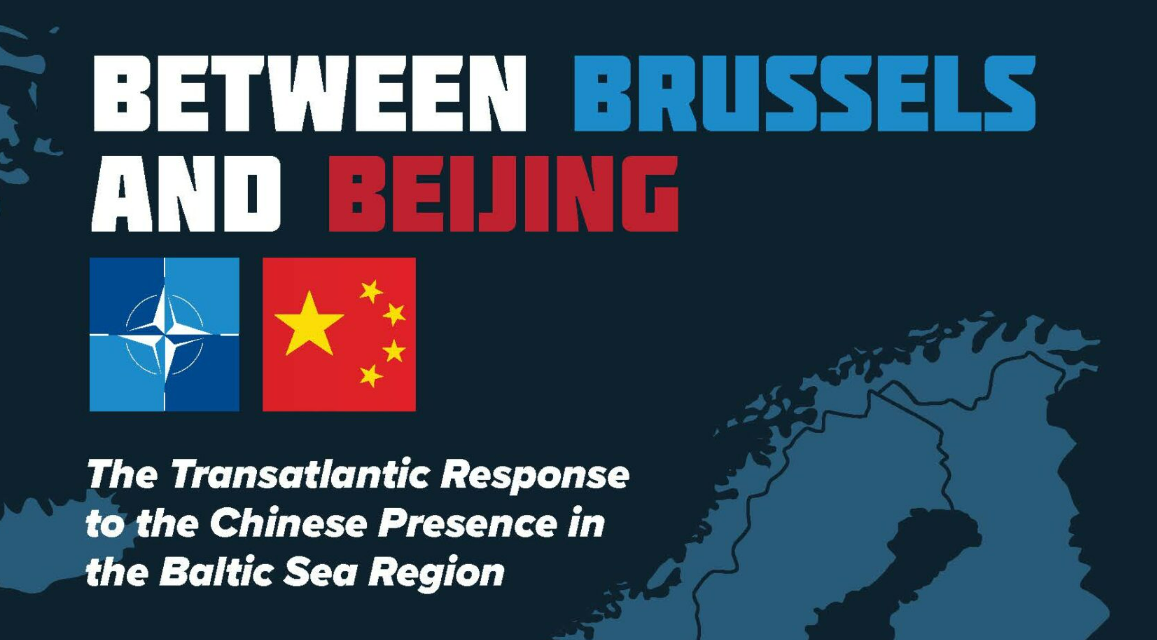
We are proud to annouce, that Patrycja Pendrakowska and Paweł Behrendt made a contribution to the latest project of the Baltic Security Foundation, The Jamestown Foundation and the Baltic-American Freedom Foundation – the book “Between Brussels and Beijing: The Transatlantic Response to the Chinese Presence in the Baltic Sea Region”.
Between Brussels and Beijing: The Transatlantic Response to the Chinese Presence in the Baltic Sea Region serves as a comprehensive analysis of China’s presence in the Baltic Sea littoral countries and subsequently related developments in the domains of education, finance and infrastructure.
In this book, edited by Olevs Nikers and Otto Tabuns and published by the Jamestown Foundation, they prepared a chapter “Navigating Sino-Polish Relations “.
For more information, click HERE

Więcej informacji na temat: newslettera, polityki prywatności serwisu
czytaj więcej
TSRG 2021: The Impacts of the BRI on Europe: The Case of Poland and Germany
It is important to contribute to the understanding of what the New Silk Road can mean in economic, political, leadership and cultural terms for the European countries involved. This analysis should reveal the practical consequences of the Belt and Road Initiative for Europe in the case of Poland and Germany, as well as their respective social effects.
Environmental problems transcend not only national borders but also historical periods. And yet debates on the necessary measures and timelines are often constrained by considerations of election cycles (or dynastic successions) in any given country.
Dawid JuraszekAre “Climate Refugees” (Just) About Climate?
As the awareness of the scale and pervasiveness of climate impacts on human societies keeps rising, so does the frequency with which the terms “climate refugees” and “climate migrants” are being used in the public discourse “to describe those who are being displaced due to adverse consequences related to climate change” (Atapattu, 2020).
Dawid JuraszekPaths to Asia: Conversations that Inspire
Wojciech Jaworski is the founder of Huqiao Games, a company specializing in bringing PC games to the Chinese market. A graduate of Jagiellonian University and participant in the “Chinese Bridge” program, he is currently working on a new, as yet unannounced project in the gamedev/tech industry.
Patrycja Zdybel“Green growth” may well be more of the same
Witnessing the recent flurry of political activity amid the accelerating environmental emergency, from the Green New Deal to the UN climate summits to European political initiatives, one could be forgiven for thinking that things are finally moving forward.
Dawid JuraszekNavigating tomorrow – the significance of Australia’s navy build-up
Australia has recently announced a plan to build the largest fleet since World War II. This move constitutes another step in Canberra's shift of defence strategy and commitment to adapt to the changing security environment.
Jakub WitczakOnline Course: “Conflict Resolution and Democracy”
The course will be taught via interactive workshops, employing the Adam Institute’s signature “Betzavta – the Adam Institute’s Facilitation Method“, taught by its creator, Dr. Uki Maroshek-Klarman. The award-winning “Betzavta” method is rooted in an empirical approach to civic education, interpersonal communication and conflict resolution.
The New Trilateral Axis in Asia: What the Pakistan-Saudi-Türkiye Pact Means for India
On 7 August 2026, Pakistan, Saudi Arabia, and Türkiye jointly entered into a defence alliance, known as the ‘Mecca Joint Defence Agreement'. Under this pact, an attack on any one of the three countries would be considered an attack on all three, and accordingly, the three countries would provide each other with the necessary defence support.
Nihar KulkarniCentral Asia. The winding road to regional integration
The aim of the paper is to present the current stage of integration among the Central Asian republics and to analyze directions and dynamics of this process in the nearest future. This study also attempts to identify factors which can either slow down or strengthen the process of integration as well as its causes and consequences.
Jerzy OlędzkiCharitable activities of the Vietnamese in Poland: their scope and sources
The scale of assistance provided to medics by the Vietnamese community during the 2020 pandemic inspires admiration and gratitude. It stems from the sense of belonging to Poland and deeply rooted in the culture order to help those in need and repay the debt incurred at the time when they themselves needed such help.
Ewa GrabowskaInterview: Why Does Poland Need ‘17+1’?
Interview with Michał Wójcik - Director of the Department of International Cooperation of the Ministry of Marine Economy and Inland Navigation (DWM MGMiŻŚ). In the Ministry, he is leading the Coordinating Secretariat for Maritime Issues , monitoring the cooperation of Central and Eastern European States with China.
Krzysztof ZalewskiRoman Catholic cemetery in Harbin (1903-1958)
First burials of Catholics, mostly Poles but also other Non-Orthodox believers took place in future Harbin in the so called small „old” or later Pokrovskoe Orthodox cemetery in the future European New Town quarter and small graveyards at the military and civilian hospitals of Chinese Eastern Railway at the turn of XIX and XX century.
Jerzy CzajewskiPolish women do not often become the heroines of media reports in Central Asia. In February 2020, however, it was different. The story of Agnieszka Pikulicka-Wilczewska, a journalist, "heated up" the headlines of local news portals. More importantly, "between the lines" she talked a lot about contemporary Uzbekistan and the role of women in politics.
Magdalena Sobańska-CwalinaWe would like to inform, that Financial Intelligence has published interview for Balkan Development Support with Patrycja Pendrakowska.
From ‘strategic engagement’ to ‘competition’. Interview with William Yu
Ewelina Horoszkiewicz in conversation with Professor William Yu (UCLA) on USA, China and Europe. Professor William Yu is an economist with the UCLA Anderson Forecast and specializes in the economies of Los Angeles and China.
Ewelina HoroszkiewiczSmiles, Handshakes, and Suspicion: What the US-China Summit Really Tells Us
The US and China held a bilateral summit on the 13th and 14th of May 2026 in Beijing. The visit was attended by the presidents of both countries, accompanied by the top business leaders, particularly from the American side.
Nihar KulkarniBook review: “Korean Diaspora in Postwar Japan – Geopolitics, Identity and Nation-Building”
Book review of "Korean Diaspora in Postwar Japan - Geopolitics, Identity and Nation-Building", written by Kim Myung-ja and published by I.B Tauris in 2017.
Nicolas LeviChina’s Social Credit System – How will it affect Polish enterprises in China?
The Social Credit System currently being rolled out in China may pose significant organisational and legal challenges for both foreign and Polish entities operating in China. We invite you to read our report, prepared in cooperation between the Boym Institute and Kochanski & Partners.
Patrycja ZdybelDr Krzysztof Zalewski participates in the Kigali Global Dialogue in Rwanda
A short note and photo gallery from the chairman of the Board of the Boym Institute, who stays in Rwanda at the "Kigali Global Dialogue" conference.
Internet, cryptocurrencies & blockchains in North Korea
North Korea is considered as a secretive state, but, paradoxically, the country is developing last trend technologies. With prohibitions restricting the flow of money, the country is turning to bitcoin and other cryptocurrencies to finance their programs, instead of coming under new pressure.
Nicolas LeviChinese work on the military use of artificial intelligence
Intensive modernization and the desire to catch up with the armed forces of the United States made chinese interest in the military application of futuristic technologies grow bigger.
Paweł BehrendtWill 2023 be the year of improving relations between Albania and South Korea?
In April 2021, the 30 years of establishing diplomatic relations between the Republic of Korea (ROK) and Albania was officially organized in the South Korean embassy in Athens, the capital of Greece. The localization of these official festivities perfectly pictured the nature of the relations between these two countries.
Nicolas LeviGuidance for Workplaces on Preparing for Coronavirus Spread
Due to the spread of coronavirus, the following workplace recommendations have been issued by the Ministry of Development, in cooperation with the Chief Sanitary Inspector. We also invite you to read article about general information and recommendations for entrepreneurs.
“May you be the mother of a thousand sons” – the status of women in Indian society
The 1950 Indian Constitution introduced the principle of equal opportunities for gender equality, which grants women and men the same rights in family life, political, social and economic life. So why is it that nearly forty per cent of girls aged 15-17 do not attend school, the custom of dowry giving is still cultivated and prenatal sex selection is still a huge social problem?
Magdalena Rybczyńska