
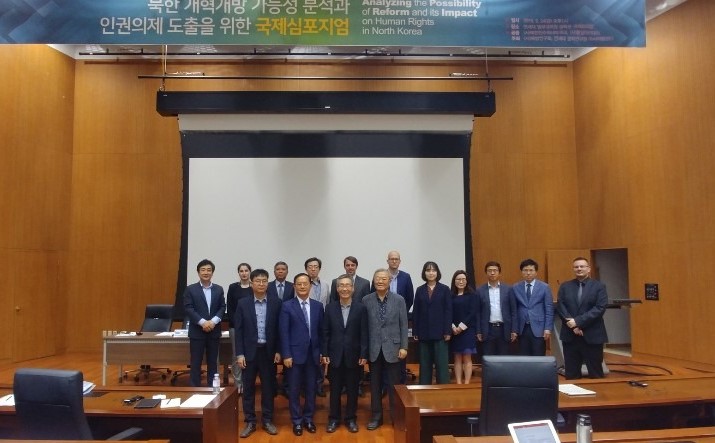
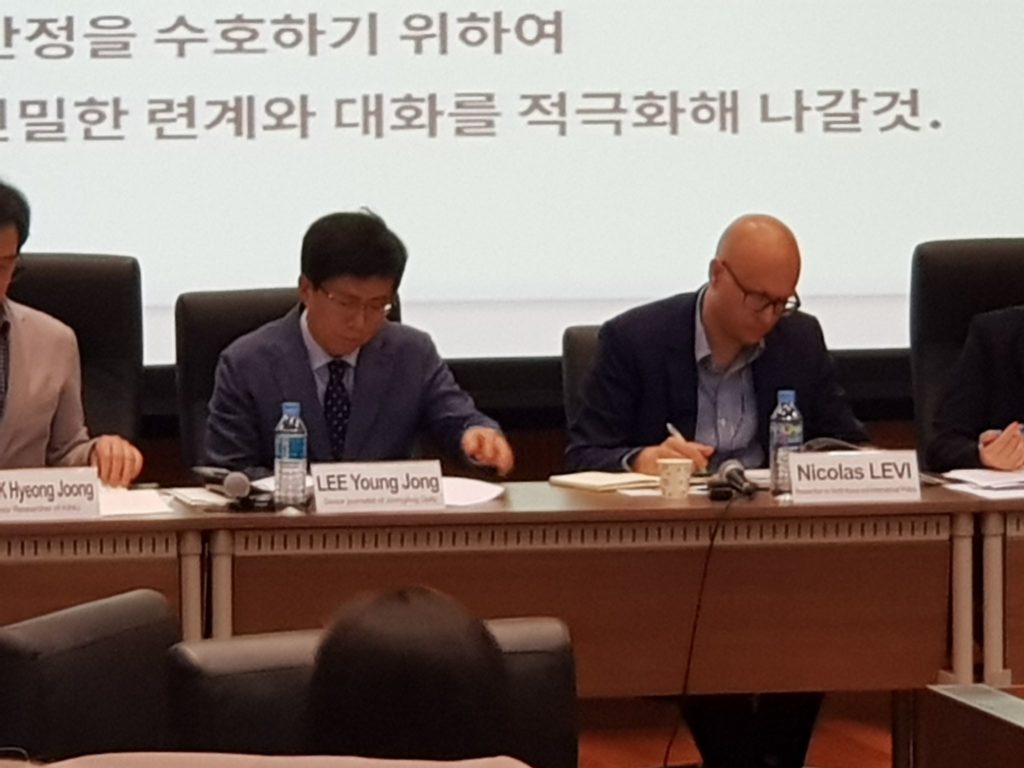
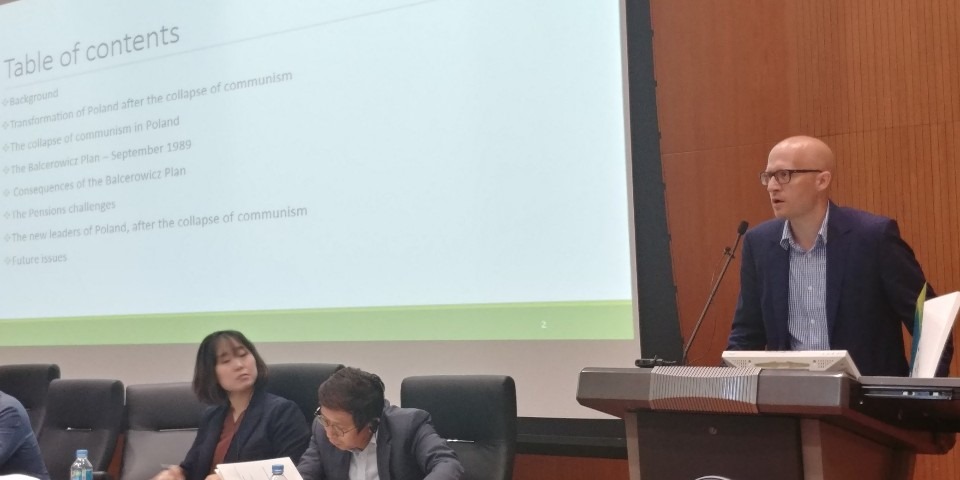
Speech by dr. Nicolas Levi contained reflections on Balcerowicz’s plan called “shock therapy”. It was a plan of Poland’s transition to a market economy after political liberalization in 1989. The seminar “Analyzing the Possibility of Reform and its Impact on Human Rights in North Korea” took place on May 24 at the prestigious Yonsei University in Seoul, South Korea.

Więcej informacji na temat: newslettera, polityki prywatności serwisu
czytaj więcej
Online Course: “Educational tools for addressing the effects of war”
The Adam Institute for Democracy and Peace is offering “Betzavta” facilitators, middle school and high school educators, social activists, communal activists and those assisting refugees an online seminar to explore educational issues related to wartime.
Will 2023 be the year of improving relations between Albania and South Korea?
In April 2021, the 30 years of establishing diplomatic relations between the Republic of Korea (ROK) and Albania was officially organized in the South Korean embassy in Athens, the capital of Greece. The localization of these official festivities perfectly pictured the nature of the relations between these two countries.
Nicolas LeviIndonesia – between religion and democracy
Indonesia is the largest Muslim democracy in the world. Approximately 88% of the population in Indonesia declares Islamic religion, but in spite of this significant dominance, Indonesia is not a religious state.
Anna GrzywaczWe would like to inform, that Observer Research Foundation has published article of Patrycja Pendrakowska - the Boym Institute Analyst and President of the Board.
Patrycja ZdybelKyrgyzstan on the Path to Political Stabilisation
On 10 January, early presidential elections were held in Kyrgyzstan, following the resignation of the incumbent, President Zheenbekov. The atmosphere in which the vote was conducted remained tense. This had been the case since the results of the October elections were announced, in which the opposition grouping failed to win a single parliamentary seat.
Jerzy OlędzkiPolish women do not often become the heroines of media reports in Central Asia. In February 2020, however, it was different. The story of Agnieszka Pikulicka-Wilczewska, a journalist, "heated up" the headlines of local news portals. More importantly, "between the lines" she talked a lot about contemporary Uzbekistan and the role of women in politics.
Magdalena Sobańska-CwalinaThe 16th India-Japan Summit: What It Means for the Indo-Pacific and the Quad
Japanese Prime Minister Sanae Takaichi visited New Delhi from 1-3 July 2026 for the 16th India-Japan Annual Summit; this visit followed Indian Prime Minister Narendra Modi's visit to Tokyo for the 15th India-Japan Annual Summit in August 2025.
Nihar KulkarniChinese work on the military use of artificial intelligence
Intensive modernization and the desire to catch up with the armed forces of the United States made chinese interest in the military application of futuristic technologies grow bigger.
Paweł BehrendtOnline Course: “Conflict Resolution and Democracy”
The course will be taught via interactive workshops, employing the Adam Institute’s signature “Betzavta – the Adam Institute’s Facilitation Method“, taught by its creator, Dr. Uki Maroshek-Klarman. The award-winning “Betzavta” method is rooted in an empirical approach to civic education, interpersonal communication and conflict resolution.
Globalization of business, education and China: interview with prof. Chiwen Jevons Lee
Interview of Ewelina Horoszkiewicz with prof. Chiwen Jevons Lee on China on globalization of Chinese business education and his thoughts of China’s role in the global marketplace.
Ewelina HoroszkiewiczShort summary of events at the Boym Institute
We want the Boym Institute to become a valuable platform of exchanging views, making valuable acquaintances and, above all, deepening knowledge. Therefore, we undertake the organization of many events: debates, lectures, and conferences.
Patrycja Pendrakowska and Paweł Behrendt on navigating Sino-Polish relations
We are proud to annouce, that Patrycja Pendrakowska and Paweł Behrendt made a contribution to the latest project of the Baltic Security Foundation, The Jamestown Foundation and the Baltic-American Freedom Foundation.
Online Course: “Conflict Resolution and Democracy”
The course will be taught via interactive workshops, employing the Adam Institute’s signature “Betzavta – the Adam Institute’s Facilitation Method“, taught by its creator, Dr. Uki Maroshek-Klarman. The award-winning “Betzavta” method is rooted in an empirical approach to civic education, interpersonal communication and conflict resolution.
China – USA in the South China Sea
The trade war is just one of the problems of confrontation between the United States and the People's Republic of China. Many aspects of this competition coincide in the South China Sea.
Paweł BehrendtThe Boym Institute message to Indian policymakers and analysts
India’s current position towards the Russian invasion on Ukraine may damage its reputation as a major force of peace in the world
We’re Stronger Together – an Interview with Minister Marcin Przydacz
"Cooperation and investments – we are absolutely up for it. However, we prefer to keep a certain degree of caution when it comes to entrusting the transfer of technology and critical infrastructure to external investors. The security of Poland and the EU should be considered more important than even the greatest economic gains..."
From ‘strategic engagement’ to ‘competition’. Interview with William Yu
Ewelina Horoszkiewicz in conversation with Professor William Yu (UCLA) on USA, China and Europe. Professor William Yu is an economist with the UCLA Anderson Forecast and specializes in the economies of Los Angeles and China.
Ewelina HoroszkiewiczAn interview with Mr. Meirzhan Yussupov, Chairman of the Board of the “National Company” KAZAKH INVEST” JSC - Member of the Board of Directors of the Company
Magdalena Sobańska-CwalinaWhy is stronger foreign investment protection needed in relations with China?
One of the key elements of the protection of foreign investment (and thus the foreign investor) is the mechanism for resolving disputes between the state and the foreign investor. The mechanism itself may take different forms...
Adrian ZwolińskiPatrycja Pendrakowska as a founding member of the WICCI’s India-EU Business Council
By sharing knowledge, business opportunities, and best practices the Council generates awareness of women's contributions in developing the India-EU relations.
To free oneself from the Chinese embrace. On Indo-Russian relations with Nandan Unnikrishnan
Interview with Nandan Unnikrishnan, who has served for many years as a correspondent for Indian media in Russia. Currently he is a research fellow at the Observer Research Foundation in Delhi. The interview was conducted during the Raisina Dialogue 2019 in Delhi.
Krzysztof ZalewskiForeign Direct Investment in Vietnam
Thanks to continuous economic development, Vietnam attracts a record number of Foreign Direct Investment (FDI). The catalyst for such a strong growth of FDI in Vietnam is not only the ongoing trade war between the US and China, but also new international agreements.
Jakub KrólczykBook review: “Korean Diaspora in Postwar Japan – Geopolitics, Identity and Nation-Building”
Book review of "Korean Diaspora in Postwar Japan - Geopolitics, Identity and Nation-Building", written by Kim Myung-ja and published by I.B Tauris in 2017.
Nicolas LeviWe would like to inform, that Observer Research Foundation has published article of Patrycja Pendrakowska - the Boym Institute Analyst and President of the Board.
Patrycja Zdybel