
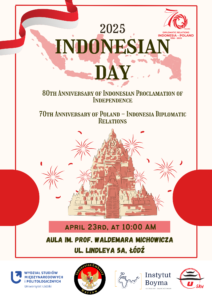
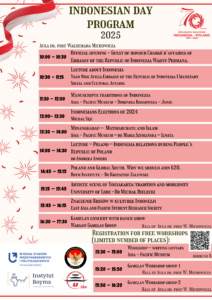
On the occasion of the 80th anniversary of Indonesia’s Independence and the 70th anniversary of Polish-Indonesian diplomatic relations, we invite you to a special event celebrating the richness of local culture and history. “Indonesian Day 2025” will take place on April 23rd. Join us in the Professor Waldemar Michowicz Auditorium, ul. Lindleya 5A, Łódź. The event will begin at 10:00 AM!

Więcej informacji na temat: newslettera, polityki prywatności serwisu
czytaj więcej
Globalization of business, education and China: interview with prof. Chiwen Jevons Lee
Interview of Ewelina Horoszkiewicz with prof. Chiwen Jevons Lee on China on globalization of Chinese business education and his thoughts of China’s role in the global marketplace.
Ewelina HoroszkiewiczThe North Korean nuclear dismantlement and the management of its nuclear wastes
Evidence suggests that North Korea stores its high-level nuclear waste (HLW) in liquid form in tanks on the same site where it is made, and has not invested in infrastructure to reduce, dentrify, or vitrify this waste. However, this is just the tip of the iceberg, one of many aspects of the North Korean nuclear waste problem.
Nicolas LeviPeace is a precondition for LiFE. How systemic conflicts endanger developmental goals
The G20 can play a pivotal role in dealing with the mounting global challenges by proposing policy coordination and solutions disincentivising armed conflicts.
Krzysztof ZalewskiChinese work on the military use of artificial intelligence
Intensive modernization and the desire to catch up with the armed forces of the United States made chinese interest in the military application of futuristic technologies grow bigger.
Paweł BehrendtOnline Course: “Conflict Resolution and Democracy”
The course will be taught via interactive workshops, employing the Adam Institute’s signature “Betzavta – the Adam Institute’s Facilitation Method“, taught by its creator, Dr. Uki Maroshek-Klarman. The award-winning “Betzavta” method is rooted in an empirical approach to civic education, interpersonal communication and conflict resolution.
The New Trilateral Axis in Asia: What the Pakistan-Saudi-Türkiye Pact Means for India
On 7 August 2026, Pakistan, Saudi Arabia, and Türkiye jointly entered into a defence alliance, known as the ‘Mecca Joint Defence Agreement'. Under this pact, an attack on any one of the three countries would be considered an attack on all three, and accordingly, the three countries would provide each other with the necessary defence support.
Nihar KulkarniEurope and the Consequences of China’s First Step on the Moon
Just a few years ago, it was assumed that the United States would almost automatically reclaim the lead in landing on the Moon. The original timeline envisioned Artemis III for 2024, but successive delays pushed the mission first to 2025–2026 and now to no earlier than mid-2027.
Kamil GolemoBorder conflicts as political tools: the Thailand–Cambodia crisis
The border conflict between Thailand and Cambodia is much more than just a territorial dispute. Rooted in historical ambiguities, it has become a tool for domestic political maneuvering in both countries and a stage for international strategic competition.
Andżelika SerwatkaBeyond Grey Hulls: Europe’s Role in “Crowdsourcing” Maritime Domain Awareness in the South China Sea
If developments observed in the South China Sea over the recent months are of any indication, it simply means that the situation has worsened. China’s continued aggression towards its neighbors – the Philippines and Vietnam in particular, has continued unabated.
Collin KohCoronavirus (COVID-19) outbreak and emerging contractual claims
With China one of the key players in the global supply chain, supplying major manufacturing companies with commodities, components and final products, the recent emerging outbreak of Coronavirus provides for a number of organizational as well as legal challenges.
The link between EU Aid and Good Governance in Central Asia
Nowadays all the CA states continue transitioning into the human-centered model of governance where the comprehensive needs of societies must be satisfied, nevertheless, the achievements are to a greater extent ambiguous.
In the first part of this analysis of Ulaanbaatar’s winning 2040 General Development Plan Conception (GDPC) I look into the historical preconditions for the city’s planned development as well as present the legislative climate in which works on Ulaanbaatar’s future development strategies have recently found themselves.
Paweł SzczapGuidance for Workplaces on Preparing for Coronavirus Spread
Due to the spread of coronavirus, the following workplace recommendations have been issued by the Ministry of Development, in cooperation with the Chief Sanitary Inspector. We also invite you to read article about general information and recommendations for entrepreneurs.
TSRG 2021: The Impacts of the BRI on Europe: The Case of Poland and Germany
It is important to contribute to the understanding of what the New Silk Road can mean in economic, political, leadership and cultural terms for the European countries involved. This analysis should reveal the practical consequences of the Belt and Road Initiative for Europe in the case of Poland and Germany, as well as their respective social effects.
Polish-Macanese Artist Duo Presents New Works in Lisbon
Artist couple Marta Stanisława Sala (Poland) and Cheong Kin Man (Macau) will present their latest works in the exhibition “The Wondersome and Peculiar Voyages of Cheong Kin Man, Marta Stanisława Sala and Deborah Uhde”, on view at the Macau Museum of the Macau Scientific and Cultural Centre (CCCM) in Lisbon, from 5 June to 6 July 2025.
Women in Public Debate – A Guide to Organising Inclusive and Meaningful Discussions
On the occasion of International Women's Day, we warmly invite you to read our guide to good practices: "Women in Public Debate – A Guide to Organising Inclusive and Meaningful Discussions."
Ada DyndoThe Boym Institute contribution to the Transcultural Caravan project
We are pleased to announce, that our analysts and contributors are among authors of the newest publication - "European Perspectives on the New Silk Roads – A Transcultural Approach".
Indian Roundtable – Poland’s Challenges and Opportunities in the Subcontinent
In recent years, India has been the fastest growing among the major countries' economies in the world. (...) In the coming decades, the Subcontinent's largest country may remain one of the pillars of global economic growth. This is one of the reasons why the country is already the most popular destination for Polish foreign investment in the Asian-Pacific region.
We would like to inform, that Observer Research Foundation has published article of Patrycja Pendrakowska - the Boym Institute Analyst and President of the Board.
Patrycja ZdybelHow to deal with gender-based segregation?
Interview on the project Supporting the Economic Empowerment of Afghan Women through Education and Training in Kazakhstan and Uzbekistan. Magdalena Sobańska-Cwalina and Krzysztof M. Zalewski (The Boym Institute) in discussion with: Yakup Beris, Johannes Stenbaek Madsen, Maria Dotsenko, Gulnar Smailova,
Zespół Instytutu BoymaLiquidation of the Polish colony in Manchuria (north-eastern China)
Ms. Łucja Drabczak - A Polish woman born in Harbin, she spent her childhood in China. She returned to Poland at the age of 10. She is the author of the book 'China... Memories from my childhood'. She contacted us to convey special family memories related to leaving Manchuria in 1949.
The 16th India-Japan Summit: What It Means for the Indo-Pacific and the Quad
Japanese Prime Minister Sanae Takaichi visited New Delhi from 1-3 July 2026 for the 16th India-Japan Annual Summit; this visit followed Indian Prime Minister Narendra Modi's visit to Tokyo for the 15th India-Japan Annual Summit in August 2025.
Nihar KulkarniBook review: “Europe – North Korea. Between Humanitarianism And Business?”
Book review of "Europe – North Korea. Between Humanitarianism And Business?", written by Myung-Kyu Park, Bernhard Seliger, Sung-Jo Park (Eds.) and published by Lit Verlag in 2010.
Nicolas LeviBook review of "GDR International Development Policy Involvement. Doctrine and Strategies between Illusions and Reality 1960-1990, The example (South) Africa", written by Ulrich van der Heyden and published by Lit Verlag in 2013.
Nicolas Levi