
Lisbon, Portugal, 3 June 2025
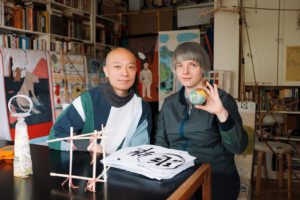
Artist couple Marta Stanisława Sala (Poland) and Cheong Kin Man (Macau) will present their latest works in the exhibition “The Wondersome and Peculiar Voyages of Cheong Kin Man, Marta Stanisława Sala and Deborah Uhde” (As Espantosas e Curiosas Viagens de Cheong Kin Man, Marta Stanisława Sala e Deborah Uhde), on view at the Macau Museum of the Macau Scientific and Cultural Centre (CCCM) in Lisbon, from 5 June to 6 July 2025. The Boym Institute is the patron of the event
Known for combining textile, video, and linguistic experimentation, the duo invites the public on a journey through parallel worlds and personal archives in three multimedia projects: “The Compass of Utopia”, “Apocalypses”, and a new experimental video project on the Macanese diaspora.
“The Compass of Utopia”, partially developed with the support of the City of Kraków and Fundação Oriente, is a bamboo and textile installation composed of 13 fabric compositions that materialise cultural exchange and mutual learning. Inspirations include the Jesuit Michael Boym’s “Flora Sinensis” (1656), the musicality of Cantonese poetry translated into colour forms, and autoethnographic elements drawn from Macanese family migration histories and contemporary travels.
“Apocalypses”, first shown at the Macau Biennale in 2023, blends text, textile, and video in a science fiction narrative. The fabric featured in this fantastical world encodes threads from a Polish family archive, recalling their migration journeys across 20th-century borders – from Vilnius, through the fringes of Mongolia, to contemporary Poland. The piece represented both Poland and Berlin at the biennale.
The exhibition also features an experimental video project based on interviews with the Macanese diaspora. Its narrative travels through Brazil, where the shared human feeling of nostalgia echoes through automatic translations into various languages. Accompanying the video is a new artist book titled “Entre-vista, Między-widzenie. Roz-mowa, Des-locução”. Presented as a flipbook with a Portuguese-Polish glossary, the artistic publication deconstructs a video interview extract, pausing on each spoken word to explore the possibilities and limitations of translation.
At the exhibition opening on 5 June, the artists will lead a guided tour. The following day, on 6 June, the Goethe-Institut Library in Lisbon will host an artist talk and the launch of the expanded edition of “Apocalypses” (720 pages) — a collection of fictional ideograms originally created at the Krakauer Haus in Nuremberg, Kraków City Council’s only cultural mission abroad.
Exhibition Details
Portuguese Title: As Espantosas e Curiosas Viagens de Cheong Kin Man, Marta Stanisława Sala e Deborah Uhde\
English Title: The Wondersome and Peculiar Voyages of Cheong Kin Man, Marta Stanisława Sala and Deborah Uhde
Artists: Cheong Kin Man, Marta Stanisława Sala, Deborah Uhde
Curator: Lorena Tabares Salamanca
Vernissage with guided tour: 5 June 2025, 17:00
Exhibition dates: 6 June – 6 July 2025
Venue:
Macau Museum (Museu de Macau)
Macau Scientific and Cultural Centre (CCCM)
Rua da Junqueira 30, 1300-343 Lisbon
Opening hours: Tuesday–Sunday, 10:00–17:30
Accompanying Event
Artist talk and book launch
Date: 6 June 2025, 18:00
Location: Goethe-Institut Library,
Campo dos Mártires da Pátria 37, 1169-016 Lisbon
Support
Honorary Patronage:
Embassy of Poland in Portugal
Embassy of Colombia in Portugal
Financial Support:
Ministry of Culture and National Heritage of Poland (for Marta Sala)
Adam Mickiewicz Institute of Poland (for Marta Sala)
Fundação Oriente of Portugal (for the reedition of the artist book by Cheong Kin Man and Marta Sala)
Partners:
City of Kraków
Goethe-Institut Portugal
Media Patronage:
Krakow.pl
Boym Institute

Więcej informacji na temat: newslettera, polityki prywatności serwisu
czytaj więcej
Book review: “North Korea’s Cities”
Book review of "North Korea’s Cities", written by Rainer Dormels and published byJimoondang Publishing Company in 2014.
Nicolas LeviWe’re Stronger Together – an Interview with Minister Marcin Przydacz
"Cooperation and investments – we are absolutely up for it. However, we prefer to keep a certain degree of caution when it comes to entrusting the transfer of technology and critical infrastructure to external investors. The security of Poland and the EU should be considered more important than even the greatest economic gains..."
The Global Waste Trade: Unveiling Waste Colonialism in Southeast Asia
Although 19th-century colonialism may seem like a relic of the past, the global community continues to grapple with its modern counterparts, often referred to as neo-colonialism.
Andżelika SerwatkaInvest and cooperate with Serbia or Poland? A dilemma for South Korean companies
This paper explains why Serbia may replace Poland as a strategic outsourcing centre for South Korean companies in Central and Southern Europe.
Nicolas LeviInterview with Arthur Tun on Myanmar’s Coup d’État
On the 1st of February 2021, Myanmar’s military forces overthrew the government and arrested the Prime Minister, Aung San Suu Kyi. On the fifth anniversary of these events, the Boym Institute decided to ask what Myanmar looks like after the coup.
Paweł MazurekCoronavirus and climate policies: long-term consequences of short-term initiatives
As large parts of the world are gradually becoming habituated to living in the shadow of the coronavirus pandemic, global attention has turned to restarting the economy. One of the most consequential impacts of these efforts will be that on our climate policies and environmental conditions.
Dawid JuraszekPatrycja Pendrakowska made it to the Top 40 under 40 Europe-India leaders list
#EuropeIndia40, an initiative of EICBI, covers the stories of leaders below the age of 40 and their contributions to promoting EU India / UK India relations.
The 16th India-Japan Summit: What It Means for the Indo-Pacific and the Quad
Japanese Prime Minister Sanae Takaichi visited New Delhi from 1-3 July 2026 for the 16th India-Japan Annual Summit; this visit followed Indian Prime Minister Narendra Modi's visit to Tokyo for the 15th India-Japan Annual Summit in August 2025.
Nihar KulkarniSaudi ‘Vision 2030’. How the Kingdom is using oil to end its economic overdependence on oil.
With the advent of clean energy technologies the Saudis realize they need to end their economic dependency on oil. ‘Vision 2030’ is a vast and complex plan that seeks to preserve Saudi Arabia’s regional power, economic prosperity, and - not the least - authoritarian rule in the post-oil future.
Jan KosińskiThe Dasgupta Review on Women and the Environmental Crisis
Commissioned in 2019 by the British government and published in February 2021, The Dasgupta Review has been likened to the 2006 Stern Review. Where the latter brought to widespread attention the many failings of the world economy in the face of global warming, the former makes similar points as regards biodiversity – and identifies the unique challenges faced by women.
Dawid JuraszekChinese work on the military use of artificial intelligence
Intensive modernization and the desire to catch up with the armed forces of the United States made chinese interest in the military application of futuristic technologies grow bigger.
Paweł BehrendtAre “Climate Refugees” (Just) About Climate?
As the awareness of the scale and pervasiveness of climate impacts on human societies keeps rising, so does the frequency with which the terms “climate refugees” and “climate migrants” are being used in the public discourse “to describe those who are being displaced due to adverse consequences related to climate change” (Atapattu, 2020).
Dawid Juraszek“May you be the mother of a thousand sons” – the status of women in Indian society
The 1950 Indian Constitution introduced the principle of equal opportunities for gender equality, which grants women and men the same rights in family life, political, social and economic life. So why is it that nearly forty per cent of girls aged 15-17 do not attend school, the custom of dowry giving is still cultivated and prenatal sex selection is still a huge social problem?
Magdalena RybczyńskaThis is the second part of an inquiry into Ulaanbaatar’s winning 2040 General Development Plan Conception (GDPC). In this part of paper, I look into some of the plans and/or solutions proposed in Ulaanbaatar’s 2040 GDPC.
Paweł SzczapNuclear Temptations in an Age of Uncertainty
For decades, the pursuit of weapons of mass destruction was largely confined to rogue and authoritarian regimes. Today, the discussion increasingly includes U.S. allies, signaling a profound shift in global security dynamics
Paweł BehrendtOpportunities and challenges of India’s G20 Presidency
Ada Dyndo conducts an interview with Shairee Malhotra on India’s role in G20. Shairee Malhotra serves as a Coordinator of the T20 India Taskforce on Reformed Multilateralism for India’s G20 presidency.
Ada DyndoBook review: “North Korean Defectors in a New and Competitive Society”
Book review of "North Korean Defectors in a New and Competitive Society", written by Lee Ahlam - assistant professor in the Department of Educational Leadership and Human Resource Development at Xavier University Cincinnati, Ohio.
Nicolas LeviWomen’s liberation in China: interview with prof. Wu Lijuan
Interview of Ewelina Horoszkiewicz with prof. Wu Lijuan - Associate Professor at the Department of Sociology at Peking University. Her research concentrates on the gender issues and social changes brought about by globalization. She wrote a book “Job Placements and Job Shifts in China: The Effects of Education, Family Background and Gender”.
Ewelina HoroszkiewiczChina – USA in the South China Sea
The trade war is just one of the problems of confrontation between the United States and the People's Republic of China. Many aspects of this competition coincide in the South China Sea.
Paweł BehrendtWe would like to inform, that Observer Research Foundation has published article of Patrycja Pendrakowska - the Boym Institute Analyst and President of the Board.
Patrycja ZdybelHow China uses its narratives on the Russo-Ukrainian war to court the Global South
Three years after Russia’s full-scale invasion of Ukraine, it is entirely clear that this conflict has irrevocably changed the geopolitical landscape both in Europe and beyond and its repercussions will be felt far beyond the battlefield for years to come.
Konrad SzattersBook review: “Unveiling the North Korean economy”
Book review of "Unveiling the North Korean economy", written by Kim Byung-yeon and published by Cambridge University Press in 2016.B. Tauris in 2017.
Nicolas LeviAn “Asian NATO”: Chances and perspectives
The Russian invasion of Ukraine has reinvigorated NATO. Can the Chinese pressure on its neighbours, especially Taiwan, create an Asian equivalent of NATO?
Paweł BehrendtIndonesia – between religion and democracy
Indonesia is the largest Muslim democracy in the world. Approximately 88% of the population in Indonesia declares Islamic religion, but in spite of this significant dominance, Indonesia is not a religious state.
Anna Grzywacz