
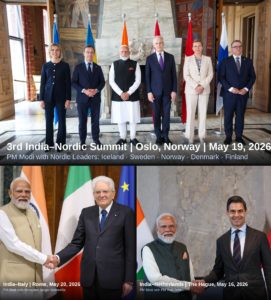
India’s Prime Minister, Narendra Modi, concluded a five-day visit to Europe from May 15 to 20, 2026, covering the Netherlands, Sweden, Norway, and Italy. The central purpose of the visit was to attend the India–Nordic Summit 2026, strengthen bilateral and strategic ties with Nordic countries, attract Nordic investment to India, and foster cooperation in areas such as green technology. More broadly, the visit raises important questions regarding the future trajectory and further deepening of India–Europe cooperation.
India and the Nordic Region: Cooperation for the Global South
India has steadily enhanced its multisectoral bilateral partnerships with Nordic countries in areas such as economic cooperation, climate change, sustainable maritime governance, education, research, maritime security, as well as people-to-people and cultural exchanges. The first India–Nordic Summit was held in 2018 in Stockholm, Sweden, followed by the second summit in Copenhagen, Denmark, in 2022 (Press Information Bureau, 2022; Siddiqui, 2026; Stener, 2026). Key areas of discussion have included multilateral cooperation in post-pandemic economic recovery (particularly during the 2022 summit), climate change, sustainable development, innovation, digitalisation, and green and clean growth. India has also consistently invited and encouraged Nordic countries to invest in its blue economy sectors and the Sagarmala project, which aims to promote port-led development in India (S. and W. of I. Ministry of Ports, n.d.; Siddiqui, 2026).
The third India–Nordic Summit, held in 2026 in Oslo, Norway, brought together Prime Minister Modi and his counterparts from all five Nordic nations (Ministry of External Affairs of India, 2026b). The summit focused on deepening India’s economic, research, and technological ties with the Nordic region. Its most significant outcome was the elevation of India–Nordic relations to a “Green Technology and Innovation Strategic Partnership” (Ministry of External Affairs of India, 2026b).
The primary aim of this partnership is to cooperate in the development of green technologies, implement them at India’s scale, and subsequently share them with countries in the Global South to promote collective growth and planetary sustainability.
Additionally, both sides share common objectives, including addressing climate change, transitioning to green energy sources, enhancing maritime security, and promoting the blue economy. To advance these goals, India and the Nordic countries agreed to collaborate on wind and hydrogen energy projects, joint Arctic and polar research initiatives, Artificial Intelligence (AI), and Research and Development (R&D), particularly in green technologies and climate change. They also agreed to strengthen digital cooperation, which could help accelerate India’s digital public infrastructure (DPI) and provide a replicable model for the developing world (Ministry of External Affairs of India, 2026b).
The India–Nordic Summit helps shape a broader strategic framework for India’s engagement with the Nordic region, while its goals and outcomes are implemented through both bilateral cooperation with individual Nordic countries and wider multilateral engagement. Each Nordic country holds a specific strategic value for India. For instance, Norway is a priority partner in the shipbuilding sector; Sweden in defence, economic, and space cooperation; while Iceland, Finland, and Denmark are important for green technology, digital innovation, and Arctic research (DD India, 2026; Gahr & Modi, 2026; S. and W. Ministry of Ports, 2025; Modi, 2026b, 2026c; Press Information Bureau, 2022; Siddiqui, 2026; Stener, 2026). India also elevated bilateral relations to the Strategic Partnership level with both Norway and Sweden during this summit, demonstrating a long-term commitment and political will towards building deep ties with the Nordic region (Government Offices of Sweden, 2026).
The Geopolitical Rationale Behind India’s Strategic Nordic Engagement
India’s deepening engagement with Nordic countries is not merely economic; it is also driven by strong geopolitical considerations rooted in geographical realities and the growing strategic significance of the Arctic region in global affairs.
As Arctic ice continues to melt, it raises serious environmental concerns with far-reaching consequences. These include shifts in weather patterns, changes in global ocean temperatures and wind systems, disruptions to monsoon cycles and agricultural production, and alterations in ocean currents. Such developments carry profound implications for India and its population of approximately 1.4 billion, making Arctic-related issues a strategic priority for the country. Consequently, India has increasingly promoted Arctic research, as reflected in the establishment of its permanent research station, Himadri, in 2008 at Ny-Ålesund, Svalbard, Norway. The station is dedicated to research in biological, glaciological, and atmospheric sciences (Government of India, 2022; Ministry of Earth Sciences of India, 2022; Embassy of India in Oslo, 2022).
Beyond environmental concerns, the melting of Arctic ice is also creating new opportunities for global trade by opening alternative maritime routes. Moreover, it is unlocking vast reserves of natural resources, including oil, natural gas, minerals, freshwater, fisheries, and renewable energy potential (Arctic Portal, n.d.). According to the 2008 US Geological Survey, the Arctic region—defined as the polar area surrounding the North Pole and encompassing the Arctic Ocean and eight surrounding states, including the United States (Alaska), Canada, Russia, and the five Nordic countries of Denmark, Sweden, Norway, Finland, and Iceland—is estimated to contain approximately 22% of the world’s undiscovered oil and gas reserves, amounting to nearly 412 billion barrels of oil equivalent. Of these resources, roughly 78% are believed to consist of natural gas and natural gas liquids (NGLs) (Arctic Portal, n.d.; Bird et al., 2008).
For India, whose economic development requires sustained access to natural resources, maintaining cordial relations with resource-rich countries and regions is essential for securing energy supplies, particularly through emerging shipping routes. At the same time, a resource-rich region such as the Arctic naturally becomes a site of geopolitical competition among major and regional powers. A recent example is President Donald Trump’s position that Greenland—a resource-rich Arctic territory and an autonomous constituent of the Kingdom of Denmark—should come under United States jurisdiction (Nova, 2025). This stance generated diplomatic tensions between the United States, Denmark, and European Union (EU) member states. Any geopolitical or military confrontation in the Arctic would likely have global repercussions. As a result, Arctic states and major global powers, including India, are increasingly engaged in efforts to preserve peace, stability, and multilateral cooperation in the region. India also holds observer status in the Arctic Council, the principal high-level intergovernmental forum for cooperation and coordination among Arctic nations, of which all Nordic countries are members.
India’s Broader European Engagement
Apart from the India–Nordic Summit, Prime Minister Modi also visited the Netherlands, Sweden, and Italy, making this one of the most expansive European tours undertaken by an Indian Prime Minister. The visit involved engagement with seven countries in five days—namely the Netherlands, Sweden, Norway, Finland, Iceland, Denmark, and Italy. During this tour, India elevated its bilateral relations with the Netherlands, Norway, and Sweden to the level of Strategic Partnership, while establishing a Special Strategic Partnership with Italy. These developments demonstrate India’s intent to build comprehensive and strategically significant ties across different regions of Europe.
India also signed several significant economic and strategic agreements during the visit. For instance, a joint agreement on semiconductor manufacturing in India was concluded between ASML, a leading Dutch semiconductor equipment company, and Tata Electronics, one of India’s major electronics firms. Under this agreement, ASML will support Tata Electronics by supplying high-precision lithography machines, thereby enabling advanced semiconductor manufacturing in India (Ministry of External Affairs of India, 2026a).
In Sweden, India signed cooperation agreements covering the economic, defence, technology, and space sectors (Government Offices of Sweden, 2026; Kristersson et al., 2026; Modi, 2026a). In the area of space cooperation, Sweden agreed to participate in India’s Venus Orbiter Mission and will develop an instrument called the Venusian Neutrals Analyser (VNA) for use in the mission (MyGov India, 2026; Singh, 2026).
India and Italy also concluded agreements on connectivity, particularly regarding cooperation on the India–Middle East–Europe Corridor (IMEC), a multimodal transport corridor linking India and Europe through the Middle East (Ministry of External Affairs of India, 2026c, 2026d). Additionally, Italy agreed to cooperate with India in joint defence production, commercial space collaboration, maritime security, and broader engagement in the Indo-Pacific region (Ministry of External Affairs of India, 2026).
Discussions during these visits also addressed the ongoing wars in Ukraine and West Asia, which have contributed to global energy shortages and intensified great-power rivalry, thereby generating significant uncertainty in the international order. Amid this uncertainty, India views its partnerships with European countries as essential for addressing global challenges through sustained dialogue and multisectoral cooperation. In its engagements with the Nordic countries, the Netherlands, and Italy, India also reached agreements on cooperation in global governance institutions, including the United Nations, reforms of multilateral institutions, and the condemnation of and firm action against all forms of terrorism worldwide (Ministry of External Affairs of India, 2026b; Modi, 2026c). Indian Prime Minister Narendra Modi explicitly stated that, “India and Europe are strategic partners for a balanced, secure, and sustainable world” (Modi, 2026a). This statement encapsulates India’s position that the India–Europe partnership is intended to promote peace, growth, and sustainability, rather than being understood through the lens of a traditional geopolitical alliance.
Across bilateral meetings, India’s engagement also consistently included invitations to business leaders to invest in India, collaborate with Indian technology firms, and strengthen institutional and educational partnerships with research institutions and universities. These efforts aim to foster deeper and more sustainable India–Europe connectivity, with the longer-term objective of expanding collaboration across the developing world (Gahr & Modi, 2026; Kristersson et al., 2026; Modi, 2026a, 2026b).
Furthermore, India signed a free trade agreement with the EU in February 2026, which is expected to facilitate trade and deepen economic engagement. Consequently, India is likely to witness increased cooperation with EU member states across Nordic, Central-Eastern, and Western Europe.
Challenges and the Way Forward
Despite growing momentum, significant challenges remain in advancing India–EU relations. The foremost obstacle is the insufficient level of political trust and strategic convergence between the two sides. While India and Europe are increasingly interested in deepening economic cooperation and extracting mutual benefits, there remains comparatively less political will—particularly on the European side—to cultivate a deeper strategic partnership with India. This hesitation stems largely from concerns over India’s continued engagement with Russia and broader foreign policy divergences. However, addressing these concerns requires a deeper understanding of India’s strategic thinking and political culture.
First and foremost, it is essential to recognise the enduring pragmatism of India’s foreign policy, characterised by strategic autonomy and independent decision-making. Questions are often raised in Western strategic circles and media regarding why European countries or the broader West should trust India, particularly given its long-standing partnership with Russia—a country widely perceived as an existential threat in Europe (Economic Times, 2026; GLOBSEC Forum, 2022). This is a legitimate question and deserves a direct response: India has historically remained loyal to those who supported it during times of strategic vulnerability.
For instance, the Soviet Union during the Cold War, and later Russia, provided critical support to India during the 1971 war with Pakistan and remained a key security partner thereafter. Even amid immense diplomatic, political, and economic pressure from Western countries during the war in Ukraine, India maintained its ties with Russia, reflecting continuity in its strategic outlook and a pragmatic commitment to long-standing partnerships.
Similarly, Israel extended crucial military assistance to India during the 1962 war with China, despite the absence of formal diplomatic relations at the time. Diplomatic ties between India and Israel were established only in 1992; nevertheless, Israel continued to support India, including during the 1999 Kargil conflict (Operation Vijay) against Pakistan (Bhattacherjee, 2017; Malik, 2017; Sharma, 2023). Today, India maintains strong defence and strategic relations with Israel despite the risk that such ties could complicate its relations with several West Asian countries. These examples illustrate a broader pattern: despite geopolitical pressures and diplomatic constraints, India has remained consistent in safeguarding its national interests, preserving strategic autonomy, and honouring relationships with long-standing partners.
Therefore, the key point European countries must understand about India’s strategic culture is this: India does not abandon those who stood by it in difficult times. This consistency should be viewed not as a weakness, but as a source of reliability in India’s foreign policy. If European countries acknowledge this strategic logic and invest in India through sustained multisectoral cooperation, trust-building, and long-term engagement, the returns are likely to be durable and mutually beneficial. To overcome differences and foster confidence, regular institutionalised political dialogue, strategic consultations, and sustained people-to-people engagement remain the only credible pathways toward a stronger India–Europe partnership.
Secondly, as India, the Nordic countries, and the broader European Union increasingly converge on shared interests in the Indo-Pacific, a practical way forward lies in establishing issue-based minilateral groupings. Such frameworks could facilitate cooperation in the Global South and within regional institutions across the Indo-Pacific, including the Indian Ocean Rim Association (IORA), the African Union (AU), and other developing regions where India and Europe possess complementary strengths and shared strategic interests.
In the end, the future of India–Europe relations will depend not on the absence of differences, but on the willingness to build trust despite them.
Acknowledgement: The author would like to sincerely thank Dr. Krzysztof M. Zalewski for his thorough review and insightful, detailed, and constructive comments, which significantly enhanced the quality of this paper.
References:
- Arctic Portal. (n.d.). Natural Resources . Arctic Portal.Org. Retrieved May 8, 2026, from https://arcticportal.org/the-arctic-portlet/hot-topics/natural-resources
- Bhattacherjee, K. (2017, May 27). With Nehru writing to its PM, Israel gave arms to India in 1962 . The Hindu . https://www.thehindu.com/news/national/with-nehru-writing-to-its-pm-israel-gave-arms-to-india-in-1962/article18591835.ece#google_vignette
- Bird, K. J., Charpentier, R. R., Gautier, D. L., Houseknecht, D. W., Klett, T. R., Pitman, J. K., Moore, T. E., Schenk, C. J., Tennyson, M. E., & Wandrey, C. R. (2008). Circum-Arctic Resource Appraisal: Estimates of Undiscovered Oil and Gas North of the Arctic Circle. In The US Geological Survey . https://pubs.usgs.gov/fs/2008/3049/fs2008-3049.pdf
- DD India. (2026, May 19). 8 big developments from the India–Nordic Summit & more news | DD India Newshour | 9 PM IST – YouTube. DD India . https://www.youtube.com/watch?v=6Y5k2nj7_so
- Economic Times. (2026, May 19). Drama in Oslo Presser: “Why should we trust you” asks scribe, India’s MEA answers – The Economic Times Video | ET Now. The Economic Times. https://economictimes.indiatimes.com/news/india/drama-in-oslo-presser-why-should-we-trust-you-asks-scribe-indias-mea-answers/videoshow/131188460.cms
- Embassy of India in Oslo. (2022, November 22). India-Norway Bilateral Relations. Embassy of India in Oslo, Ministry of External Affairs of India . https://www.mea.gov.in/Portal/ForeignRelation/IndiaNorwayNov_2022.pdf
- Gahr, J., & Modi, N. (2026, May 18). PM Modi, Norwegian PM Jonas Gahr Støre attend joint press meet – YouTube. Narendra Modi: You Tube. https://www.youtube.com/watch?v=tgnQtJ8VvGA
- GLOBSEC Forum. (2022, June 3). EAM at GLOBESEC-Taking Friendship to the Next Level: Allies in the Indo-Pacific (June 03, 2022) – YouTube [Broadcast]. Ministry of External Affairs of India . https://www.youtube.com/watch?v=9KwXJ-jlY44
- Government of India. (2022, March 17). India’s Arctic Policy: Building A Partnership For Sustainable Development. Ministry of Earth Sciences, Government of India. https://www.moes.gov.in/static/uploads/2025/07/23b232e6d6a8a7d2f1d9b187a2855330.pdf
- Government Offices of Sweden. (2026, May 17). Strategic partnership between India and Sweden – cutting-edge collaboration with historical ties. Regeringen och Regeringskansliet. Prime Minister’s Office, Ministry for Foreign Affairs, Government of Sweden. https://www.government.se/press-releases/2026/05/strategic-partnership-between-india-and-sweden–cutting-edge-collaboration-with-historical-ties/
- Kristersson, U., Leyen, Von Der, U., & Modi, N. (2026, May 17). India-Sweden : Press Statements at European Round Table for Industry – YouTube. Ministry of External Affairs of India. https://www.youtube.com/watch?v=2TrlQN2n-OI
- Malik, V. (2017, July 5). My journey to Israel . The Indian Express. https://indianexpress.com/article/opinion/columns/my-journey-to-israel-4735753/
- Ministry of Earth Sciences of India. (2022, March 17). Union Minister Dr. Jitendra Singh releases India’s Arctic Policy in New Delhi today. Press Information Bureau, Ministry of Earth Sciences, Government of India. https://www.pib.gov.in/PressReleasePage.aspx?PRID=1806993®=3&lang=2
- Ministry of External Affairs. (2026, May 20). Prime Minister meets with Prime Minister of Italy (May 20, 2026). Ministry of External Affairs, Government of India. https://www.mea.gov.in/outoging-visit-detail.htm?41197/Prime+Minister+meets+with+Prime+Minister+of+Italy+May+20+2026
- Ministry of External Affairs of India. (2026a, May 16). Prime Minister witnesses signing of agreement between ASML and Tata Electronics for Semiconductor manufacturing. Ministry of External Affairs, Government of India. https://www.mea.gov.in/outoging-visit-detail.htm?41156/Prime+Minister+witnesses+signing+of+agreement+between+ASML+and+Tata+Electronics+for+Semiconductor+manufacturing
- Ministry of External Affairs of India. (2026b, May 19). Prime Minister participates in the 3rd India-Nordic Summit along with Prime Ministers of Nordic countries. Ministry of External Affairs, Government of India. https://www.mea.gov.in/outoging-visit-detail.htm?41191/Prime+Minister+participates+in+the+3rd+IndiaNordic+Summit+along+with+Prime+Ministers+of+Nordic+countries
- Ministry of External Affairs of India. (2026c, May 20). India-Italy Joint Declaration (May 2, 2026). Ministry of External Affairs, Government of India. https://www.mea.gov.in/outoging-visit-detail.htm?41198/IndiaItaly+Joint+Declaration+May+20+2026
- Ministry of External Affairs of India. (2026d, May 20). List of Outcomes: Prime Minister’s Visit to Italy (May 19-20, 2026). Ministry of External Affairs, Government of India . https://www.mea.gov.in/outoging-visit-detail.htm?41201/List+of+Outcomes+Prime+Ministers+visit+to+Italy+May+1920+2026
- Ministry of Ports, S. and W. (2025, June 4). India, Norway bilateral talks focus on powering Green Maritime Technologies. Press Information Bureau, Government of India . https://www.pib.gov.in/PressReleasePage.aspx?PRID=2133875®=3&lang=2
- Ministry of Ports, S. and W. of I. (n.d.). SAGARMALA | Ministry of Ports,Shipping and Waterways. Ministry of Ports, Shipping and Waterways, Government of India. Retrieved May 22, 2026, from https://shipmin.gov.in/en/division/sagarmala
- Modi, N. (2026a, May 17). PM Modi’s address at the European Round Table for Industry – YouTube. Narendra Modi . https://www.youtube.com/watch?v=T9vTYfw4lwA
- Modi, N. (2026b, May 18). PM Modi addresses the India-Norway Business and Research Summit – YouTube. Narendra Modi: You Tube . https://www.youtube.com/watch?v=oXKdV8aITus
- Modi, N. (2026c, May 19). PM Modi’s remarks during the joint press meet with leaders of Nordic nations – YouTube. Narendra Modi . https://www.youtube.com/watch?v=r9WneVB5cQA
- My Gov India. (2026, May 19). India & Sweden Join Hands for ISRO’s Venus Mission. My Gov India, Youtube. https://www.bing.com/videos/riverview/relatedvideo?q=India%20Sweden%20cooperation%20in%20Space&mmscn=stvo&mid=10A3207D46B2562123CF10A3207D46B2562123CF&ajaxhist=0
- Nova, A. (2025, March 4). Trump’s Greenland message: U.S. will control it “one way or the other.” CNBC. https://www.cnbc.com/2025/03/04/trump-says-the-us-will-take-greenland-one-way-or-the-other.html?msockid=10f61346a6816d7f32ce0799a7176c28
- Press Information Bureau. (2022, May 4). 2nd India-Nordic Summit. Press Information Bureau, Government of India. https://www.pib.gov.in/PressReleasePage.aspx?PRID=1822725®=3&lang=2
- Sharma, R. (2023, October 13). How Israel stood as India’s brother in arms . India Today. https://www.indiatoday.in/history-of-it/story/india-israel-relations-modi-netanyahu-hamas-palestine-nehru-gandhi-arafat-2448244-2023-10-13
- Siddiqui, H. (2026, May 3). India-Nordic Summit: From Geopolitics To Energy And Shipping. Strat News Global . https://stratnewsglobal.com/the-gist/india-nordic-summit-from-geopolitics-to-energy-and-shipping/
- Singh, S. (2026, May 19). Space bonding with Europe: Sweden joins India’s Venus mission, Norway ties up with Isro for space cooperation. MSN. https://www.msn.com/en-in/science/environmental-science/space-bonding-with-europe-sweden-joins-india-s-venus-mission-norwayties-up-with-isro-for-space-cooperation/ar-AA23AZIr?ocid=BingNewsSerp
- Stener, M.-E. (2026). India–Nordic Summit in Oslo to Focus on Green Growth, Maritime Cooperation: Norway Envoy – YouTube. In StratNews Global-Youtube . StratNews Global . https://www.youtube.com/watch?v=mNGnJpsnHjs

Nihar Kulkarni is a PhD scholar of international relations at the Faculty of Political Science and International Studies, University of Warsaw, Poland. His PhD thesis examines “the evolution of India’s strategic partnership with Japan in the Indo-Pacific region since 2007." His research areas include India’s foreign policy and national security, geopolitics of the Indo-Pacific region, great power politics, strategic partnerships, and alliance frameworks. His work primarily examines evolving strategic and geopolitical dynamics in Asia and the broader international system.


Więcej informacji na temat: newslettera, polityki prywatności serwisu
czytaj więcej
Why is stronger foreign investment protection needed in relations with China?
One of the key elements of the protection of foreign investment (and thus the foreign investor) is the mechanism for resolving disputes between the state and the foreign investor. The mechanism itself may take different forms...
Adrian ZwolińskiPatrycja Pendrakowska as a participant of Women Economic Forum (WEF) in India
The interactive discussion covers recent projects and collaborations which have contributed to a greener economy in India
TSRG 2021: The Impacts of the BRI on Europe: The Case of Poland and Germany
It is important to contribute to the understanding of what the New Silk Road can mean in economic, political, leadership and cultural terms for the European countries involved. This analysis should reveal the practical consequences of the Belt and Road Initiative for Europe in the case of Poland and Germany, as well as their respective social effects.
Central Asia. The winding road to regional integration
The aim of the paper is to present the current stage of integration among the Central Asian republics and to analyze directions and dynamics of this process in the nearest future. This study also attempts to identify factors which can either slow down or strengthen the process of integration as well as its causes and consequences.
Jerzy OlędzkiBook review: “North Korea’s Cities”
Book review of "North Korea’s Cities", written by Rainer Dormels and published byJimoondang Publishing Company in 2014.
Nicolas LeviThe Dasgupta Review on Women and the Environmental Crisis
Commissioned in 2019 by the British government and published in February 2021, The Dasgupta Review has been likened to the 2006 Stern Review. Where the latter brought to widespread attention the many failings of the world economy in the face of global warming, the former makes similar points as regards biodiversity – and identifies the unique challenges faced by women.
Dawid JuraszekOnline Course: “Conflict Resolution and Democracy”
The course will be taught via interactive workshops, employing the Adam Institute’s signature “Betzavta – the Adam Institute’s Facilitation Method“, taught by its creator, Dr. Uki Maroshek-Klarman. The award-winning “Betzavta” method is rooted in an empirical approach to civic education, interpersonal communication and conflict resolution.
From quantity to quality. Demographic transition in China – interview with Prof. Lauren Johnston
What we observe in China is a population reduction strategy paired with the socio-economic transition. In my view it’s not a crisis, but it is a very challenging transition.
Lauren JohnstonPeace is a precondition for LiFE. How systemic conflicts endanger developmental goals
The G20 can play a pivotal role in dealing with the mounting global challenges by proposing policy coordination and solutions disincentivising armed conflicts.
Krzysztof ZalewskiDrug and Road Initiative, that is the Silk Road of drug
This paper deals with the issue of drug business in post-Soviet Central Asia, a region that plays a key role in the trafficking of banned substances from Asia (mainly Afghanistan) to Europe. The study briefly presents the areas that make up the picture of drug business in Central Asia, paying attention to production and distribution.
Jerzy OlędzkiChina’s Social Credit System – How will it affect Polish enterprises in China?
The Social Credit System currently being rolled out in China may pose significant organisational and legal challenges for both foreign and Polish entities operating in China. We invite you to read our report, prepared in cooperation between the Boym Institute and Kochanski & Partners.
Patrycja ZdybelIndia, China and the Shades of Grey
"We are at an inflection point in this century. Many of our traditional arrangements are failing. To achieve stability in this century we need to discover new solutions" - Interview with Samir Saran - Senior Fellow and Vice President at the Observer Research Foundation
Krzysztof ZalewskiIndian dream – interview with Samir Saran
Krzysztof Zalewski: India is a large country, both in terms of its population and its land area, with a fast-growing economy. It is perceived as a major new player on the global stage. What would the world order look like if co-organized by India? Samir Saran: India’s impact on the world order is already significant, but […]
Krzysztof ZalewskiAn interview with Mr. Meirzhan Yussupov, Chairman of the Board of the “National Company” KAZAKH INVEST” JSC - Member of the Board of Directors of the Company
Magdalena Sobańska-CwalinaLiquidation of the Polish colony in Manchuria (north-eastern China)
Ms. Łucja Drabczak - A Polish woman born in Harbin, she spent her childhood in China. She returned to Poland at the age of 10. She is the author of the book 'China... Memories from my childhood'. She contacted us to convey special family memories related to leaving Manchuria in 1949.
Searching for Japan’s Role in the World Amid the Russia-Ukraine War
The G7 Hiroshima Summit concluded on May 21 with a communiqué reiterating continued support for Ukraine in face of Russia’s illegal war of aggression. Although Japan was perceived at the onset of the war as reluctant to go beyond condemning Russia at the expense of its own interests, it has since become one of the leading countries taking action during the war.
Rintaro NishimuraThe Adam Institute invites you to join us for a new engaging course, tailored to participants from Poland, taught on ZOOM.
The number of confirmed executions and frequent disappearances of politicians remind us that in North Korea the rules of social Darwinism apply. Any attempt to limit Kim Jong-un's power may be considered hostile and ruthless.
Roman Husarski“May you be the mother of a thousand sons” – the status of women in Indian society
The 1950 Indian Constitution introduced the principle of equal opportunities for gender equality, which grants women and men the same rights in family life, political, social and economic life. So why is it that nearly forty per cent of girls aged 15-17 do not attend school, the custom of dowry giving is still cultivated and prenatal sex selection is still a huge social problem?
Magdalena RybczyńskaThe New Trilateral Axis in Asia: What the Pakistan-Saudi-Türkiye Pact Means for India
On 7 August 2026, Pakistan, Saudi Arabia, and Türkiye jointly entered into a defence alliance, known as the ‘Mecca Joint Defence Agreement'. Under this pact, an attack on any one of the three countries would be considered an attack on all three, and accordingly, the three countries would provide each other with the necessary defence support.
Nihar KulkarniEnvironmental problems transcend not only national borders but also historical periods. And yet debates on the necessary measures and timelines are often constrained by considerations of election cycles (or dynastic successions) in any given country.
Dawid JuraszekWorkshop – Liberalism vs authoritarianism: political ideas in Singapore and China
We cordially invite you to a workshop session “Liberalism vs authoritarianism: political ideas in Singapore and China”. The workshop is organized by Patrycja Pendrakowska and Maria Kądzielska at the Department of Philosophy, University of Warsaw on ZOOM.
We would like to inform, that Observer Research Foundation has published article of Patrycja Pendrakowska - the Boym Institute Analyst and President of the Board.
Patrycja ZdybelSaudi ‘Vision 2030’. How the Kingdom is using oil to end its economic overdependence on oil.
With the advent of clean energy technologies the Saudis realize they need to end their economic dependency on oil. ‘Vision 2030’ is a vast and complex plan that seeks to preserve Saudi Arabia’s regional power, economic prosperity, and - not the least - authoritarian rule in the post-oil future.
Jan Kosiński