
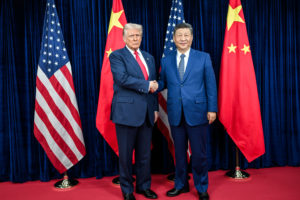
On 4th December 2025 the Donald Trump administration released the new National Security Strategy (NSS) of the United States of America. The document, which constitutes the primary roadmap of security and foreign policy, outlining national interests, addressing threats and defining strategic priorities, may provide some reference points for understanding Trump’s vision of international affairs. What are the key takeaways on Asia?
- Asia: a top priority after homeland
The new NSS hails Asia as the top US foreign policy priority. It is only preceded by the Western Hemisphere, which exerts direct impact on the US homeland security as the principal source of direct threats related to drugs and migration. NSS recognises Asia, also interchangeably referred to as the Indo-Pacific, as the central place in today’s global economic and geopolitical dynamics, stating that America’s domination there underpins prosperity “at home”. The document reiterates the US commitment to maintaining a free and open Indo-Pacific, but it is clear this pledge must, in the first place, serve the US national interests, and cannot eclipse the goal of rebalancing trade relations in the US’ favour. America’s approach towards Asia is defined largely through the prism of economic interests, which can be identified as a central thread throughout the entire NSS.
- China: between economic competition and engagement
The NSS voices criticism of the previous administrations’ approach to China. It states that promoting its integration into the global economy has led to the current trade imbalance. The new strategy and its language signal a departure from former policy. While the previous Trump and Biden administrations positioned China as a political and military contender, eroding international order and American security, this NSS lacks the “great power competition” tone and frames Beijing mainly as an economic competitor. The 2025 NSS is the first since 1988 not addressing democracy or human rights issues. One of the main objectives of Trump’s Asia policy will certainly be to reconfigure the “unbalanced” economic relations with China, with decoupling in areas critical to national security, such as rare earth elements, as a key tenet. The NSS, however, leaves room for engagement with Beijing to “maintain genuinely mutually advantageous economic relationship”.
- Taiwan and the First Island Chain: deterrence
Besides reducing the current trade deficit with China, the US strategy in Asia will concentrate on deterring a conflict over Taiwan and other parts of the First Island Chain. In contrast to the previous documents, the new NSS does not explicitly mention the “one China” policy, just stating the US commitment to the “longstanding declaratory policy” of not supporting any unilateral changes to the status quo in the Taiwan Strait. The importance of preventing a conflict over the island, mentioned for the first time as a priority, stems from its semiconductor industry and strategic location, including its proximity to key sea lines of communication. There is a clear strategic focus on securing the First Island Chain, evidenced by four references to it – the first occurrence of such mentions in an NSS. The US aims to achieve this by maintaining a favourable balance of military power – here the document heralds close defence and military cooperation with allies, noting “the American military cannot, and should not have to, do this alone”. The new national strategy remains silent on North Korea, potentially implying a deprioritisation of the issue.
- Allies: defence build-ups and trade balance
The NSS mentions America’s network of alliances as one of the strategic assets, echoing the longstanding view that partnerships enhance US security. Trump’s administration stresses its willingness to develop them, but concurrently emphasises restraining free-riding and trade imbalances. The new NSS treats Asian allies in a softer way than the European partners, sparing them criticism about economic decline, censorship or “prospect of civilizational erasure”. Trump will, however, keep putting pressure on Asian allies and partners, including Japan, Australia, Taiwan and South Korea, to ramp up military expenditure and develop capabilities reinforcing regional deterrence. The NSS assigns partners in the Indo-Pacific a crucial role in curbing China’s economic influence, and even suggests that Trump may seek to integrate Asian allies into a unified economic bloc. The document mentions Australia, Japan, South Korea, Taiwan, the Quad format (the US, Japan, India, Australia) and India, outlining the need for its greater contribution to Indo-Pacific security, but leaves out the Philippines and the AUKUS partnership (Australia, the UK, the US).
Jakub Witczak Project Coordinator at the Boym Institute. Student of international relations at the University of Warsaw. Member of the Forum of Young Diplomats and founder of the Student Association of Pacific Area States. Research areas include transatlantic security, international security in the Indo-Pacific, international military relations, security policy of Japan, Taiwan, Sino-American relations and history of Asia-Pacific.


Więcej informacji na temat: newslettera, polityki prywatności serwisu
czytaj więcej
Takaichi’s Historic Election Win: What’s Next for Japan?
In the Japanese snap election on 8th February 2026, Prime Minister Sanae Takaichi’s Liberal Democratic Party (LDP) achieved a landslide victory, securing 316 out of 465 seats in the lower house of parliament. What does this supermajority mean for Takaichi and Japan?
Jakub WitczakThe North Korean nuclear dismantlement and the management of its nuclear wastes
Evidence suggests that North Korea stores its high-level nuclear waste (HLW) in liquid form in tanks on the same site where it is made, and has not invested in infrastructure to reduce, dentrify, or vitrify this waste. However, this is just the tip of the iceberg, one of many aspects of the North Korean nuclear waste problem.
Nicolas LeviThe Boym Institute contribution to the Transcultural Caravan project
We are pleased to announce, that our analysts and contributors are among authors of the newest publication - "European Perspectives on the New Silk Roads – A Transcultural Approach".
Central Asia. The winding road to regional integration
The aim of the paper is to present the current stage of integration among the Central Asian republics and to analyze directions and dynamics of this process in the nearest future. This study also attempts to identify factors which can either slow down or strengthen the process of integration as well as its causes and consequences.
Jerzy OlędzkiAsia-Integration – Follow-up Report on Polish Policy Challenges Towards Asian Countries
The debate was the consequence of positive reactions to the open letter that the Boym Institute published in the summer of 2020. Many of its readers pointed out the necessity of broad consultations regarding the principles of the new multidimensional policy in order to reflect the diversity of perspectives, interests and conditions.
Women in Public Debate – A Guide to Organising Inclusive and Meaningful Discussions
On the occasion of International Women's Day, we warmly invite you to read our guide to good practices: "Women in Public Debate – A Guide to Organising Inclusive and Meaningful Discussions."
Ada DyndoAn interview with Mr. Meirzhan Yussupov, Chairman of the Board of the “National Company” KAZAKH INVEST” JSC - Member of the Board of Directors of the Company
Magdalena Sobańska-CwalinaOn conflict in the Middle East: Malik Dahlan’s Letter to President Isaac Herzog
This letter has been included into our Voices From Asia series, as we consider it a significant addition to the ongoing discussion surrounding the ongoing conflict in the Middle East.
Malik DahlanIndian dream – interview with Samir Saran
Krzysztof Zalewski: India is a large country, both in terms of its population and its land area, with a fast-growing economy. It is perceived as a major new player on the global stage. What would the world order look like if co-organized by India? Samir Saran: India’s impact on the world order is already significant, but […]
Krzysztof ZalewskiWorkshop – Liberalism vs authoritarianism: political ideas in Singapore and China
We cordially invite you to a workshop session “Liberalism vs authoritarianism: political ideas in Singapore and China”. The workshop is organized by Patrycja Pendrakowska and Maria Kądzielska at the Department of Philosophy, University of Warsaw on ZOOM.
Peace is a precondition for LiFE. How systemic conflicts endanger developmental goals
The G20 can play a pivotal role in dealing with the mounting global challenges by proposing policy coordination and solutions disincentivising armed conflicts.
Krzysztof ZalewskiDr. Nicolas Levi with a lecture in Seoul
On May 24 Dr. Nicolas Levi gave a lecture on Balcerowicz's plan in the context of North Korea. The speech took place as part of the seminar "Analyzing the Possibility of Reform and its Impact on Human Rights in North Korea". The seminar took place on May 24 at the prestigious Yonsei University in Seoul, South Korea.
Meeting with Dr. Uki Maroshek-Klarman
It’s a great pleasure for the Boym Institute to organize an open meeting with dr Uki Maroshek who founded the betzavta method. Betzavta is taught across the globe at the Adam Institute for Democracy and Peace in Jerusalem as well as in other institutions in Europe and the Middle East.
In the first part of this analysis of Ulaanbaatar’s winning 2040 General Development Plan Conception (GDPC) I look into the historical preconditions for the city’s planned development as well as present the legislative climate in which works on Ulaanbaatar’s future development strategies have recently found themselves.
Paweł SzczapCoronavirus (COVID-19) outbreak and emerging contractual claims
With China one of the key players in the global supply chain, supplying major manufacturing companies with commodities, components and final products, the recent emerging outbreak of Coronavirus provides for a number of organizational as well as legal challenges.
Interview: Why Does Poland Need ‘17+1’?
Interview with Michał Wójcik - Director of the Department of International Cooperation of the Ministry of Marine Economy and Inland Navigation (DWM MGMiŻŚ). In the Ministry, he is leading the Coordinating Secretariat for Maritime Issues , monitoring the cooperation of Central and Eastern European States with China.
Krzysztof ZalewskiSearching for Japan’s Role in the World Amid the Russia-Ukraine War
The G7 Hiroshima Summit concluded on May 21 with a communiqué reiterating continued support for Ukraine in face of Russia’s illegal war of aggression. Although Japan was perceived at the onset of the war as reluctant to go beyond condemning Russia at the expense of its own interests, it has since become one of the leading countries taking action during the war.
Rintaro NishimuraBook review: “Europe – North Korea. Between Humanitarianism And Business?”
Book review of "Europe – North Korea. Between Humanitarianism And Business?", written by Myung-Kyu Park, Bernhard Seliger, Sung-Jo Park (Eds.) and published by Lit Verlag in 2010.
Nicolas LeviShort summary of events at the Boym Institute
We want the Boym Institute to become a valuable platform of exchanging views, making valuable acquaintances and, above all, deepening knowledge. Therefore, we undertake the organization of many events: debates, lectures, and conferences.
Foreign Direct Investment in Vietnam
Thanks to continuous economic development, Vietnam attracts a record number of Foreign Direct Investment (FDI). The catalyst for such a strong growth of FDI in Vietnam is not only the ongoing trade war between the US and China, but also new international agreements.
Jakub KrólczykEurope and the Consequences of China’s First Step on the Moon
Just a few years ago, it was assumed that the United States would almost automatically reclaim the lead in landing on the Moon. The original timeline envisioned Artemis III for 2024, but successive delays pushed the mission first to 2025–2026 and now to no earlier than mid-2027.
Kamil GolemoBook review: “Unveiling the North Korean economy”
Book review of "Unveiling the North Korean economy", written by Kim Byung-yeon and published by Cambridge University Press in 2016.B. Tauris in 2017.
Nicolas LeviThe Boym Institute message to Chinese policymakers and analysts
The EU-China relations require common perspective on Russia’s invasion on Ukraine
Patrycja Pendrakowska as a founding member of the WICCI’s India-EU Business Council
By sharing knowledge, business opportunities, and best practices the Council generates awareness of women's contributions in developing the India-EU relations.