
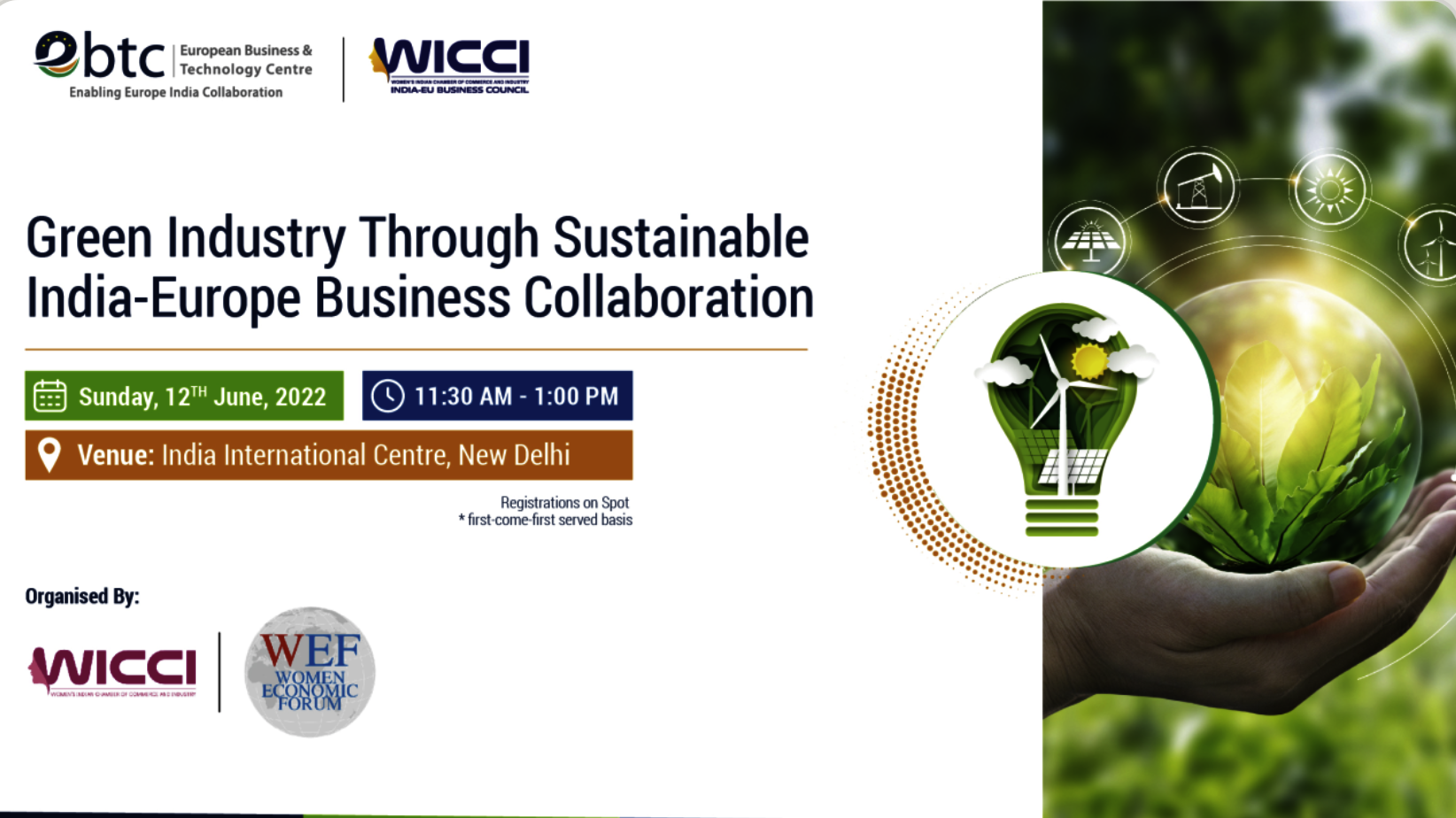
European businesses along with their technology and innovation have a crucial role to play in achieving industry transition required to meet India’s objective to become CarbonNeutral by 2070.
This panel, part of the Women Economic Forum (WEF) on ‘Cohesive & Sustainable World in the Era of Digital’, organised by WICCI – Women’s Indian Chamber of Commerce and Industry, brings experts from the Europe-India Business Corridor. It seeks to analyse the emerging role of collaborations between the two regions to combat climate change and recent policies in India in line with COP26.
The interactive discussion covers recent projects and collaborations which have contributed to a greener economy in India. It takes a practical approach to highlight how European businesses can create demand-driven value in India and the role of gender equality to create a long-term sustainability.
Speakers
1. Dr. Ajai Garg, Senior Director, Ministry of Electronics & Information Technology
2. Ms. Patrycja Pendrakowska, President of the Boym Institute
3. Ms. Shalini Sharma, Founder Director of Global Institute for Circular Economy & SDGs, Co-Founder and CEO of Sanshodhan
4. Ms. Priti Srivastava, Senior Vice President, Public Affairs, Reliance Industries, Founder of DayaRani
5. Mr. Dr. Muralee Thummarukudy, Director, G20 Global Initiative, UNCCD
Moderated by: Ada Dyndo

Więcej informacji na temat: newslettera, polityki prywatności serwisu
czytaj więcej
Short summary of events at the Boym Institute
We want the Boym Institute to become a valuable platform of exchanging views, making valuable acquaintances and, above all, deepening knowledge. Therefore, we undertake the organization of many events: debates, lectures, and conferences.
Foreign Direct Investment in Vietnam
Thanks to continuous economic development, Vietnam attracts a record number of Foreign Direct Investment (FDI). The catalyst for such a strong growth of FDI in Vietnam is not only the ongoing trade war between the US and China, but also new international agreements.
Jakub KrólczykTakaichi’s Historic Election Win: What’s Next for Japan?
In the Japanese snap election on 8th February 2026, Prime Minister Sanae Takaichi’s Liberal Democratic Party (LDP) achieved a landslide victory, securing 316 out of 465 seats in the lower house of parliament. What does this supermajority mean for Takaichi and Japan?
Jakub WitczakBook review: “Korean Diaspora in Postwar Japan – Geopolitics, Identity and Nation-Building”
Book review of "Korean Diaspora in Postwar Japan - Geopolitics, Identity and Nation-Building", written by Kim Myung-ja and published by I.B Tauris in 2017.
Nicolas LeviThe Boym Institute message to Chinese policymakers and analysts
The EU-China relations require common perspective on Russia’s invasion on Ukraine
India, China and the Shades of Grey
"We are at an inflection point in this century. Many of our traditional arrangements are failing. To achieve stability in this century we need to discover new solutions" - Interview with Samir Saran - Senior Fellow and Vice President at the Observer Research Foundation
Krzysztof ZalewskiInterview: Why Does Poland Need ‘17+1’?
Interview with Michał Wójcik - Director of the Department of International Cooperation of the Ministry of Marine Economy and Inland Navigation (DWM MGMiŻŚ). In the Ministry, he is leading the Coordinating Secretariat for Maritime Issues , monitoring the cooperation of Central and Eastern European States with China.
Krzysztof ZalewskiBorder conflicts as political tools: the Thailand–Cambodia crisis
The border conflict between Thailand and Cambodia is much more than just a territorial dispute. Rooted in historical ambiguities, it has become a tool for domestic political maneuvering in both countries and a stage for international strategic competition.
Andżelika SerwatkaThe strategic imperatives driving ASEAN-EU free trade talks: colliding values as an obstacle
Recently revived talks aimed at the conclusion of an inter-regional free trade agreement between the Association of Southeast Asian Nations (ASEAN) and the European Union (EU) are driven by strategic imperatives of both regions.
Robin RamcharanFrom ‘strategic engagement’ to ‘competition’. Interview with William Yu
Ewelina Horoszkiewicz in conversation with Professor William Yu (UCLA) on USA, China and Europe. Professor William Yu is an economist with the UCLA Anderson Forecast and specializes in the economies of Los Angeles and China.
Ewelina HoroszkiewiczRoman Catholic cemetery in Harbin (1903-1958)
First burials of Catholics, mostly Poles but also other Non-Orthodox believers took place in future Harbin in the so called small „old” or later Pokrovskoe Orthodox cemetery in the future European New Town quarter and small graveyards at the military and civilian hospitals of Chinese Eastern Railway at the turn of XIX and XX century.
Jerzy CzajewskiInterview with Uki Maroshek-Klarman on “Betzavta” method
Interview with Uki Maroshek-Klarman - Academic Director of the Adam Institute for Democracy and Peace in Israel. Founder of "Betzavta" method, which was created with intention of streghtening people's participation in society and making conflicts easier to solve.
Patrycja ZdybelSearching for Japan’s Role in the World Amid the Russia-Ukraine War
The G7 Hiroshima Summit concluded on May 21 with a communiqué reiterating continued support for Ukraine in face of Russia’s illegal war of aggression. Although Japan was perceived at the onset of the war as reluctant to go beyond condemning Russia at the expense of its own interests, it has since become one of the leading countries taking action during the war.
Rintaro NishimuraCoronavirus and climate policies: long-term consequences of short-term initiatives
As large parts of the world are gradually becoming habituated to living in the shadow of the coronavirus pandemic, global attention has turned to restarting the economy. One of the most consequential impacts of these efforts will be that on our climate policies and environmental conditions.
Dawid JuraszekAre Polish Universities Really Victims of a Chinese Influence Campaign?
The Chinese Influence Campaign can allegedly play a dangerous role at certain Central European universities, as stated in the article ‘Countering China’s Influence Campaigns at European Universities’, (...) However, the text does ignore Poland, the country with the largest number of universities and students in the region. And we argue, the situation is much more complex.
Patrycja ZdybelOnline Course: “Feminism and Democracy: a Deep Dive”
The course will be taught via interactive workshops, employing the Adam Institute’s signature “Betzavta – the Adam Institute’s Facilitation Method“, taught by its creator, Dr. Uki Maroshek-Klarman. The award-winning “Betzavta” method is rooted in an empirical approach to civic education, interpersonal communication and conflict resolution.
This is the second part of an inquiry into Ulaanbaatar’s winning 2040 General Development Plan Conception (GDPC). In this part of paper, I look into some of the plans and/or solutions proposed in Ulaanbaatar’s 2040 GDPC.
Paweł SzczapThe Global Waste Trade: Unveiling Waste Colonialism in Southeast Asia
Although 19th-century colonialism may seem like a relic of the past, the global community continues to grapple with its modern counterparts, often referred to as neo-colonialism.
Andżelika SerwatkaThe countries of the Indochinese Peninsula are struggling with the problem of the deteriorating state of the Mekong River, which scientists and publicists are increasingly boldly describing as an ecological disaster. Alongside climate change, existing hydropower plants and those under construction in China and Laos are among the greatest threats. These ventures deepen the regional dispute over a river crucial to communities of tens of millions of people.
Jakub KamińskiThe Adam Institute invites you to join us for a new engaging course, tailored to participants from Poland, taught on ZOOM.
Young Indo-Pacific: Forward-looking perspectives on the EU Indo-Pacific Strategy
The Boym Institute, working with other think tanks, organizes panel discussions on topics related to the European Union's Indo-Pacific strategy
Book review: “Unveiling the North Korean economy”
Book review of "Unveiling the North Korean economy", written by Kim Byung-yeon and published by Cambridge University Press in 2016.B. Tauris in 2017.
Nicolas LeviBeyond Grey Hulls: Europe’s Role in “Crowdsourcing” Maritime Domain Awareness in the South China Sea
If developments observed in the South China Sea over the recent months are of any indication, it simply means that the situation has worsened. China’s continued aggression towards its neighbors – the Philippines and Vietnam in particular, has continued unabated.
Collin KohThe Boym Institute message to Indian policymakers and analysts
India’s current position towards the Russian invasion on Ukraine may damage its reputation as a major force of peace in the world