
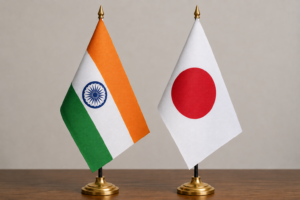
Japanese Prime Minister Sanae Takaichi visited New Delhi from 1-3 July 2026 for the 16th India-Japan Annual Summit; this visit followed Indian Prime Minister Narendra Modi’s visit to Tokyo for the 15th India-Japan Annual Summit in August 2025. The primary focus of Prime Minister Takaichi’s visit was to advance bilateral economic cooperation and finalize several key trade and investment agreements. The summit further reaffirmed the three priority pillars of the India-Japan partnership: (a) defense and security cooperation; (b) economic partnership, including economic security, energy resilience, technology, and innovation; and (c) people-to-people exchanges.
During the summit, India and Japan signed several agreements aimed at enhancing bilateral economic cooperation and the overall Special Strategic and Global Partnership. In the past year alone, more than 120 Memoranda of Understanding (MoUs) have been signed between the two countries. At this summit, Japan has also announced plans to invest ₹1 trillion (equivalent to $10.5 billion USD, calculated at ₹95.2 per dollar during early August 2026) across multiple sectors, including business, connectivity, infrastructure development, science and technology cooperation, artificial intelligence, and innovation. Furthermore, both countries reiterated and agreed on developing joint projects and initiatives in defense, energy, science and technology, and infrastructure sectors, including progress on the UNICORN defense project, JIMEX naval exercises, maritime domain awareness, and connectivity projects in Northeast India, among others.
However, beyond the bilateral agreements, this summit raises a more important question considering changing global geopolitical dynamics, including US-China relations and strategic rivalry, regional security challenges of the Indo-Pacific, among others, because nearly one month after the May 2026 US-China bilateral summit in Beijing, Washington quietly reinstated the US Pacific Command (USPACOM) designation, reverting to the pre-2018 name. This was a significant signal. The Indo-Pacific framing and geopolitical notion have long been opposed by Beijing, which views it as a strategic construct designed to encircle China. The US decision to step back from that label has put the notion of the Indo-Pacific on the defensive, raising uncomfortable questions about Washington’s long-term commitment to the framework. Moreover, how the US’s allies, especially Japan, would react to Washington’s stance on the Indo-Pacific and the future of the Quad is another important question.
The question is particularly urgent right now. It is worth recalling that India and Japan were the original architects of the Indo-Pacific concept, especially when Japanese Prime Minister Shinzo Abe made a historical “Confluence of two seas” speech in the Indian Parliament in 2007, arguing that the security challenges of one region (either the Pacific or the Indian Ocean region) affect the other part of the region due to the interconnectedness of maritime trade routes. The concept of the Indo-Pacific was born out of the India-Japan strategic convergence, and it is no coincidence that its future now depends significantly on how these two countries choose to sustain, adapt, and champion it.
In this regard, in the 16th India-Japan annual summit, there was comparatively less focus on the Indo-Pacific narrative by both governments and especially in the media, as opposed to the overwhelming emphasis and focus on the Indo-Pacific narrative in the last 10 years.
Is Quad still relevant?
Hence, the question of whether the Quad will become fully functional in the future, and what the future of the Indo-Pacific and the Quad partnership will look like, has become more pressing. Regarding this, India and Japan discussed broader global issues and the changing geopolitical dynamics of the Indo-Pacific region, especially concerns related to supply chain resilience; maritime security challenges in the South China and East China Seas; energy security; connectivity in Northeast India and its linkages with the wider Indo-Pacific region; and both leaders have reiterated the importance of strengthening the Quad framework in these areas of key strategic priority. Another question at this point is whether the Quad is relevant or actively functioning. The answer to this question would be both ‘yes‘ and ‘no.’
Yes, because all four Quad countries, including the US, Australia, Japan, and India, continue to view the Quad as an important platform for addressing common security challenges and advancing shared strategic priorities in the Indo-Pacific region.
No, because despite regular leaders’ meetings, ministerial dialogues, maritime exercises, and some progress in supply chain resilience and other initiatives, the Quad has not yet delivered any major institutional or strategic outcomes. Therefore, it would be fair to argue that the Quad is still evolving and has not yet become a fully functional strategic framework.
One of the most important players in the Quad is the US, and the US reinstatement of the Pacific Command nomenclature seems like a policy reversal. Whether this policy reversal should be interpreted as a genuine accommodation of China’s interests or merely a tactical strategic repositioning by the United States in the Pacific remains to be seen in the coming years.
One can argue that the US decision to reinstate the name Pacific Command might be a signal of accommodating China’s interests in the Indo-Pacific region, particularly because China has been opposed to the concept of the Indo-Pacific and the Quad framework. On the other hand, one can also argue that the reinstatement of the Pacific Command name reflects the US’s core strategic focus on the Pacific region and its attempt to avoid strategic distractions by expanding its focus to other areas, including the Indian Ocean Region. When the US renamed Pacific Command as Indo-Pacific Command in 2018, analysts such as Van Jackson argued the shift was a folly that would invite disaster. This could be based on the assumption that US-China rivalry will intensify in the future, leading to greater strategic competition and tensions; therefore, the US may be seeking to avoid unnecessary strategic distractions.
India, Japan, and the Indo-Pacific vision
However, since India and Japan are the original architects of the Indo-Pacific concept, they have a responsibility to keep this vision alive, regardless of whether their allies continue to support it. If the US, in the process of accommodating Chinese strategic interests, chooses to deviate from the Indo-Pacific narrative, India and Japan must remain committed to their shared goal. Their partnership was the foundation of this idea, and they must continue to pursue it to ensure their common vision for the region is not lost to the shifting priorities of others.
Furthermore, it is important to look at how strategic ideas evolve. Between 2000 and 2013, India and Japan often centered their cooperation around the idea of an ‘Asian Century,’ but that narrative was largely replaced by the broader Indo-Pacific framework after 2017-2018. Having made this shift, both nations must now avoid strategic impatience. For the Indo-Pacific vision to succeed, New Delhi and Tokyo must commit to it for at least the next few decades, ensuring the concept takes deep root rather than being abandoned for the next new trend.
Nevertheless, returning to the Quad, its relevance can still be maintained if there is sufficient political will among its members. Even if, hypothetically, the United States attempts to accommodate China, there remains significant strategic distrust between Washington and Beijing. Consequently, power dynamics and the security dilemma in the Indo-Pacific are likely to continue evolving.
Therefore, the Quad framework is likely to evolve over time rather than disappear. The common and overlapping interests of the Quad countries, including maritime and transnational security, economic security and prosperity, critical minerals, critical and emerging technologies, resilient supply chains, and humanitarian assistance and disaster response, will continue to provide a strong foundation for cooperation. This India-Japan Annual Summit also highlights the continuing importance of the Quad. Both countries reiterated their commitment to strengthening cooperation within the Quad framework and reaffirmed their support for holding the next Quad Leaders’ Summit.
In my view, as long as regional security challenges posed by both state and non-state actors continue to exist, and as long as the Quad countries continue to share overlapping strategic interests, cooperation within this framework will continue. Whether that cooperation is high or low intensity will depend on prevailing geopolitical circumstances, strategic priorities, and political necessity. At times, we may witness deeper and more active cooperation, while at other times, cooperation may appear limited. However, the Quad is unlikely to disappear because the member countries will continue to face common strategic challenges and security threats, including conventional and non-conventional maritime security challenges, maintaining supply chain resilience, and the hegemonic rise of China, among others, in the Indo-Pacific region.

Nihar Kulkarni is a PhD scholar of international relations at the Faculty of Political Science and International Studies, University of Warsaw, Poland. His PhD thesis examines “the evolution of India’s strategic partnership with Japan in the Indo-Pacific region since 2007." His research areas include India’s foreign policy and national security, geopolitics of the Indo-Pacific region, great power politics, strategic partnerships, and alliance frameworks. His work primarily examines evolving strategic and geopolitical dynamics in Asia and the broader international system.


Więcej informacji na temat: newslettera, polityki prywatności serwisu
czytaj więcej
Women in Public Debate – A Guide to Organising Inclusive and Meaningful Discussions
On the occasion of International Women's Day, we warmly invite you to read our guide to good practices: "Women in Public Debate – A Guide to Organising Inclusive and Meaningful Discussions."
Ada DyndoThe Global Waste Trade: Unveiling Waste Colonialism in Southeast Asia
Although 19th-century colonialism may seem like a relic of the past, the global community continues to grapple with its modern counterparts, often referred to as neo-colonialism.
Andżelika SerwatkaBorder conflicts as political tools: the Thailand–Cambodia crisis
The border conflict between Thailand and Cambodia is much more than just a territorial dispute. Rooted in historical ambiguities, it has become a tool for domestic political maneuvering in both countries and a stage for international strategic competition.
Andżelika SerwatkaBook review: “Europe – North Korea. Between Humanitarianism And Business?”
Book review of "Europe – North Korea. Between Humanitarianism And Business?", written by Myung-Kyu Park, Bernhard Seliger, Sung-Jo Park (Eds.) and published by Lit Verlag in 2010.
Nicolas LeviPeace is a precondition for LiFE. How systemic conflicts endanger developmental goals
The G20 can play a pivotal role in dealing with the mounting global challenges by proposing policy coordination and solutions disincentivising armed conflicts.
Krzysztof ZalewskiWe would like to inform, that Observer Research Foundation has published article of Patrycja Pendrakowska - the Boym Institute Analyst and President of the Board.
Patrycja ZdybelAdam Institute for Democracy & Peace – Crowdfunding Campaign December 2020
Democracy in Israel is in crisis. And if we don't educate for democracy, it just won't exist. It's that simple. The actual teaching of democracy, on the other hand, isn't so simple. It requires experience, theoretical and practical knowledge and the flexibility to adapt to our ever-changing reality.
A Story of Victory? The 30th Anniversary of Kazakh Statehood and Challenges for the Future.
On 25 May 2021, the Boym Institute, in cooperation with the Embassy of the Republic of Kazakhstan, organised an international debate with former Polish President Aleksander Kwaśniewski (1995-2005).
The New Trilateral Axis in Asia: What the Pakistan-Saudi-Türkiye Pact Means for India
On 7 August 2026, Pakistan, Saudi Arabia, and Türkiye jointly entered into a defence alliance, known as the ‘Mecca Joint Defence Agreement'. Under this pact, an attack on any one of the three countries would be considered an attack on all three, and accordingly, the three countries would provide each other with the necessary defence support.
Nihar KulkarniWorkshop – Liberalism vs authoritarianism: political ideas in Singapore and China
We cordially invite you to a workshop session “Liberalism vs authoritarianism: political ideas in Singapore and China”. The workshop is organized by Patrycja Pendrakowska and Maria Kądzielska at the Department of Philosophy, University of Warsaw on ZOOM.
Interview with Uki Maroshek-Klarman on “Betzavta” method
Interview with Uki Maroshek-Klarman - Academic Director of the Adam Institute for Democracy and Peace in Israel. Founder of "Betzavta" method, which was created with intention of streghtening people's participation in society and making conflicts easier to solve.
Patrycja ZdybelThe North Korean nuclear dismantlement and the management of its nuclear wastes
Evidence suggests that North Korea stores its high-level nuclear waste (HLW) in liquid form in tanks on the same site where it is made, and has not invested in infrastructure to reduce, dentrify, or vitrify this waste. However, this is just the tip of the iceberg, one of many aspects of the North Korean nuclear waste problem.
Nicolas LeviPaweł Behrendt for 9DASHLINE: The South China Sea – from colonialism to the Cold War
We would like to inform, that 9DASHLINE has published article of Paweł Behrendt - the Boym Institute Analyst, in which he wrote about history of the South China Sea dispute over the 20th century.
Paweł BehrendtIndonesia – between religion and democracy
Indonesia is the largest Muslim democracy in the world. Approximately 88% of the population in Indonesia declares Islamic religion, but in spite of this significant dominance, Indonesia is not a religious state.
Anna GrzywaczVoices from Asia – introduction
We would like to cordially invites all to the new series "Voices from Asia" that is devoted to the Asian perspectives on the conflict in Ukraine. In this series, we publish analysis by experts based in Asia or working on Asian affairs who present their positions on this matter.
Book review: “Unveiling the North Korean economy”
Book review of "Unveiling the North Korean economy", written by Kim Byung-yeon and published by Cambridge University Press in 2016.B. Tauris in 2017.
Nicolas LeviWe would like to inform, that Observer Research Foundation has published article of Krzysztof Zalewski - the Boym Institute Analyst, Chairman of the Board and Editor of the “Tydzień w Azji” weekly.
Krzysztof ZalewskiNew Female Prime Minister Faces Thailand’s Political Turmoil
Thailand, known for military coups, political downfalls, and dashed democratic hopes, has a new Prime Minister. Paetongtarn Shinawatra is not only the youngest elected Prime Minister in the country's history and the second woman to hold this post, but she is also a member of the Shinawatra political dynasty.
Andżelika SerwatkaThe Boym Institute contribution to the Transcultural Caravan project
We are pleased to announce, that our analysts and contributors are among authors of the newest publication - "European Perspectives on the New Silk Roads – A Transcultural Approach".
From ‘strategic engagement’ to ‘competition’. Interview with William Yu
Ewelina Horoszkiewicz in conversation with Professor William Yu (UCLA) on USA, China and Europe. Professor William Yu is an economist with the UCLA Anderson Forecast and specializes in the economies of Los Angeles and China.
Ewelina HoroszkiewiczIndia, China and the Shades of Grey
"We are at an inflection point in this century. Many of our traditional arrangements are failing. To achieve stability in this century we need to discover new solutions" - Interview with Samir Saran - Senior Fellow and Vice President at the Observer Research Foundation
Krzysztof ZalewskiLessons for China and Taiwan from the war in Ukraine
The situation of Taiwan and Ukraine is often compared. The logic is simple: a democracy is threatened by a repressive, authoritarian regime making territorial claims and denying it the right to exist.
Paweł BehrendtPatrycja Pendrakowska as a founding member of the WICCI’s India-EU Business Council
By sharing knowledge, business opportunities, and best practices the Council generates awareness of women's contributions in developing the India-EU relations.
Transcultural Winter School 2021 (8th of November — 12th of November)
This year’s research project TSRG 2021 as a collaborative initiative between Leadership Excellence Institute Zeppelin and the Boym Institute continued with a Transcultural Winter School in Zeppelin University, in Friedrichshafen.