
By Nihar Kulkarni & Dr. Uday Patil
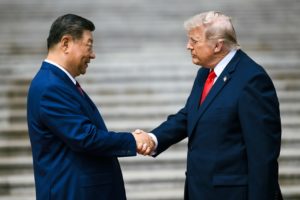
The US and China held a bilateral summit on the 13th and 14th of May 2026 in Beijing. The visit was attended by the presidents of both countries, accompanied by the top business leaders, particularly from the American side. By all outward appearances, it was considered a significant diplomatic moment in the history of US-China relations. Readouts from both governments suggest that they have multiple economic agreements and discussed strategic issues of mutual interest. However, something else happened at this summit that deserves far more attention than the agreements themselves.
As the US delegation departed China, footage circulated in the media showing American officials throwing away all the gifts, electronic devices, and souvenirs they had received from the PRC. The reason, according to media reports, is straightforward: due to the high risk of surveillance and digital espionage through electronic devices, the US delegation had decided not to carry a single item or use their own personal devices during the entire visit.
This scenario tells something else about the visit: on one hand, two heads of state shaking hands, business leaders smiling for cameras, and agreements being signed. And on the other hand, behind all of it, a delegation is so distrustful of its host that it discarded every gift upon leaving.
This detail deserves more analytical attention than any agreement signed in the room. It is not a footnote. It is the story. The media, strategic policy circles, and academic commentators have been flooded with speculation since the talks. Some argued that a G-2 is likely to emerge, a new concert of great powers between Washington and Beijing. Others warn of Cold War 2.0. At this moment, it is genuinely difficult to explain or predict the most likely scenario. But one thing is clear: both parties fundamentally lack confidence in one another. The distrust is deep, structural, and mutual. The image of discarded gifts is not a minor detail; it is a window into the actual state of the relationship.
This is why it is unlikely to see the formation of a G-2 so easily. There will be some economic cooperation between these two great powers because trade is too intertwined, supply chains too enmeshed, and mutual dependence too entrenched for a clean rupture. Hence, both will have to cooperate, but this cooperation will exist alongside innumerable geopolitical and strategic frictions. The summit is evidence of both simultaneously.
What we are witnessing, then, is not Cold War 2.0 in a simple sense. It is the return of Cold War logic, but with different characteristics. The original Cold War had its own architecture: ideological blocs, proxy conflicts, and arms races with clear adversaries. This one is different. Two economies are deeply integrated. Two powers that need each other even as they fundamentally distrust each other. The Cold War is at our doorstep, but it will not look like the previous one.
Though multiple media reports and strategic commentaries suggest that the summit was unsuccessful and could not achieve desired outcomes such as accommodating each other’s strategic interests; however, nearly one month after that, on 16th June 2026, the US government made a decision to restore the US Pacific Command (USPACOM) designation, reverting to the pre-2018 designation. This reverse approach by the US could be seen as a milestone in accommodating China’s strategic interests in the region, as we are aware that China has long opposed the notion of the ‘Indo-Pacific’ and ‘QUAD’. Whether this signals genuine accommodation or tactical repositioning, the structural distrust revealed at the airport shows that the answer is more likely the latter.
This phase will be full of recalibration of foreign policy and national security priorities by great powers, and broader changes in global politics. For the world at large, the priority must be improving economic, strategic, and institutional resilience at the domestic level. States cannot afford to be structurally dependent on either pole in a world where great powers are simultaneously competing and cooperating with each other.
For small states, three principles matter above all. First, respect geography, whether you are closer to the US, China, or any other great power; be pragmatic with your neighbours and respect the realities of your geographic position. Second, cultivate regional multilaterals and people-to-people contact, academic exchanges, cultural ties, and joint development projects, because trust built on the ground will prove more durable than any formal agreement on paper. And third, build resilience at home: structural development, stronger institutions, and more capable national systems, so that in times of crisis, countries can absorb the shock.
The US-China summit of May 2026 will be studied for years. Yet the most revealing part of the meeting was not what was signed in the conference room. It was what was thrown away at the airport. That simple act captured the reality of the relationship more clearly than any joint statement. Behind the smiles and handshakes, distrust remains the defining feature of US-China relations, and that leaves little room for optimism about the future.
Nihar Kulkarni is a PhD researcher in International Relations at the University of Warsaw. He writes on the geopolitics of the Indo-Pacific region, great power politics, and India’s foreign and national security policy.
Uday Patil completed his Ph.D. at the Department of Geopolitics and International Relations, Manipal Academy of Higher Education (MAHE), Manipal, where he was a Dr. T. M. A. Pai Doctoral Fellow. His doctoral research focused on post-Cold War American policy-making towards China. His research interests include U.S. grand strategy, U.S.–China relations, and great power competition in the Indo-Pacific. Dr. Patil has published in Strategic Analysis (MP-IDSA), STSF, East Asia Forum, and The Hindu.
Nihar Kulkarni is a PhD scholar of international relations at the Faculty of Political Science and International Studies, University of Warsaw, Poland. His PhD thesis examines “the evolution of India’s strategic partnership with Japan in the Indo-Pacific region since 2007." His research areas include India’s foreign policy and national security, geopolitics of the Indo-Pacific region, great power politics, strategic partnerships, and alliance frameworks. His work primarily examines evolving strategic and geopolitical dynamics in Asia and the broader international system.


Więcej informacji na temat: newslettera, polityki prywatności serwisu
czytaj więcej
Book review: “Europe – North Korea. Between Humanitarianism And Business?”
Book review of "Europe – North Korea. Between Humanitarianism And Business?", written by Myung-Kyu Park, Bernhard Seliger, Sung-Jo Park (Eds.) and published by Lit Verlag in 2010.
Nicolas LeviOpportunities and challenges of India’s G20 Presidency
Ada Dyndo conducts an interview with Shairee Malhotra on India’s role in G20. Shairee Malhotra serves as a Coordinator of the T20 India Taskforce on Reformed Multilateralism for India’s G20 presidency.
Ada DyndoAre “Climate Refugees” (Just) About Climate?
As the awareness of the scale and pervasiveness of climate impacts on human societies keeps rising, so does the frequency with which the terms “climate refugees” and “climate migrants” are being used in the public discourse “to describe those who are being displaced due to adverse consequences related to climate change” (Atapattu, 2020).
Dawid Juraszek“May you be the mother of a thousand sons” – the status of women in Indian society
The 1950 Indian Constitution introduced the principle of equal opportunities for gender equality, which grants women and men the same rights in family life, political, social and economic life. So why is it that nearly forty per cent of girls aged 15-17 do not attend school, the custom of dowry giving is still cultivated and prenatal sex selection is still a huge social problem?
Magdalena RybczyńskaAssessing the New U.S. National Security Strategy: Key Takeaways on Asia
On 4th December 2025 the Donald Trump administration released the new National Security Strategy (NSS) of the United States of America. What are the key takeaways on Asia?
Jakub WitczakPatrycja Pendrakowska as a participant of Women Economic Forum (WEF) in India
The interactive discussion covers recent projects and collaborations which have contributed to a greener economy in India
At the Boym Institute we are coming out with new initiative: #WomeninBoym, which aims to show the activity of this – often less visible – half of society. We will write about what women think, say and do. We will also publicise what women are researching and writing.
Meeting with Dr. Uki Maroshek-Klarman
It’s a great pleasure for the Boym Institute to organize an open meeting with dr Uki Maroshek who founded the betzavta method. Betzavta is taught across the globe at the Adam Institute for Democracy and Peace in Jerusalem as well as in other institutions in Europe and the Middle East.
We would like to inform, that Observer Research Foundation has published article of Patrycja Pendrakowska - the Boym Institute Analyst and President of the Board.
Patrycja ZdybelThe Global Waste Trade: Unveiling Waste Colonialism in Southeast Asia
Although 19th-century colonialism may seem like a relic of the past, the global community continues to grapple with its modern counterparts, often referred to as neo-colonialism.
Andżelika SerwatkaTaiwanese Perceptions of Russia’s Ukraine war
Since the invasion of Ukraine, the Taiwanese government remained committed to its position of condemnation for Russia, humanitarian support for Ukraine, and deep appreciation and admiration for the Ukrainian people’s will to defy power, resist aggression, and defend their nation.
Kuan Ting ChenThe unification of the two Koreas: an ASEAN perspective
The aim of the paper is to discuss the role of the ASEAN as a critical component of the solution to the Korean unification. The Korean Unification refers to the potential reunification of both Koreas into a single sovereign Korean state led by the leadership of the two Koreas.
Nicolas LeviThe link between EU Aid and Good Governance in Central Asia
Nowadays all the CA states continue transitioning into the human-centered model of governance where the comprehensive needs of societies must be satisfied, nevertheless, the achievements are to a greater extent ambiguous.
Online Course: “Educational tools for addressing the effects of war”
The Adam Institute for Democracy and Peace is offering “Betzavta” facilitators, middle school and high school educators, social activists, communal activists and those assisting refugees an online seminar to explore educational issues related to wartime.
Central Asia. The winding road to regional integration
The aim of the paper is to present the current stage of integration among the Central Asian republics and to analyze directions and dynamics of this process in the nearest future. This study also attempts to identify factors which can either slow down or strengthen the process of integration as well as its causes and consequences.
Jerzy OlędzkiNuclear Temptations in an Age of Uncertainty
For decades, the pursuit of weapons of mass destruction was largely confined to rogue and authoritarian regimes. Today, the discussion increasingly includes U.S. allies, signaling a profound shift in global security dynamics
Paweł BehrendtPolish women do not often become the heroines of media reports in Central Asia. In February 2020, however, it was different. The story of Agnieszka Pikulicka-Wilczewska, a journalist, "heated up" the headlines of local news portals. More importantly, "between the lines" she talked a lot about contemporary Uzbekistan and the role of women in politics.
Magdalena Sobańska-CwalinaBook review: “North Korean Defectors in a New and Competitive Society”
Book review of "North Korean Defectors in a New and Competitive Society", written by Lee Ahlam - assistant professor in the Department of Educational Leadership and Human Resource Development at Xavier University Cincinnati, Ohio.
Nicolas LeviInterview with Arthur Tun on Myanmar’s Coup d’État
On the 1st of February 2021, Myanmar’s military forces overthrew the government and arrested the Prime Minister, Aung San Suu Kyi. On the fifth anniversary of these events, the Boym Institute decided to ask what Myanmar looks like after the coup.
Paweł MazurekA letter from the Adam Institute in Jerusalem
This letter is part of our series on the Voices from Asia. We share our platform with Dr. Uki Maroshek-Klarman who serves as the Executive Director at the Adam Institute for Democracy and Peace in Jerusalem, Israel.
Uki Maroshek-KlarmanAn “Asian NATO”: Chances and perspectives
The Russian invasion of Ukraine has reinvigorated NATO. Can the Chinese pressure on its neighbours, especially Taiwan, create an Asian equivalent of NATO?
Paweł BehrendtOn conflict in the Middle East: Malik Dahlan’s Letter to President Isaac Herzog
This letter has been included into our Voices From Asia series, as we consider it a significant addition to the ongoing discussion surrounding the ongoing conflict in the Middle East.
Malik DahlanInterview with Uki Maroshek-Klarman on “Betzavta” method
Interview with Uki Maroshek-Klarman - Academic Director of the Adam Institute for Democracy and Peace in Israel. Founder of "Betzavta" method, which was created with intention of streghtening people's participation in society and making conflicts easier to solve.
Patrycja ZdybelCoronavirus and climate policies: long-term consequences of short-term initiatives
As large parts of the world are gradually becoming habituated to living in the shadow of the coronavirus pandemic, global attention has turned to restarting the economy. One of the most consequential impacts of these efforts will be that on our climate policies and environmental conditions.
Dawid Juraszek