
OPEN CALL
Transcultural Student Research Group 2021
The Impacts of the BRI on Europe: The Case of Poland and Germany in cooperation with The Boym Institute
Looking for a topic for your Humboldt, Elinor Ostrom, Bachelor or Master Thesis?
Interested in thinking about “The Impacts of the Belt and Road Initiative in Europe”?
Keen on cooperation with international peers?
Motivated to become part of the LEIZ’ project “Transcultural Caravan” and to join an interdisciplinary research group?
Can’t wait to publish your first chapter in a scientific book?
If you answered at least two of these questions with “yes”, we look forward to receiving your application! For further information on the application process, please see the corresponding section in this document.
Transcultural Student Research Group | TSRG 2021
The Impacts of the Belt and Road Initiative on Europe: The Case of Poland and Germany
As an ambitious project, the Belt and Road Initiative creates global value chains in a network that connects Europe, Asia, and Africa and that is characterised by diversity in languages, traditions, values, as well as political, social, and economic systems and settings. As one of the most fascinating and risky developments driving the formation of a global society, this initiative represents a global economic, political, social, and cultural experiment with potentially beneficial but also potentially disruptive consequences for all involved.
Against this background, it is important to contribute to the understanding of what the New Silk Road can mean in economic, political, leadership and cultural terms for the European countries involved. This analysis should reveal the practical consequences of the Belt and Road Initiative for Europe in the case of Poland and Germany, as well as their respective social effects.
The following topics are possible for the sub-research projects:
- Economic impacts: international economy, business, logistic & transportation, innovation & technology, the impacts of COVID-19, international trade and investment, global value chains, value creation networks.
- Socio-cultural impacts: transculturality, gender equality, arts, academia, media & communication, civil society organizations.
- Political impacts: geopolitical impacts, bilateral relations vs. multilateral relations, 17+1, EU policy, para-diplomacy.
- Leadership: relational leadership, transcultural leadership, cross-sectoral leadership, organization and management culture.
Timeframe
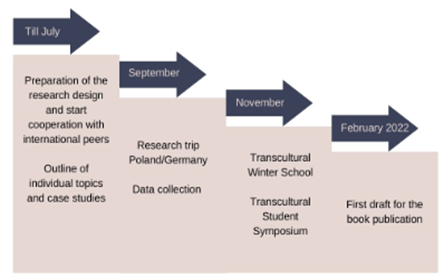
Starting in May, all TSRG 2021 participants will conceptually develop specific research questions that correlate both with their disciplinary background and with the TSRG 2021 overall research topic, together with experts at LEIZ and The Michał Boym Institute for Asian and Global Studies, as well as individual supervisors (ZU professors). Subsequently, the students will work on these questions together with students from Poland in an academic co-authoring process.
Accordingly, the group consists of several such pairs, who apply the common questions to their respective case studies and disciplines and exchange on their experiences and findings within the group. The case study research includes interviews and field research realized in the pairs and in cooperation with local universities and cooperation partners.
First results of the studies may be presented during the Transcultural Winter School 2021. After having submitted their individual Humboldt, Elinor Ostrom, Bachelor or Master theses, a joint book from all involved students will be published in the “Transcultural Management Series” at Metropolis Publisher.
Application
Interested Polish students from all study programs are welcome and can apply for the TRSG until April 12,2021. To apply for the TRSG 2021, please send an email with your CV and Cover Letter to the Head of the Michał Boym Institute for Asian and Global Studies Patrycja Pendrakowska (ppendrakowska@instytutboyma.org). Please take into consideration that for working on this research project you should reserve around 10 hours per week and be able to take part in research trips to Germany and Poland. We welcome Bachelor and Master students, as well as PhD Candidates.
Team

Jessica Geraldo Schwengber
Research fellow at “Transcultural Competences“ Research Group, Project Manager of the Transcultural Caravan
Leadership Excellence Institute Zeppelin | LEIZ
Phone +49 7541 6009 2265
Fax +49 7541 6009 1299
jessica.schwengber@zu.de

Dr Julika Baumann Montecinos
Head of Research Group “Transcultural Competences”, Project Manager of the Transcultural Caravan
Leadership Excellence Institute Zeppelin | LEIZ
Phone +49 7541 6009 2264
Fax +49 7541 6009 1299
julika.montecinos@zu.de

Prof Dr Josef Wieland, Vice President (Research)
Director Leadership Excellence Institute Zeppelin | LEIZ
Chair of Institutional Economics, Organisational Governance, Integrity Management and Transcultural Leadership
Phone +49 7541 6009 2261
Fax +49 7541 6009 1299
josef.wieland@zu.de

Katharina Hahn
Project coordinator
k.hahn@zeppelin-university.net
Patrycja Pendrakowska
Head of the Boym Institute
ppendrakowska@instytutboyma.org
Paweł Behrendt
Member of the Board at the Boym Institute
pbehrendt@instytutboyma.org
For further information:
www.zu.de/leiz
www.transcultural-caravan.org

Więcej informacji na temat: newslettera, polityki prywatności serwisu
czytaj więcej
Patrycja Pendrakowska made it to the Top 40 under 40 Europe-India leaders list
#EuropeIndia40, an initiative of EICBI, covers the stories of leaders below the age of 40 and their contributions to promoting EU India / UK India relations.
Women in Public Debate – A Guide to Organising Inclusive and Meaningful Discussions
On the occasion of International Women's Day, we warmly invite you to read our guide to good practices: "Women in Public Debate – A Guide to Organising Inclusive and Meaningful Discussions."
Ada DyndoThe North Korean nuclear dismantlement and the management of its nuclear wastes
Evidence suggests that North Korea stores its high-level nuclear waste (HLW) in liquid form in tanks on the same site where it is made, and has not invested in infrastructure to reduce, dentrify, or vitrify this waste. However, this is just the tip of the iceberg, one of many aspects of the North Korean nuclear waste problem.
Nicolas LeviSmiles, Handshakes, and Suspicion: What the US-China Summit Really Tells Us
The US and China held a bilateral summit on the 13th and 14th of May 2026 in Beijing. The visit was attended by the presidents of both countries, accompanied by the top business leaders, particularly from the American side.
Nihar KulkarniTakaichi’s Historic Election Win: What’s Next for Japan?
In the Japanese snap election on 8th February 2026, Prime Minister Sanae Takaichi’s Liberal Democratic Party (LDP) achieved a landslide victory, securing 316 out of 465 seats in the lower house of parliament. What does this supermajority mean for Takaichi and Japan?
Jakub WitczakSan Zhong Zhanfa or Three Warfares. Chinese Hybrid Warfare
Cognitive operations are becoming an increasingly significant and common element of non-kinetic military operations. States and other political players deliberately manipulate the way their actions, those of their allies and those of their adversaries are perceived by the governments and societies of other international players.
Paweł BehrendtThe strategic imperatives driving ASEAN-EU free trade talks: colliding values as an obstacle
Recently revived talks aimed at the conclusion of an inter-regional free trade agreement between the Association of Southeast Asian Nations (ASEAN) and the European Union (EU) are driven by strategic imperatives of both regions.
Robin RamcharanAdam Institute for Democracy & Peace – Crowdfunding Campaign December 2020
Democracy in Israel is in crisis. And if we don't educate for democracy, it just won't exist. It's that simple. The actual teaching of democracy, on the other hand, isn't so simple. It requires experience, theoretical and practical knowledge and the flexibility to adapt to our ever-changing reality.
We would like to inform, that Observer Research Foundation has published article of Krzysztof Zalewski - the Boym Institute Analyst, Chairman of the Board and Editor of the “Tydzień w Azji” weekly.
Krzysztof ZalewskiPolish-Asian Cooperation in the Field of New Technologies – Report
Polish and Polish-founded companies are already on the largest continent in sectors such as: IT, educational technology, finance, marketing, e-commerce and space. Despite this, the potential lying dormant in the domestic innovation sector seems to be underutilized.
Online Course: “Conflict Resolution and Democracy”
The course will be taught via interactive workshops, employing the Adam Institute’s signature “Betzavta – the Adam Institute’s Facilitation Method“, taught by its creator, Dr. Uki Maroshek-Klarman. The award-winning “Betzavta” method is rooted in an empirical approach to civic education, interpersonal communication and conflict resolution.
Globalization of business, education and China: interview with prof. Chiwen Jevons Lee
Interview of Ewelina Horoszkiewicz with prof. Chiwen Jevons Lee on China on globalization of Chinese business education and his thoughts of China’s role in the global marketplace.
Ewelina HoroszkiewiczWICCI’s India-EU Business Council – a new platform for women in business
Interview with Ada Dyndo, President of WICCI's India-EU Business Council and Principal Consultant of European Business and Technology Centre
Ada DyndoInterview: Why Does Poland Need ‘17+1’?
Interview with Michał Wójcik - Director of the Department of International Cooperation of the Ministry of Marine Economy and Inland Navigation (DWM MGMiŻŚ). In the Ministry, he is leading the Coordinating Secretariat for Maritime Issues , monitoring the cooperation of Central and Eastern European States with China.
Krzysztof ZalewskiNot only tests and masks: the history of Polish-Vietnamese mutual helpfulness
On the initiative of the Vietnamese community in Poland and Vietnamese graduates of Polish universities, our country received support from Vietnam - a country that deals with the threat posed by Sars-Cov-2 very effectively.
Grażyna Szymańska-MatusiewiczHow to deal with gender-based segregation?
Interview on the project Supporting the Economic Empowerment of Afghan Women through Education and Training in Kazakhstan and Uzbekistan. Magdalena Sobańska-Cwalina and Krzysztof M. Zalewski (The Boym Institute) in discussion with: Yakup Beris, Johannes Stenbaek Madsen, Maria Dotsenko, Gulnar Smailova,
Zespół Instytutu BoymaAn interview with Mr. Meirzhan Yussupov, Chairman of the Board of the “National Company” KAZAKH INVEST” JSC - Member of the Board of Directors of the Company
Magdalena Sobańska-CwalinaPeace and development as the call of our day again face severe challenges on a global scale, with more prominent instability, uncertainty and complexity
Yiwei WangBorder conflicts as political tools: the Thailand–Cambodia crisis
The border conflict between Thailand and Cambodia is much more than just a territorial dispute. Rooted in historical ambiguities, it has become a tool for domestic political maneuvering in both countries and a stage for international strategic competition.
Andżelika SerwatkaVoices from Asia – introduction
We would like to cordially invites all to the new series "Voices from Asia" that is devoted to the Asian perspectives on the conflict in Ukraine. In this series, we publish analysis by experts based in Asia or working on Asian affairs who present their positions on this matter.
Transcultural Winter School 2021 (8th of November — 12th of November)
This year’s research project TSRG 2021 as a collaborative initiative between Leadership Excellence Institute Zeppelin and the Boym Institute continued with a Transcultural Winter School in Zeppelin University, in Friedrichshafen.
Searching for Japan’s Role in the World Amid the Russia-Ukraine War
The G7 Hiroshima Summit concluded on May 21 with a communiqué reiterating continued support for Ukraine in face of Russia’s illegal war of aggression. Although Japan was perceived at the onset of the war as reluctant to go beyond condemning Russia at the expense of its own interests, it has since become one of the leading countries taking action during the war.
Rintaro NishimuraAfter the darkness of the Cultural Revolution, the times of the Chinese transformation had come. In 1978, Deng Xiaoping realised the need to educate a new generation of leaders: people proficient in science, management and politics. Generous programmes were created that aimed at attracting back to China fresh graduates of foreign universities, young experts, entrepreneurs and professionals.
Ewelina HoroszkiewiczKyrgyzstan on the Path to Political Stabilisation
On 10 January, early presidential elections were held in Kyrgyzstan, following the resignation of the incumbent, President Zheenbekov. The atmosphere in which the vote was conducted remained tense. This had been the case since the results of the October elections were announced, in which the opposition grouping failed to win a single parliamentary seat.
Jerzy Olędzki