
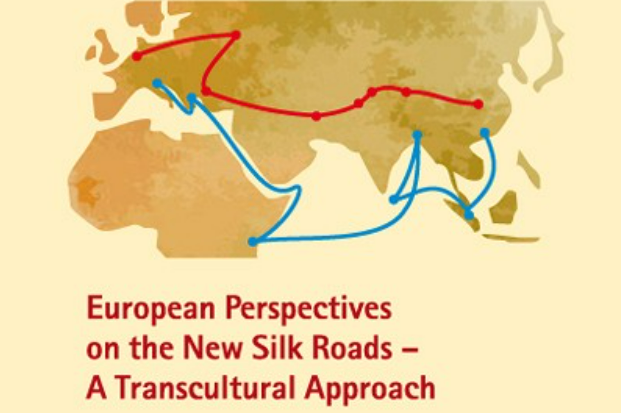
We are pleased to announce, that our analysts and contributors are among authors of the newest publication made possible by Transcultural Caravan project – “European Perspectives on the New Silk Roads – A Transcultural Approach“.
We encourage you to check out works of Patrycja Pendrakowska, Paweł Behrendt, Sandra Krawczyszyn, Patryk Szczotka and many other scholars and young researchers who took part in this project.
Click HERE for more information.

Więcej informacji na temat: newslettera, polityki prywatności serwisu
czytaj więcej
The Boym Institute message to Chinese policymakers and analysts
The EU-China relations require common perspective on Russia’s invasion on Ukraine
Online Course: “Conflict Resolution and Democracy”
The course will be taught via interactive workshops, employing the Adam Institute’s signature “Betzavta – the Adam Institute’s Facilitation Method“, taught by its creator, Dr. Uki Maroshek-Klarman. The award-winning “Betzavta” method is rooted in an empirical approach to civic education, interpersonal communication and conflict resolution.
Are Polish Universities Really Victims of a Chinese Influence Campaign?
The Chinese Influence Campaign can allegedly play a dangerous role at certain Central European universities, as stated in the article ‘Countering China’s Influence Campaigns at European Universities’, (...) However, the text does ignore Poland, the country with the largest number of universities and students in the region. And we argue, the situation is much more complex.
Patrycja ZdybelKyrgyzstan on the Path to Political Stabilisation
On 10 January, early presidential elections were held in Kyrgyzstan, following the resignation of the incumbent, President Zheenbekov. The atmosphere in which the vote was conducted remained tense. This had been the case since the results of the October elections were announced, in which the opposition grouping failed to win a single parliamentary seat.
Jerzy OlędzkiPatrycja Pendrakowska as a founding member of the WICCI’s India-EU Business Council
By sharing knowledge, business opportunities, and best practices the Council generates awareness of women's contributions in developing the India-EU relations.
Dr. Nicolas Levi with a lecture in Seoul
On May 24 Dr. Nicolas Levi gave a lecture on Balcerowicz's plan in the context of North Korea. The speech took place as part of the seminar "Analyzing the Possibility of Reform and its Impact on Human Rights in North Korea". The seminar took place on May 24 at the prestigious Yonsei University in Seoul, South Korea.
Foreign Direct Investment in Vietnam
Thanks to continuous economic development, Vietnam attracts a record number of Foreign Direct Investment (FDI). The catalyst for such a strong growth of FDI in Vietnam is not only the ongoing trade war between the US and China, but also new international agreements.
Jakub KrólczykIndian Roundtable – Poland’s Challenges and Opportunities in the Subcontinent
In recent years, India has been the fastest growing among the major countries' economies in the world. (...) In the coming decades, the Subcontinent's largest country may remain one of the pillars of global economic growth. This is one of the reasons why the country is already the most popular destination for Polish foreign investment in the Asian-Pacific region.
How China uses its narratives on the Russo-Ukrainian war to court the Global South
Three years after Russia’s full-scale invasion of Ukraine, it is entirely clear that this conflict has irrevocably changed the geopolitical landscape both in Europe and beyond and its repercussions will be felt far beyond the battlefield for years to come.
Konrad SzattersWe would like to inform, that Observer Research Foundation has published article of Patrycja Pendrakowska - the Boym Institute Analyst and President of the Board.
Patrycja ZdybelRisk and oppportunities for self-driving vehicles. Exploring global regulations and security challenges in the future of connected vehicles. The report was co-produced by Boym Institute and 9DASHLINE.
Saudi ‘Vision 2030’. How the Kingdom is using oil to end its economic overdependence on oil.
With the advent of clean energy technologies the Saudis realize they need to end their economic dependency on oil. ‘Vision 2030’ is a vast and complex plan that seeks to preserve Saudi Arabia’s regional power, economic prosperity, and - not the least - authoritarian rule in the post-oil future.
Jan KosińskiCharitable activities of the Vietnamese in Poland: their scope and sources
The scale of assistance provided to medics by the Vietnamese community during the 2020 pandemic inspires admiration and gratitude. It stems from the sense of belonging to Poland and deeply rooted in the culture order to help those in need and repay the debt incurred at the time when they themselves needed such help.
Ewa GrabowskaPatrycja Pendrakowska as a participant of Women Economic Forum (WEF) in India
The interactive discussion covers recent projects and collaborations which have contributed to a greener economy in India
Guidance for Workplaces on Preparing for Coronavirus Spread
Due to the spread of coronavirus, the following workplace recommendations have been issued by the Ministry of Development, in cooperation with the Chief Sanitary Inspector. We also invite you to read article about general information and recommendations for entrepreneurs.
Peace is a precondition for LiFE. How systemic conflicts endanger developmental goals
The G20 can play a pivotal role in dealing with the mounting global challenges by proposing policy coordination and solutions disincentivising armed conflicts.
Krzysztof ZalewskiOnline Course: “Conflict Resolution and Democracy”
The course will be taught via interactive workshops, employing the Adam Institute’s signature “Betzavta – the Adam Institute’s Facilitation Method“, taught by its creator, Dr. Uki Maroshek-Klarman. The award-winning “Betzavta” method is rooted in an empirical approach to civic education, interpersonal communication and conflict resolution.
Coronavirus and climate policies: long-term consequences of short-term initiatives
As large parts of the world are gradually becoming habituated to living in the shadow of the coronavirus pandemic, global attention has turned to restarting the economy. One of the most consequential impacts of these efforts will be that on our climate policies and environmental conditions.
Dawid JuraszekLessons for China and Taiwan from the war in Ukraine
The situation of Taiwan and Ukraine is often compared. The logic is simple: a democracy is threatened by a repressive, authoritarian regime making territorial claims and denying it the right to exist.
Paweł BehrendtBook review: “Europe – North Korea. Between Humanitarianism And Business?”
Book review of "Europe – North Korea. Between Humanitarianism And Business?", written by Myung-Kyu Park, Bernhard Seliger, Sung-Jo Park (Eds.) and published by Lit Verlag in 2010.
Nicolas LeviAssessing the New U.S. National Security Strategy: Key Takeaways on Asia
On 4th December 2025 the Donald Trump administration released the new National Security Strategy (NSS) of the United States of America. What are the key takeaways on Asia?
Jakub WitczakThe strategic imperatives driving ASEAN-EU free trade talks: colliding values as an obstacle
Recently revived talks aimed at the conclusion of an inter-regional free trade agreement between the Association of Southeast Asian Nations (ASEAN) and the European Union (EU) are driven by strategic imperatives of both regions.
Robin RamcharanPatrycja Pendrakowska made it to the Top 40 under 40 Europe-India leaders list
#EuropeIndia40, an initiative of EICBI, covers the stories of leaders below the age of 40 and their contributions to promoting EU India / UK India relations.
Searching for Japan’s Role in the World Amid the Russia-Ukraine War
The G7 Hiroshima Summit concluded on May 21 with a communiqué reiterating continued support for Ukraine in face of Russia’s illegal war of aggression. Although Japan was perceived at the onset of the war as reluctant to go beyond condemning Russia at the expense of its own interests, it has since become one of the leading countries taking action during the war.
Rintaro Nishimura