
About the authors
Krinal Shah Suri is Director of Global Affairs and International Cooperation at the Chamber of Commerce and Industry in Katowice, a Member of the Board of the United Nations Association Poland, and Head of India Relations. Her work focuses on advancing international partnerships, strengthening economic diplomacy and fostering cross-border cooperation, with particular emphasis on trade, investment, economic security and strategic engagement across global markets.
Krzysztof M. Zalewski, PhD, is President of the Michał Boym Institute for Asian and Global Studies in Warsaw. His work focuses on India, international relations and the economic and technological transformations shaping Asia. He previously held positions at the European Union Agency for Fundamental Rights (2014–2016), the Chancellery of the President of Poland (2010–2014), the Chancellery of the Polish Sejm (2009–2010), and the Centre for Eastern Studies in Warsaw (2009). He is an alumnus of the Bucerius Summer School on Global Governance (2012) and the Marshall Memorial Fellowship (2011).
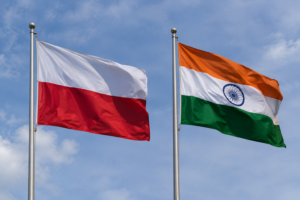
The Polish Prime Minister’s visit to India on 21–23 October opened new opportunities for cooperation in railways, defence, space technology, mining, healthcare and beyond. Realising this potential will require sustained political engagement, closer institutional collaboration and a stronger Polish business presence in India.
Sixteen years after his previous visit to India as prime minister in 2010, Donald Tusk returned in October 2026 to a changed economic landscape. Both countries had become substantially larger economies, with more sophisticated industries and greater international ambitions, creating new opportunities for cooperation. The business delegation of around 85 companies accompanying him and meetings in New Delhi and Bengaluru reflected this shift, highlighting the private sector’s role in turning political engagement into concrete business opportunities.
Tusk’s talks in India gave practical direction to the strategic partnership launched in 2024, when Indian Prime Minister Narendra Modi travelled to Poland. The long-term impact of Tusk’s diplomatic and business mission will depend on effective follow-up: translating memoranda into viable projects, turning investment commitments into operational ventures, and embedding cooperation across government institutions, businesses, research organisations, think tanks and regional authorities.
- Sixteen years of change
Economic expansion has given Poland and India a stronger foundation for cooperation. Both now have larger domestic markets, greater investment capacity and more resources to pursue their international ambitions.
| Nominal GDP, current US dollars | 2010 | 2013 | 2019 | 2026 forecast |
| Poland | $478 billion | $518 billion | $603 billion | $1.13 trillion |
| India | $1.68 trillion | $1.86 trillion | $2.84 trillion | $4.15 trillion |
Historical figures: World Bank; 2026 projections: IMF, April 2026. Current-dollar comparisons reflect exchange rates and inflation as well as real economic growth.
By the end of 2026, both economies are projected to be more than twice their 2013 size in nominal dollar terms. Poland’s expansion strengthens its economic weight within the European Union, its capacity to contribute to European security and its case for permanent membership of the G20.
India’s much larger economy provides a growing base for technological development, industrial investment and global diplomatic influence. Economic size does not automatically translate into political power, but it gives both countries greater means to pursue their strategic objectives.
For bilateral relations, this creates opportunities that extend beyond trade. Poland and India have more scope to develop technologies together, invest in production and build research partnerships. Their strategic partnership, established in 2024, provides a framework for connecting these economic opportunities with closer political and security cooperation.
Yet economic scale should not be confused with household purchasing power. The 2026 projections put GDP per capita at approximately $31,200 in Poland and $2,750 in India. These national averages conceal substantial internal differences, but they underline why success in India requires attention to affordability, distribution and local production. A vast market does not automatically mean a vast market for products designed and priced for Europe.
This creates a distinctive opportunity. Polish businesses can contribute specialised engineering, manufacturing and technological capabilities. Indian partners can offer complementary expertise, production capacity, access to customers and immense entrepreneurial spirit leading to innovation. According to Inc42’s Indian Unicorn Tracker, 133 Indian start-ups had achieved unicorn status—a valuation of at least $1 billion—by August 2026, underscoring the country’s growing innovation potential. Commercial success of both partners will depend on identifying precisely where these strengths meet a practical need.
- A closer bilateral relationship within a changing European framework
The political foundation was strengthened during Narendra Modi’s visit to Poland in August 2024, when the two countries established a strategic partnership and adopted an action plan for 2024–2028. Tusk’s October visit provided an opportunity to advance its implementation.
This bilateral process is taking place within a broader rapprochement between India and the European Union. Negotiations on the EU–India Free Trade Agreement concluded on 27 January 2026. Importantly, concluding negotiations does not itself bring preferential trading conditions into force: signature, the relevant approval procedures – expected to be finalized by December 2026 – and implementation remain essential. The agreement envisages eliminating or reducing tariffs on more than 96 per cent of EU goods exports to India. Separate negotiations address investment protection and geographical indications.
For Polish companies, the prospective trade agreement provides a reason to prepare early. Businesses need to understand which products will benefit, how rules of origin will apply and what certification or regulatory requirements will remain. Companies already producing in India will face different strategic choices from those planning to export there.
The European agenda also extends beyond trade. The EU and India signed a Security and Defence Partnership in January 2026, covering cooperation in areas including maritime security, defence technology, cyber threats and space. Their Trade and Technology Council provides another channel for engagement on the relationship between commerce, innovation and security. These mechanisms create additional opportunities for Polish institutions and companies to participate in European cooperation with India.
- What Tusk’s visit achieved: government frameworks and business opportunities
At government level, the visit established priorities and proposed mechanisms that could help businesses overcome obstacles. At companies level, it produced initiatives at different stages of maturity. These distinctions matter when assessing what was achieved.
The principal government-to-government outcomes included:
- A target to double bilateral trade by 2030. This gives economic cooperation a measurable objective. Its practical value will depend on identifying the sectors, investments and market-access improvements capable of delivering that growth. A useful assessment should track the composition of trade, the participation of smaller businesses and the development of investment alongside headline turnover.
- A proposed Defence Industry Dialogue. Building on the existing defence working group, this could connect political cooperation with industrial partnerships, including technology cooperation, co-development and co-production. The next task is to establish a working format involving companies and officials able to address procurement, technical requirements and implementation.
- Agriculture: reopening channels for practical cooperation. The leaders agreed to resume the bilateral agricultural working group. Its priority should be to address market-access barriers, including certification and sanitary requirements, and identify opportunities in agricultural production, food processing and trade.
- Advanced technologies: connecting research with business. The leaders encouraged collaboration in artificial intelligence, semiconductors, quantum technologies and start-ups. Progress will require sustained partnerships between research institutions and companies, with defined projects, funding and pathways to commercial application.
- Counter-terrorism cooperation. Both sides agreed to strengthen cooperation on counter-terrorism by establishing a dedicated bilateral dialogue to improve information-sharing and coordination in addressing shared security threats.
- Strengthening the framework for sensitive cooperation. Both sides expressed their expectation that an agreement on the mutual protection and exchange of classified information would be signed soon, facilitating sensitive defence and technological cooperation. India has comparable arrangements with partners including Germany, France and the United States, while negotiations with the EU were launched in January 2026. Poland also announced its decision to join the India-led Coalition for Disaster Resilient Infrastructure, supporting a separate agenda of infrastructure resilience.
These government-level initiatives can provide a stronger framework for commercial cooperation by facilitating institutional contacts, building trust and addressing regulatory barriers.
Businesses, in turn, must identify viable projects and find the right partners to deliver them. The company cases below show where Polish capabilities meet Indian demand, how cooperation is taking shape and what further support is needed to turn promising opportunities into lasting business partnerships.
Business partnerships
- Pesa and Jupiter Wagons: passenger mobility and industrial localisation. Their non-binding memorandum provides a framework for exploring passenger rolling stock for India’s metro, regional and intercity markets, including opportunities associated with faster rail travel. The partners bring complementary strengths: Pesa’s passenger-vehicle engineering and Jupiter Wagons’ manufacturing capabilities and experience supplying the Indian railway market.
The partnership could help meet demand for modern passenger trains backed by local manufacturing and maintenance capabilities. For Pesa, local cooperation offers a route into a demanding market; for Jupiter Wagons, it supports expansion into passenger mobility.
The memorandum is an opening stage. Progress will require defined products, technical adaptation, certification, an industrial model and ultimately orders.
- Scanway and Pixxel: optical technology for expanding satellite capabilities. Earth observation is becoming an increasingly important source of information for agriculture, resource management, infrastructure planning and security. Meeting these needs requires specialised optical instruments that deliver reliable imagery and can be integrated into new satellites and larger constellations. This creates opportunities for Polish suppliers to contribute to Indian satellite programmes and jointly serve international customers.
The memorandum signed on 23 October expands an existing relationship that already includes an agreement to supply Earth-observation telescopes. It covers further generations of optical instruments, adaptation to new satellites and constellations, and potential joint projects in international markets. Scanway gains an opportunity to deepen a customer relationship and develop technology alongside it, while Pixxel gains access to complementary optical expertise to support the expansion of its satellite capabilities.
- “Different terrain, different demands”. WB Group: connecting drones and satellite capabilities across different operational geographies. India’s vast territory, high-altitude borders and extensive maritime approaches create requirements that differ from those of Poland and Europe. WB Group has outlined an ambition to make India a drone manufacturing and design hub through the phased transfer of combat-tested technology.
A potential area of cooperation is the need to monitor large, remote areas while retaining the ability to examine developments locally. Satellite imagery can identify areas requiring closer attention, while drones can provide more detailed surveillance and support operational decisions. Combining these capabilities—and, where required, satellite communications—calls for adaptation to terrain, weather, communications coverage and the distances involved.
WB Group’s proposed manufacturing facility in Jhansi, Uttar Pradesh, could provide an industrial base for cooperation around these needs, building on its existing Indian presence and supporting local production and supply chains. For the Polish group, collaboration with Indian partners could offer opportunities to adapt and scale its technologies in a different operational environment. Connecting drones with satellite capabilities represents a potential direction for cooperation.
- TZMO: established experience meeting changing healthcare needs. Poland’s TZMO Group provides an example of sustained Polish business engagement in India, supported by an established manufacturing and commercial presence. Its Indian operations include Bella Premier Happy Hygienecare in Dindigul, Bella India Healthcare in Bengaluru and Bella Trade Healthcare in Mumbai. During Prime Minister Tusk’s visit to Bengaluru in October 2026, the Karnataka Chief Minister welcomed TZMO’s proposed investment of approximately ₹80 crore ($8,5M) in the KIADB Vemgal Industrial Area in Kolar district. The five-acre project is expected to introduce the manufacture of smart adult pads in India and could generate around 1,000 jobs.
The investment could help meet growing demand for products supporting older people, patients and their carers, combining Polish manufacturing experience with local production. Its longer-term potential will depend on accessible distribution, customer awareness, cooperation with healthcare providers and an effective local supply network.
- Infradeep and UMPESL Group: technology and expertise for mining modernisation. Their memorandum aims to foster strategic cooperation through technology transfer, knowledge sharing, innovation and joint mining projects. The potential partnership addresses the need for advanced equipment and operational expertise to improve mine productivity, safety and resource efficiency. It provides a framework for combining technology with local project requirements, although concrete opportunities will depend on identifying suitable mines, defining technical needs and establishing commercially viable projects.
Institutional partnerships
- Chamber of Commerce and Industry in Katowice (RIG Katowice) and Confederation of Indian Industry (CII): helping businesses find partners and navigate unfamiliar markets. Their memorandum aims to strengthen institutional cooperation, promote trade and investment, and facilitate contacts between companies in Poland and India, with opportunities extending to the wider EU market. Its practical value lies in helping businesses identify suitable partners, understand local conditions and reach relevant institutions. For smaller companies in particular, sustained support from business organisations can reduce the time and uncertainty involved in entering a new market.
Results will depend on targeted introductions, sector-specific activities and follow-up beyond initial networking.
- AGH University and IIIT-Bangalore: research capacity behind future business cooperation. Their memorandum covers collaboration in artificial intelligence, quantum technologies and other emerging fields through joint research, academic programmes and educational exchanges. The partnership could help meet the need for specialised expertise and stronger links between research and industrial applications. It can provide a foundation for commercial cooperation when researchers, students and businesses work together on clearly defined technical problems.
MoU’s effectiveness should be judged by joint projects, sustained exchanges and usable research outcomes.
- POLSA and ISRO: building an institutional foundation for space cooperation. Discussions involving the two agencies, Indian space-sector institutions and companies from both countries offer a route towards more structured cooperation. The practical need is to connect specialised technological capabilities with suitable projects, partners and routes to market. Institutional engagement can help companies and researchers understand each other’s space programmes, identify complementary expertise and develop proposals for joint work.
Cooperation’s value will depend on translating these contacts into defined projects, supported by clear responsibilities, funding and sustained coordination.
- The follow-up agenda
These business and institutional partnerships illustrate the opportunities for strengthening Polish–Indian cooperation across several strategic sectors, while also creating a platform for deeper engagement between Poland, India and the wider European Union.
To translate these opportunities into tangible results, it is essential to maintain momentum through structured follow-up activities, institutional coordination and continued dialogue between business communities.
First, give sectoral government working groups a predictable schedule. The general economic cooperation mechanism should provide oversight, while selected sectoral groups handle implementation. Defence, railways, space, healthcare and agriculture would benefit from officials who understand their specific obstacles. Each group should have designated coordinators, a short work programme and a record of unresolved issues and prospective projects. Meetings twice a year, supported by more frequent technical contact, would provide a practical starting point. Businesses should be able to raise problems and receive a clear explanation of who will address them in both countries.
Second, make India a regular participant in Poland’s economic forums. Gatherings such as the European Economic Congress in Katowice, European Congress of SMEs in Katowice and the Economic Forum in Karpacz could support a recurring programme involving Indian companies, state governments and sectoral institutions. Its value would come from continuity: advance preparation of business meetings, participation by relevant decision-makers and subsequent assessment of the projects discussed. Reciprocal Polish engagement in Indian forums should follow the same approach. A regular programme would allow relationships to develop over several years.
Third, organise knowledge transfer between established investors and newcomers. Polish companies already operating in India and Indian enterprises in Poland possess experience that cannot be acquired from a general market briefing: choosing partners, managing production, recruiting staff, building distribution and working with local institutions. A structured programme of confidential roundtables and sector-specific mentoring could make that experience more accessible. Established businesses should help shape its agenda, with clear protection for commercially sensitive information. The objective would be to help new entrants make better decisions and avoid repeatedly learning the same expensive lessons.
Fourth, strengthen cooperation among think tanks. A strategic partnership needs people who can explain developments in each country, assess emerging opportunities and maintain dialogue when political attention shifts elsewhere. Polish and Indian institutions should develop joint research, visiting fellowships and regular discussions with officials and businesses. A modest multi-year programme would be more useful than disconnected conferences. It could examine the ever changing geopolitics impacting business, industrial cooperation, economic security and both European and Indian regulatory frameworks. Trilateral projects with other European partners could also connect bilateral expertise to the wider EU–India agenda.
Fifth, create regular cooperation between Indian states and Polish voivodeships, and between cities. Many decisions affecting an investment are made well below the national level. State and regional authorities, industrial development bodies and municipalities can help connect businesses with land, infrastructure, training institutions and local suppliers. Partnerships should begin with a limited number of practical priorities: an industrial project, a university consortium, vocational training or an urban service challenge. Each should have a coordinator, annual work plan and review of results. This would give regional and municipal cooperation a clearer economic purpose and make it more resilient to changes in political leadership.
From Political Momentum to Shared Results
Prime Minister Narendra Modi’s visit to Poland in 2024 and Prime Minister Donald Tusk’s visit to India in 2026 have created political momentum for a stronger partnership. Its lasting value will depend on whether Poland and India turn that momentum into projects that advance their development and security priorities.
To sustain this momentum, Poland and India should jointly review progress every six months, identifying which projects are advancing, which obstacles require government action and which proposals are no longer commercially viable. This would help direct official support towards projects where it can unlock tangible results.
The opportunity is reciprocal. Polish businesses can help meet India’s development needs while gaining markets, partners and production capabilities. Indian companies can expand their European operations through Poland and draw on its industrial and research expertise. Joint technology development can deepen these gains and give both countries a stronger stake in each other’s success.
Moving towards Polish-Indian strategic interdependence will require institutional continuity, sustained investment and a deeper understanding of each other’s priorities. Engineers must have opportunities to develop solutions together, companies the confidence to commit capital, and institutions the capacity to sustain cooperation between high-level meetings.
The ultimate measure of success will be whether cooperation makes both countries more prosperous, more secure and better equipped to shape their technological future.

Krzysztof Zalewski Analyst on India and Energy. Currently a member of the Board of Directors of the Michal Boym Institute for Asian and Global Studies Foundation and is an editor of the “Tydzień w Azji” weekly (published in cooperation with wnp.pl). As a policy expert, he writes about foreign policy and digital transformations in India and Australia. He previously worked at the European Union Agency for Fundamental Rights in Vienna, at the Foreign Relations Office of the Chancellery of the President of Poland, at the Polish Parliament (Sejm) and at the Centre for Eastern Studies in Warsaw.


Więcej informacji na temat: newslettera, polityki prywatności serwisu
czytaj więcej
India, China and the Shades of Grey
"We are at an inflection point in this century. Many of our traditional arrangements are failing. To achieve stability in this century we need to discover new solutions" - Interview with Samir Saran - Senior Fellow and Vice President at the Observer Research Foundation
Krzysztof ZalewskiBook review: “North Korea’s Cities”
Book review of "North Korea’s Cities", written by Rainer Dormels and published byJimoondang Publishing Company in 2014.
Nicolas LeviPaweł Behrendt for 9DASHLINE: The South China Sea – from colonialism to the Cold War
We would like to inform, that 9DASHLINE has published article of Paweł Behrendt - the Boym Institute Analyst, in which he wrote about history of the South China Sea dispute over the 20th century.
Paweł BehrendtDr. Nicolas Levi with a lecture in Seoul
On May 24 Dr. Nicolas Levi gave a lecture on Balcerowicz's plan in the context of North Korea. The speech took place as part of the seminar "Analyzing the Possibility of Reform and its Impact on Human Rights in North Korea". The seminar took place on May 24 at the prestigious Yonsei University in Seoul, South Korea.
The link between EU Aid and Good Governance in Central Asia
Nowadays all the CA states continue transitioning into the human-centered model of governance where the comprehensive needs of societies must be satisfied, nevertheless, the achievements are to a greater extent ambiguous.
Navigating tomorrow – the significance of Australia’s navy build-up
Australia has recently announced a plan to build the largest fleet since World War II. This move constitutes another step in Canberra's shift of defence strategy and commitment to adapt to the changing security environment.
Jakub WitczakCentral Asia. The winding road to regional integration
The aim of the paper is to present the current stage of integration among the Central Asian republics and to analyze directions and dynamics of this process in the nearest future. This study also attempts to identify factors which can either slow down or strengthen the process of integration as well as its causes and consequences.
Jerzy Olędzki“May you be the mother of a thousand sons” – the status of women in Indian society
The 1950 Indian Constitution introduced the principle of equal opportunities for gender equality, which grants women and men the same rights in family life, political, social and economic life. So why is it that nearly forty per cent of girls aged 15-17 do not attend school, the custom of dowry giving is still cultivated and prenatal sex selection is still a huge social problem?
Magdalena RybczyńskaNew Female Prime Minister Faces Thailand’s Political Turmoil
Thailand, known for military coups, political downfalls, and dashed democratic hopes, has a new Prime Minister. Paetongtarn Shinawatra is not only the youngest elected Prime Minister in the country's history and the second woman to hold this post, but she is also a member of the Shinawatra political dynasty.
Andżelika SerwatkaKyrgyzstan on the Path to Political Stabilisation
On 10 January, early presidential elections were held in Kyrgyzstan, following the resignation of the incumbent, President Zheenbekov. The atmosphere in which the vote was conducted remained tense. This had been the case since the results of the October elections were announced, in which the opposition grouping failed to win a single parliamentary seat.
Jerzy OlędzkiChinese work on the military use of artificial intelligence
Intensive modernization and the desire to catch up with the armed forces of the United States made chinese interest in the military application of futuristic technologies grow bigger.
Paweł BehrendtPolish women do not often become the heroines of media reports in Central Asia. In February 2020, however, it was different. The story of Agnieszka Pikulicka-Wilczewska, a journalist, "heated up" the headlines of local news portals. More importantly, "between the lines" she talked a lot about contemporary Uzbekistan and the role of women in politics.
Magdalena Sobańska-CwalinaDrug and Road Initiative, that is the Silk Road of drug
This paper deals with the issue of drug business in post-Soviet Central Asia, a region that plays a key role in the trafficking of banned substances from Asia (mainly Afghanistan) to Europe. The study briefly presents the areas that make up the picture of drug business in Central Asia, paying attention to production and distribution.
Jerzy OlędzkiPolish-Macanese Artist Duo Presents New Works in Lisbon
Artist couple Marta Stanisława Sala (Poland) and Cheong Kin Man (Macau) will present their latest works in the exhibition “The Wondersome and Peculiar Voyages of Cheong Kin Man, Marta Stanisława Sala and Deborah Uhde”, on view at the Macau Museum of the Macau Scientific and Cultural Centre (CCCM) in Lisbon, from 5 June to 6 July 2025.
We would like to inform, that Observer Research Foundation has published article of Patrycja Pendrakowska - the Boym Institute Analyst and President of the Board.
Patrycja ZdybelAiluna Shamurzaeva – Research Fellow at the Boym Institute
Her research focuses on political economy, migration studies, and international trade. Ailuna, we are more than happy to welcome you to the team!
After the darkness of the Cultural Revolution, the times of the Chinese transformation had come. In 1978, Deng Xiaoping realised the need to educate a new generation of leaders: people proficient in science, management and politics. Generous programmes were created that aimed at attracting back to China fresh graduates of foreign universities, young experts, entrepreneurs and professionals.
Ewelina HoroszkiewiczLessons for China and Taiwan from the war in Ukraine
The situation of Taiwan and Ukraine is often compared. The logic is simple: a democracy is threatened by a repressive, authoritarian regime making territorial claims and denying it the right to exist.
Paweł BehrendtEnvironmental problems transcend not only national borders but also historical periods. And yet debates on the necessary measures and timelines are often constrained by considerations of election cycles (or dynastic successions) in any given country.
Dawid JuraszekThe unification of the two Koreas: an ASEAN perspective
The aim of the paper is to discuss the role of the ASEAN as a critical component of the solution to the Korean unification. The Korean Unification refers to the potential reunification of both Koreas into a single sovereign Korean state led by the leadership of the two Koreas.
Nicolas LeviOnline Course: “Conflict Resolution and Democracy”
The course will be taught via interactive workshops, employing the Adam Institute’s signature “Betzavta – the Adam Institute’s Facilitation Method“, taught by its creator, Dr. Uki Maroshek-Klarman. The award-winning “Betzavta” method is rooted in an empirical approach to civic education, interpersonal communication and conflict resolution.
Coronavirus outbreak in Poland – General information and recommendations for entrepreneurs
Kochański & Partners and the Boym Institute engaged in delivering information about latest after-effects of COVID-19 pandemia, which has begun to spread in Poland during the past days.
Meeting with Dr. Uki Maroshek-Klarman
It’s a great pleasure for the Boym Institute to organize an open meeting with dr Uki Maroshek who founded the betzavta method. Betzavta is taught across the globe at the Adam Institute for Democracy and Peace in Jerusalem as well as in other institutions in Europe and the Middle East.
Internet, cryptocurrencies & blockchains in North Korea
North Korea is considered as a secretive state, but, paradoxically, the country is developing last trend technologies. With prohibitions restricting the flow of money, the country is turning to bitcoin and other cryptocurrencies to finance their programs, instead of coming under new pressure.
Nicolas Levi