
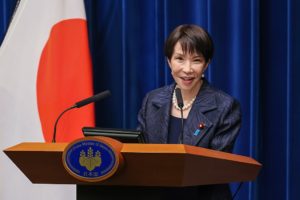
In the Japanese snap election on 8th February 2026, Prime Minister Sanae Takaichi’s Liberal Democratic Party (LDP) achieved a landslide victory, securing 316 out of 465 seats in the lower house of parliament. What does this supermajority mean for Takaichi and Japan?
Landslide victory
On 23rd January, the first Japanese female Prime Minister, Sanae Takaichi, dissolved the House of Representatives (the lower chamber of the Japanese parliament – the National Diet) and called a snap election for 8th February. With this risky move – only three months into her tenure – Takaichi aimed at capitalising on her high popularity to restore an LDP-led majority and take back control of the House. It is worth underlining that the previous two years were politically disastrous for the LDP. Its coalition with Komeito lost majority in the House of Representatives in the October 2024 snap election and majority in the House of Councillors (the upper chamber) in July 2025, marking the first time in the LDP’s 71-year existence that it did not control either of the houses.
Takaichi took a gamble that proved to be a resounding success. After the shortest election campaign in Japan’s post-war history, Takaichi’s LDP won 316 out of 465 seats in the House of Representatives – an increase from 198. Besides being the biggest electoral win in the LDP’s history, this marked the first time in Japanese post-war politics that a single party had won a two-thirds majority. The Prime Minister can also count on the 36 seats that the LDP’s coalition partner, the Japan Innovation Party (JIP), got, further strengthening her position. The LDP and JIP formed a coalition in October 2025 after Komeito broke its 26-year partnership with the LDP. The election, however, was a political catastrophe for the main opposition party. The Centrist Reform Alliance (CRA) – formed in January through the merger of the Constitutional Democratic Party of Japan (CDPJ) and Komeito – saw its representation dramatically reduced from 167 to 49 seats.
Success enablers
The LDP owes its success to a number of factors. First and foremost, it is its leader Prime Minister Sanae Takaichi. Despite her right-wing and, for some, controversial political views, since the very beginning of her tenure, she has enjoyed high public support, long unseen among the LDP leaders, with her cabinet’s approval ratings consistently staying at 60-70%. Takaichi has managed to build a very likeable “cool” image of herself, contrasting with the traditional LDP leader persona of elderly male politicians, as exemplified by her joint drum performance with the South Korean President Lee Jae-myung during their January summit. It has allowed her to refresh the party’s image and to appeal also to young voters. Takaichi’s positive effect on the LDP’s public standing was so big that even 41 out of 43 candidates she endorsed who were involved in the slush funds scandals, which had toppled the party’s power in the two previous elections, won in their constituencies. As Japanese society faces rising prices, it was also Takaichi’s counter-inflation package, including the pledge to suspend the consumption tax, that probably won people over. Although the election results demonstrate clearly the victory of the right-wing camp on the Japanese political spectrum, Takaichi’s conservative views on immigration and social issues – while largely reflecting the Japanese public’s sentiments – should not be overestimated as the decisive variable in this case. The ideological debate played a limited role in the campaign compared to the 2025 election.
Moreover, voters chose the LDP because in times of geopolitical instability and economic hardship they seek strong leadership. Takaichi gets along very well with the US President Donald Trump and can promise relatively stable US-Japan relations. The Prime Minister benefitted equally from the tensions with China stemming from her statement about Japan’s military involvement in a Taiwan contingency. Beijing’s economic and political coercion, coupled with Takaichi’s adamant stance towards China, could have created a “rally-around-the-flag” effect. The opposition’s weakness can also explain the LDP’s tremendous success. The creation of CRA by the Buddhist Komeito and the centre-left CDPJ was meant to offer a viable political alternative to the “right-wing” LDP. However, the sudden pivot towards the centre proved an ill-fated strategy, not only failing to attract new voters but also leaving the traditional base confused over the party’s political platform shift.
Whither with the supermajority?
Sanae Takaichi has been provided with an unprecedented public mandate for governance and legislative power. Her supermajority gives the LDP control of all lower house committees and the option to override the upper chamber’s decisions. This, in turn, means Takaichi can smoothly pursue her political agenda in the Diet, including her “responsible and proactive” fiscal and ambitious security policies, without having to rely on support from other parties.
Already in October 2025 the Japanese Prime Minister signalled the goal of revising the three national security documents (National Security Strategy, National Defence Strategy and Defence Buildup Programme) by December 2026 and elevating the state’s defence expenditure to 2% of GDP by the end of 2025 fiscal year (2 years ahead of the goal set in 2022 by prime minister Fumio Kishida). With the supermajority in the House of Councillors, Takaichi is now well positioned to translate her plans to further strengthen the military capabilities of the Japanese Self-Defence Forces (JSDF) and to implement security reforms into concrete action. Her government is also planning on adopting a first National Intelligence Strategy and establishing a separate intelligence bureau, with a bill to be submitted during the current Diet session. Takaichi’s security policy will also encompass further relaxation of Japan’s three rules on transfer of defence equipment and technology in order to reinforce the domestic defence industry and strengthen Tokyo’s international influence. Continued easing of post-war pacifist regulations and JSDF build-up are meant to elevate Japan’s regional deterrence and assertiveness as the country faces the most severe security environment since World War Two. While improving Japan’s autonomy in its military capabilities, the Prime Minister also wants to demonstrate to the US that Tokyo is investing in the alliance’s burden-sharing.
Most importantly, however, Sanae Takaichi has set her eyes on Article 9 of the Japanese constitution adopted in 1946. LDP has long sought to amend the pacifist clause prohibiting the use of force and the maintenance of armed forces; former prime ministers Shinzo Abe and Fumio Kishida aimed at achieving constitutional revision by 2020 and 2024, respectively. Notwithstanding their political ambitions, the objective remained unrealised under both administrations, constrained by the requirement for a two-thirds majority in parliament. Now Takaichi – wielding the two-thirds power in the lower house – desires to push for the commencement of the revision process to enshrine the legality of the JSDF directly in the constitution. Though she still lacks the two-thirds majority in the House of Councillors and any parliamentary amendment would need to be approved in a national referendum, she can now start the wider debate and preparations from a good footing.
No easy path forward
Despite Takaichi’s strong electoral mandate and supermajority, the path forward with her agenda is not without hurdles. Her bid for constitutional revision could meet opposition even within the LDP, where lawmakers hold differing views on the nature and extent of potential amendments. Furthermore, on the one hand, the Prime Minister wants to bolster public spending and strategic investments. On the other hand, she has proposed to freeze the consumption tax on food and beverages for two years. The International Monetary Fund (IMF) has warned Tokyo that this step could reduce the government’s budget by $32 billion annually. Given Japan’s public debt in 2025 at 230% of GDP and Takaichi’s proactive fiscal policy, questions arise about the feasibility of all her economic policies. Japan’s defence expenditure is also about money – a tighter government budget could force trade-offs and delay the achievement of the 2% of GDP target for defence spending.
Challenges await equally in the foreign policy area. Tokyo and Washington are in the middle of negotiating the details of Japan’s $550 billion investment in the US economy as part of the July 2025 trade deal, while doubts persist among US allies about the reliability of US security guarantees under the Trump administration. On top of that, the worst crisis in Sino-Japanese relations since 2012 following Takaichi’s remarks on Japanese intervention in a Taiwan contingency continues, and in the light of China’s role as an economic partner and as a revisionist power, Takaichi faces the task of cautiously managing tensions with Beijing.
Sanae Takaichi’s popularity and hopes to retake control of the House of Councillors in the 2028 election will hinge on how she addresses these challenges. Following the 2024 and 2025 losses, voices about the end of the LDP grew louder. However, after the 2026 snap election the party could say, quoting the famous words of Mark Twain, “The reports of my death have been greatly exaggerated”. Similarly, one should now refrain from declaring the LDP is back to its full strength. The landslide election win constituted, to a great extent, a “Takaichi success” and the society’s vote of confidence in her leadership style and vision. The upcoming months will show whether she can translate this momentum into long-term political stability and the LDP’s domination.

Jakub Witczak Project Coordinator at the Boym Institute. Student of international relations at the University of Warsaw. Member of the Forum of Young Diplomats and founder of the Student Association of Pacific Area States. Research areas include transatlantic security, international security in the Indo-Pacific, international military relations, security policy of Japan, Taiwan, Sino-American relations and history of Asia-Pacific.


Więcej informacji na temat: newslettera, polityki prywatności serwisu
czytaj więcej
Environmental problems transcend not only national borders but also historical periods. And yet debates on the necessary measures and timelines are often constrained by considerations of election cycles (or dynastic successions) in any given country.
Dawid JuraszekCoronavirus and climate policies: long-term consequences of short-term initiatives
As large parts of the world are gradually becoming habituated to living in the shadow of the coronavirus pandemic, global attention has turned to restarting the economy. One of the most consequential impacts of these efforts will be that on our climate policies and environmental conditions.
Dawid JuraszekPolish-Asian Cooperation in the Field of New Technologies – Report
Polish and Polish-founded companies are already on the largest continent in sectors such as: IT, educational technology, finance, marketing, e-commerce and space. Despite this, the potential lying dormant in the domestic innovation sector seems to be underutilized.
Short summary of events at the Boym Institute
We want the Boym Institute to become a valuable platform of exchanging views, making valuable acquaintances and, above all, deepening knowledge. Therefore, we undertake the organization of many events: debates, lectures, and conferences.
Book review: “Unveiling the North Korean economy”
Book review of "Unveiling the North Korean economy", written by Kim Byung-yeon and published by Cambridge University Press in 2016.B. Tauris in 2017.
Nicolas LeviIndonesia – between religion and democracy
Indonesia is the largest Muslim democracy in the world. Approximately 88% of the population in Indonesia declares Islamic religion, but in spite of this significant dominance, Indonesia is not a religious state.
Anna GrzywaczIn the first part of this analysis of Ulaanbaatar’s winning 2040 General Development Plan Conception (GDPC) I look into the historical preconditions for the city’s planned development as well as present the legislative climate in which works on Ulaanbaatar’s future development strategies have recently found themselves.
Paweł SzczapBook review: “North Korean Defectors in a New and Competitive Society”
Book review of "North Korean Defectors in a New and Competitive Society", written by Lee Ahlam - assistant professor in the Department of Educational Leadership and Human Resource Development at Xavier University Cincinnati, Ohio.
Nicolas LeviInterview with Uki Maroshek-Klarman on “Betzavta” method
Interview with Uki Maroshek-Klarman - Academic Director of the Adam Institute for Democracy and Peace in Israel. Founder of "Betzavta" method, which was created with intention of streghtening people's participation in society and making conflicts easier to solve.
Patrycja PendrakowskaWe would like to inform, that Observer Research Foundation has published article of Patrycja Pendrakowska - the Boym Institute Analyst and President of the Board.
Patrycja PendrakowskaPaths to Asia: Conversations that Inspire
Wojciech Jaworski is the founder of Huqiao Games, a company specializing in bringing PC games to the Chinese market. A graduate of Jagiellonian University and participant in the “Chinese Bridge” program, he is currently working on a new, as yet unannounced project in the gamedev/tech industry.
Patrycja PendrakowskaOnline Course: “Feminism and Democracy: a Deep Dive”
The course will be taught via interactive workshops, employing the Adam Institute’s signature “Betzavta – the Adam Institute’s Facilitation Method“, taught by its creator, Dr. Uki Maroshek-Klarman. The award-winning “Betzavta” method is rooted in an empirical approach to civic education, interpersonal communication and conflict resolution.
The North Korean nuclear dismantlement and the management of its nuclear wastes
Evidence suggests that North Korea stores its high-level nuclear waste (HLW) in liquid form in tanks on the same site where it is made, and has not invested in infrastructure to reduce, dentrify, or vitrify this waste. However, this is just the tip of the iceberg, one of many aspects of the North Korean nuclear waste problem.
Nicolas LeviA letter from the Adam Institute in Jerusalem
This letter is part of our series on the Voices from Asia. We share our platform with Dr. Uki Maroshek-Klarman who serves as the Executive Director at the Adam Institute for Democracy and Peace in Jerusalem, Israel.
Uki Maroshek-KlarmanBook review: “Korean Diaspora in Postwar Japan – Geopolitics, Identity and Nation-Building”
Book review of "Korean Diaspora in Postwar Japan - Geopolitics, Identity and Nation-Building", written by Kim Myung-ja and published by I.B Tauris in 2017.
Nicolas LeviOn conflict in the Middle East: Malik Dahlan’s Letter to President Isaac Herzog
This letter has been included into our Voices From Asia series, as we consider it a significant addition to the ongoing discussion surrounding the ongoing conflict in the Middle East.
Malik DahlanHow China uses its narratives on the Russo-Ukrainian war to court the Global South
Three years after Russia’s full-scale invasion of Ukraine, it is entirely clear that this conflict has irrevocably changed the geopolitical landscape both in Europe and beyond and its repercussions will be felt far beyond the battlefield for years to come.
Konrad SzattersBorder conflicts as political tools: the Thailand–Cambodia crisis
The border conflict between Thailand and Cambodia is much more than just a territorial dispute. Rooted in historical ambiguities, it has become a tool for domestic political maneuvering in both countries and a stage for international strategic competition.
Andżelika SerwatkaWe would like to inform, that Financial Intelligence has published interview for Balkan Development Support with Patrycja Pendrakowska.
Online Course: “Conflict Resolution and Democracy”
The course will be taught via interactive workshops, employing the Adam Institute’s signature “Betzavta – the Adam Institute’s Facilitation Method“, taught by its creator, Dr. Uki Maroshek-Klarman. The award-winning “Betzavta” method is rooted in an empirical approach to civic education, interpersonal communication and conflict resolution.
Voices from Asia – introduction
We would like to cordially invites all to the new series "Voices from Asia" that is devoted to the Asian perspectives on the conflict in Ukraine. In this series, we publish analysis by experts based in Asia or working on Asian affairs who present their positions on this matter.
Searching for Japan’s Role in the World Amid the Russia-Ukraine War
The G7 Hiroshima Summit concluded on May 21 with a communiqué reiterating continued support for Ukraine in face of Russia’s illegal war of aggression. Although Japan was perceived at the onset of the war as reluctant to go beyond condemning Russia at the expense of its own interests, it has since become one of the leading countries taking action during the war.
Rintaro NishimuraPaweł Behrendt for 9DASHLINE: The South China Sea – from colonialism to the Cold War
We would like to inform, that 9DASHLINE has published article of Paweł Behrendt - the Boym Institute Analyst, in which he wrote about history of the South China Sea dispute over the 20th century.
Paweł Behrendt“Green growth” may well be more of the same
Witnessing the recent flurry of political activity amid the accelerating environmental emergency, from the Green New Deal to the UN climate summits to European political initiatives, one could be forgiven for thinking that things are finally moving forward.
Dawid Juraszek