
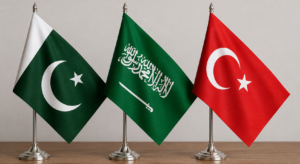
On 7 August 2026, Pakistan, Saudi Arabia, and Türkiye jointly entered into a defence alliance, known as the ‘Mecca Joint Defence Agreement‘. Under this pact, an attack on any one of the three countries would be considered an attack on all three, and accordingly, the three countries would provide each other with the necessary defence support. In the parlance of international relations, this arrangement constitutes a formal alliance, where an attack on any one member is effectively an attack on all. During the Cold War, from 1945 to 1991, several military and defence alliances emerged on the global stage. Examples include the North Atlantic Treaty Organisation (NATO), the Warsaw Pact, the Australia-New Zealand security arrangement, the United States-South Korea alliance, and the US-Japan alliance, among others.
Pakistan is a neighbouring country to India, and both have had a tense bilateral relationship since their inception, due to political issues and Pakistan-sponsored terrorism in the Jammu and Kashmir region. Therefore, a country that has been nurturing terrorism and unleashing it into the territory of India has entered into an alliance framework. Hence, this new trilateral agreement is also likely to have implications for India.
In this context, there are two major possible implications for India:
First, Pakistan may become more confident knowing that two countries are available to provide assistance or defence cooperation in times of crisis. Particularly in the event of an India–Pakistan conflict, India may need to consider the possibility of diplomatic or other forms of support that Pakistan could receive from Saudi Arabia and Türkiye. Over the last decade, India and Pakistan have repeatedly skirted the brink of large-scale conflict. From the 2016 surgical strikes, a direct response to attacks in Poonch and Uri, to the 2019 Balakot airstrikes following the Pulwama tragedy, and the 2025 operations after the Pahalgam killings, India has consistently responded to cross-border provocations with targeted, punitive strikes. The key point here is that India has kept retaliating against the terrorist attacks in the form of small-scale military operations in Pakistan’s territory, destroying terror infrastructure. India is likely to continue similar strikes if Pakistan does not stop sending terrorists across the border and harbouring terrorism in the country. India has also announced that the ‘Operation Sindoor‘ that was launched in May 2025 is continuing, in some form or another. On the other hand, Pakistan has been seeing these strikes as a gross violation of Pakistan’s sovereignty.
Hence, the second implication India likely faces is that if it were to undertake any military action within Pakistani territory in the future, it would have to consider not only Pakistan’s response but also its relations with Saudi Arabia and Türkiye, as they are now in formal military alliances. This is particularly important in the case of Saudi Arabia, with which India has developed cordial and increasingly strategically significant bilateral relations over the past few years. Therefore, India must carefully calibrate its security responses to ensure that military necessity does not create untenable friction with Saudi Arabia and Türkiye.
On the other hand, India’s relations with Türkiye have not been that cordial because of Turkish President Recep Tayyip Erdogan’s close ties and support for Pakistan, along with Türkiye’s overall support for Pakistan on the Jammu and Kashmir issue. Additionally, Türkiye’s support for Pakistan with drone delivery during the Operation Sindoor against India has strained bilateral ties. Despite that, attempts have been made at the Track 2 dialogue level to mend India-Türkiye bilateral ties. Still, the ultimate result will depend upon how the two sides accommodate each other’s strategic interests.
However, there is another important aspect that needs to be taken into consideration in this entire situation, which is that India’s position has consistently been ‘anti-terrorism and counter terrorism‘. India has been taking an active stance on counter terrorism, right from raising public awareness, counter terrorism challenges at international forums, in bilateral, trilateral, and multilateral diplomatic engagements, to taking hard punitive actions on the ground, including military strikes on terror infrastructure. Hence, India’s primary focus has been on destroying the terror infrastructure and system. Even if India has carried out strikes in the territory of Pakistan, India has categorically taken a position that this action is not against the state or civilian population of Pakistan, but against the terrorists and terror infrastructure.
A normative, balanced and pragmatic position on counter terrorism could become particularly important for India in the coming period, especially while engaging diplomatically with Saudi Arabia and Türkiye, during the India-Pakistan conflict over counter-terrorism.
In particular, India would need to effectively communicate that any potential military action it would take against Pakistan is neither directed against Pakistan’s civilian population nor against Pakistan’s sovereign existence, but specifically against terrorist infrastructure. India has consistently shared intelligence regarding terror infrastructure with the Pakistani government. To strengthen its position, India should proactively share this same intelligence with Saudi Arabia and Türkiye, as well as the broader international community, to show that its military actions respond to specific, actionable threats. This will help India justify its position internationally, especially to Pakistan’s allies.
Nevertheless, against the backdrop of this new defence alliance, what position Saudi Arabia and Türkiye will ultimately adopt, and in what ways they will cooperate with India on issues concerning Indian interests, will become clear only with time.
Nihar Kulkarni is a PhD scholar of international relations at the Faculty of Political Science and International Studies, University of Warsaw, Poland. His PhD thesis examines “the evolution of India’s strategic partnership with Japan in the Indo-Pacific region since 2007." His research areas include India’s foreign policy and national security, geopolitics of the Indo-Pacific region, great power politics, strategic partnerships, and alliance frameworks. His work primarily examines evolving strategic and geopolitical dynamics in Asia and the broader international system.


Więcej informacji na temat: newslettera, polityki prywatności serwisu
czytaj więcej
On conflict in the Middle East: Malik Dahlan’s Letter to President Isaac Herzog
This letter has been included into our Voices From Asia series, as we consider it a significant addition to the ongoing discussion surrounding the ongoing conflict in the Middle East.
Malik DahlanFrom quantity to quality. Demographic transition in China – interview with Prof. Lauren Johnston
What we observe in China is a population reduction strategy paired with the socio-economic transition. In my view it’s not a crisis, but it is a very challenging transition.
Lauren JohnstonCharitable activities of the Vietnamese in Poland: their scope and sources
The scale of assistance provided to medics by the Vietnamese community during the 2020 pandemic inspires admiration and gratitude. It stems from the sense of belonging to Poland and deeply rooted in the culture order to help those in need and repay the debt incurred at the time when they themselves needed such help.
Ewa GrabowskaNavigating tomorrow – the significance of Australia’s navy build-up
Australia has recently announced a plan to build the largest fleet since World War II. This move constitutes another step in Canberra's shift of defence strategy and commitment to adapt to the changing security environment.
Jakub WitczakBorder conflicts as political tools: the Thailand–Cambodia crisis
The border conflict between Thailand and Cambodia is much more than just a territorial dispute. Rooted in historical ambiguities, it has become a tool for domestic political maneuvering in both countries and a stage for international strategic competition.
Andżelika SerwatkaPaths to Asia: Conversations that Inspire
Wojciech Jaworski is the founder of Huqiao Games, a company specializing in bringing PC games to the Chinese market. A graduate of Jagiellonian University and participant in the “Chinese Bridge” program, he is currently working on a new, as yet unannounced project in the gamedev/tech industry.
Patrycja ZdybelA Story of Victory? The 30th Anniversary of Kazakh Statehood and Challenges for the Future.
On 25 May 2021, the Boym Institute, in cooperation with the Embassy of the Republic of Kazakhstan, organised an international debate with former Polish President Aleksander Kwaśniewski (1995-2005).
We would like to inform, that Observer Research Foundation has published article of Patrycja Pendrakowska - the Boym Institute Analyst and President of the Board.
Patrycja ZdybelShort summary of events at the Boym Institute
We want the Boym Institute to become a valuable platform of exchanging views, making valuable acquaintances and, above all, deepening knowledge. Therefore, we undertake the organization of many events: debates, lectures, and conferences.
Nuclear Temptations in an Age of Uncertainty
For decades, the pursuit of weapons of mass destruction was largely confined to rogue and authoritarian regimes. Today, the discussion increasingly includes U.S. allies, signaling a profound shift in global security dynamics
Paweł BehrendtBeyond Grey Hulls: Europe’s Role in “Crowdsourcing” Maritime Domain Awareness in the South China Sea
If developments observed in the South China Sea over the recent months are of any indication, it simply means that the situation has worsened. China’s continued aggression towards its neighbors – the Philippines and Vietnam in particular, has continued unabated.
Collin KohCentral Asia. The winding road to regional integration
The aim of the paper is to present the current stage of integration among the Central Asian republics and to analyze directions and dynamics of this process in the nearest future. This study also attempts to identify factors which can either slow down or strengthen the process of integration as well as its causes and consequences.
Jerzy OlędzkiIndia’s Expanding Strategic Engagement with Europe
India’s Prime Minister, Narendra Modi, concluded a five-day visit to Europe from May 15 to 20, 2026, covering the Netherlands, Sweden, Norway, and Italy. The central purpose of the visit was to attend the India–Nordic Summit 2026, strengthen bilateral and strategic ties with Nordic countries, attract Nordic investment to India, and foster cooperation in areas such as green technology.
Nihar KulkarniDrug and Road Initiative, that is the Silk Road of drug
This paper deals with the issue of drug business in post-Soviet Central Asia, a region that plays a key role in the trafficking of banned substances from Asia (mainly Afghanistan) to Europe. The study briefly presents the areas that make up the picture of drug business in Central Asia, paying attention to production and distribution.
Jerzy OlędzkiIndian dream – interview with Samir Saran
Krzysztof Zalewski: India is a large country, both in terms of its population and its land area, with a fast-growing economy. It is perceived as a major new player on the global stage. What would the world order look like if co-organized by India? Samir Saran: India’s impact on the world order is already significant, but […]
Krzysztof ZalewskiGuidance for Workplaces on Preparing for Coronavirus Spread
Due to the spread of coronavirus, the following workplace recommendations have been issued by the Ministry of Development, in cooperation with the Chief Sanitary Inspector. We also invite you to read article about general information and recommendations for entrepreneurs.
Chinese work on the military use of artificial intelligence
Intensive modernization and the desire to catch up with the armed forces of the United States made chinese interest in the military application of futuristic technologies grow bigger.
Paweł BehrendtChina – USA in the South China Sea
The trade war is just one of the problems of confrontation between the United States and the People's Republic of China. Many aspects of this competition coincide in the South China Sea.
Paweł BehrendtBook review: “Unveiling the North Korean economy”
Book review of "Unveiling the North Korean economy", written by Kim Byung-yeon and published by Cambridge University Press in 2016.B. Tauris in 2017.
Nicolas LeviOnline Course: “Conflict Resolution and Democracy”
The course will be taught via interactive workshops, employing the Adam Institute’s signature “Betzavta – the Adam Institute’s Facilitation Method“, taught by its creator, Dr. Uki Maroshek-Klarman. The award-winning “Betzavta” method is rooted in an empirical approach to civic education, interpersonal communication and conflict resolution.
Ailuna Shamurzaeva – Research Fellow at the Boym Institute
Her research focuses on political economy, migration studies, and international trade. Ailuna, we are more than happy to welcome you to the team!
Europe and the Consequences of China’s First Step on the Moon
Just a few years ago, it was assumed that the United States would almost automatically reclaim the lead in landing on the Moon. The original timeline envisioned Artemis III for 2024, but successive delays pushed the mission first to 2025–2026 and now to no earlier than mid-2027.
Kamil GolemoIndia, China and the Shades of Grey
"We are at an inflection point in this century. Many of our traditional arrangements are failing. To achieve stability in this century we need to discover new solutions" - Interview with Samir Saran - Senior Fellow and Vice President at the Observer Research Foundation
Krzysztof ZalewskiWe would like to inform, that Observer Research Foundation has published article of Patrycja Pendrakowska - the Boym Institute Analyst and President of the Board.
Patrycja Zdybel