
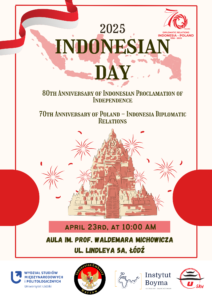
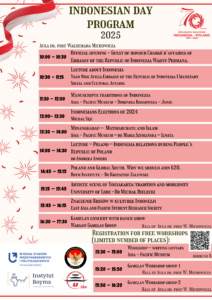
On the occasion of the 80th anniversary of Indonesia’s Independence and the 70th anniversary of Polish-Indonesian diplomatic relations, we invite you to a special event celebrating the richness of local culture and history. “Indonesian Day 2025” will take place on April 23rd. Join us in the Professor Waldemar Michowicz Auditorium, ul. Lindleya 5A, Łódź. The event will begin at 10:00 AM!

Więcej informacji na temat: newslettera, polityki prywatności serwisu
czytaj więcej
The Dasgupta Review on Women and the Environmental Crisis
Commissioned in 2019 by the British government and published in February 2021, The Dasgupta Review has been likened to the 2006 Stern Review. Where the latter brought to widespread attention the many failings of the world economy in the face of global warming, the former makes similar points as regards biodiversity – and identifies the unique challenges faced by women.
Dawid JuraszekAt the Boym Institute we are coming out with new initiative: #WomeninBoym, which aims to show the activity of this – often less visible – half of society. We will write about what women think, say and do. We will also publicise what women are researching and writing.
Book review: “North Korea’s Cities”
Book review of "North Korea’s Cities", written by Rainer Dormels and published byJimoondang Publishing Company in 2014.
Nicolas LeviRoman Catholic cemetery in Harbin (1903-1958)
First burials of Catholics, mostly Poles but also other Non-Orthodox believers took place in future Harbin in the so called small „old” or later Pokrovskoe Orthodox cemetery in the future European New Town quarter and small graveyards at the military and civilian hospitals of Chinese Eastern Railway at the turn of XIX and XX century.
Jerzy CzajewskiInterview: Why Does Poland Need ‘17+1’?
Interview with Michał Wójcik - Director of the Department of International Cooperation of the Ministry of Marine Economy and Inland Navigation (DWM MGMiŻŚ). In the Ministry, he is leading the Coordinating Secretariat for Maritime Issues , monitoring the cooperation of Central and Eastern European States with China.
Krzysztof ZalewskiTranscultural Winter School 2021 (8th of November — 12th of November)
This year’s research project TSRG 2021 as a collaborative initiative between Leadership Excellence Institute Zeppelin and the Boym Institute continued with a Transcultural Winter School in Zeppelin University, in Friedrichshafen.
Meeting with Dr. Uki Maroshek-Klarman
It’s a great pleasure for the Boym Institute to organize an open meeting with dr Uki Maroshek who founded the betzavta method. Betzavta is taught across the globe at the Adam Institute for Democracy and Peace in Jerusalem as well as in other institutions in Europe and the Middle East.
India, China and the Shades of Grey
"We are at an inflection point in this century. Many of our traditional arrangements are failing. To achieve stability in this century we need to discover new solutions" - Interview with Samir Saran - Senior Fellow and Vice President at the Observer Research Foundation
Krzysztof ZalewskiThe unification of the two Koreas: an ASEAN perspective
The aim of the paper is to discuss the role of the ASEAN as a critical component of the solution to the Korean unification. The Korean Unification refers to the potential reunification of both Koreas into a single sovereign Korean state led by the leadership of the two Koreas.
Nicolas LeviSearching for Japan’s Role in the World Amid the Russia-Ukraine War
The G7 Hiroshima Summit concluded on May 21 with a communiqué reiterating continued support for Ukraine in face of Russia’s illegal war of aggression. Although Japan was perceived at the onset of the war as reluctant to go beyond condemning Russia at the expense of its own interests, it has since become one of the leading countries taking action during the war.
Rintaro NishimuraThe link between EU Aid and Good Governance in Central Asia
Nowadays all the CA states continue transitioning into the human-centered model of governance where the comprehensive needs of societies must be satisfied, nevertheless, the achievements are to a greater extent ambiguous.
The Boym Institute message to Chinese policymakers and analysts
The EU-China relations require common perspective on Russia’s invasion on Ukraine
Indonesia – between religion and democracy
Indonesia is the largest Muslim democracy in the world. Approximately 88% of the population in Indonesia declares Islamic religion, but in spite of this significant dominance, Indonesia is not a religious state.
Anna GrzywaczReaching for the Stars: Japan’s Evolving Space Policy
From its pacifist post-war origins to an increasingly assertive space programme with growing military ambitions, Japan has undergone a profound transformation in its approach to space policy
Jakub WitczakGlobalization of business, education and China: interview with prof. Chiwen Jevons Lee
Interview of Ewelina Horoszkiewicz with prof. Chiwen Jevons Lee on China on globalization of Chinese business education and his thoughts of China’s role in the global marketplace.
Ewelina HoroszkiewiczAdam Institute for Democracy & Peace – Crowdfunding Campaign December 2020
Democracy in Israel is in crisis. And if we don't educate for democracy, it just won't exist. It's that simple. The actual teaching of democracy, on the other hand, isn't so simple. It requires experience, theoretical and practical knowledge and the flexibility to adapt to our ever-changing reality.
Coronavirus and climate policies: long-term consequences of short-term initiatives
As large parts of the world are gradually becoming habituated to living in the shadow of the coronavirus pandemic, global attention has turned to restarting the economy. One of the most consequential impacts of these efforts will be that on our climate policies and environmental conditions.
Dawid JuraszekOnline Course: “Educational tools for addressing the effects of war”
The Adam Institute for Democracy and Peace is offering “Betzavta” facilitators, middle school and high school educators, social activists, communal activists and those assisting refugees an online seminar to explore educational issues related to wartime.
We would like to inform, that Observer Research Foundation has published article of Patrycja Pendrakowska - the Boym Institute Analyst and President of the Board.
Patrycja PendrakowskaChina – USA in the South China Sea
The trade war is just one of the problems of confrontation between the United States and the People's Republic of China. Many aspects of this competition coincide in the South China Sea.
Paweł BehrendtPatrycja Pendrakowska and Paweł Behrendt on navigating Sino-Polish relations
We are proud to annouce, that Patrycja Pendrakowska and Paweł Behrendt made a contribution to the latest project of the Baltic Security Foundation, The Jamestown Foundation and the Baltic-American Freedom Foundation.
An interview with Mr. Meirzhan Yussupov, Chairman of the Board of the “National Company” KAZAKH INVEST” JSC - Member of the Board of Directors of the Company
Magdalena Sobańska-CwalinaThis is the second part of an inquiry into Ulaanbaatar’s winning 2040 General Development Plan Conception (GDPC). In this part of paper, I look into some of the plans and/or solutions proposed in Ulaanbaatar’s 2040 GDPC.
Paweł SzczapPatrycja Pendrakowska as a participant of Women Economic Forum (WEF) in India
The interactive discussion covers recent projects and collaborations which have contributed to a greener economy in India